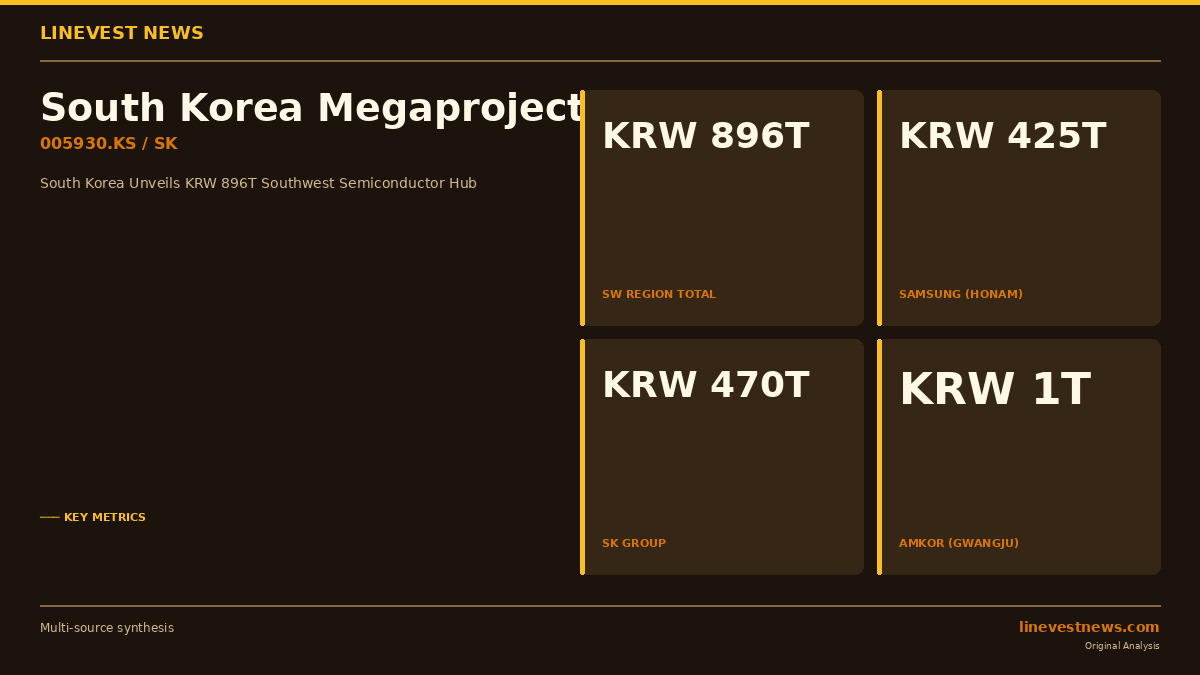
South Korea's President Lee Jae Myung on June 30 unveiled three flagship industrial megaprojects designed to establish the country's second core semiconductor manufacturing hub, drawing combined pledges of KRW 896 trillion (approximately USD 578 billion) from Samsung Electronics, SK Group and Amkor Technology for a new cluster centered on the Honam and southwestern regions.
Three Megaprojects, One Strategic Vision
The government initiative rests on three pillars: semiconductor manufacturing expansion, AI data center development and physical AI advancement. Total nationwide public-private commitments exceed KRW 1 quadrillion, with the Honam region — encompassing Gwangju and South Jeolla Province — alone earmarked to receive more than KRW 800 trillion in semiconductor investment (approximately USD 518.3 billion).
The announcement coincides with the formal merger of Gwangju and South Jeolla Province into a new integrated special city on July 1, 2026, a jurisdictional streamlining the government has engineered to accelerate industrial approvals and attract capital to the southwest.
Samsung: KRW 425 Trillion Across Fabs, AI Center and Clean Energy
Jun Young-hyun, Vice Chairman of Samsung Electronics, outlined a KRW 425 trillion commitment for the Honam region, structured across three areas:
- Semiconductor fabs (Gwangju) — KRW ~400 trillion: Two memory fabrication plants earmarked for Gwangju Metropolitan City, forming the cornerstone of what Samsung describes as its next major domestic manufacturing base beyond the established Yongin complex in Gyeonggi Province.
- National AI computing center (Solaseado, Haenam) — KRW 17 trillion: A 210-megawatt facility for national AI transformation across finance, defence and public services. Construction is scheduled to begin in the second half of 2026, with first operations targeted for 2028.
- Renewable energy (Honam-wide) — KRW 4 trillion: A portfolio of solar, nuclear power-purchase agreements (PPAs) and clean-hydrogen generation to supply nearby chip fabs and data centers directly.
Samsung Group's total domestic investment over the coming decade is framed at KRW 2,655 trillion, with KRW 625 trillion directed to regional projects outside the existing Seoul-metropolitan industrial core.
Vice Chairman Jun noted the fab commitment is contingent on government delivery of guaranteed nuclear power expansion, LNG combined heat-and-power infrastructure and stable water supply — pointing to infrastructure gaps that must be resolved before construction can begin at scale.
SK Group: KRW 470 Trillion for Two Fabs and a 1-Gigawatt Data Center
SK Group pledged KRW 470 trillion for the southwestern region, comprising two semiconductor fabrication plants and a 1-gigawatt AI data center. SK Group's broader total domestic commitment stands at approximately KRW 1.1 quadrillion, with roughly KRW 400 trillion directed to Honam development.
Amkor Technology: KRW 1 Trillion Packaging Expansion in Gwangju
U.S.-headquartered packaging specialist Amkor Technology committed KRW 1 trillion to expand its existing semiconductor packaging facility in Gwangju, adding a backend assembly capability to the front-end wafer fabrication cluster.
Chungcheong Packaging Belt: KRW 81 Trillion
A separate KRW 81 trillion advanced packaging hub has been designated in the Chungcheong region, creating a complementary supply chain corridor linking front-end wafer fabrication in Honam with backend packaging in Chungcheong.
AI Data Center Build-Out: 8.4 GW to 18.4 GW by 2035
Across the three megaprojects, the government targets an initial AI data center capacity of 8.4 gigawatts, expanding to 18.4 gigawatts nationwide by 2035. Private AI data center investment from SK Group, GS Group and Naver is targeted at KRW 550 trillion by 2029. Government projections place total job creation across semiconductor, data center and related sectors at 1.6 million positions.
Infrastructure Gaps and Analyst Caution
Despite the scale of the commitments, analysts and executives have flagged labor availability and power grid capacity as the two most pressing near-term constraints. Relocating workers and building an industrial ecosystem in regions with limited prior semiconductor presence will require years of sustained effort. UBS has separately warned of potential trillion-won losses for the sector in a cyclical downturn scenario.
The government's pledge to cover up to 100 percent of power and water infrastructure costs within designated mega special zones — alongside shortened industrial-complex development timelines — is designed to partially offset the location disadvantage relative to the established Seoul-metropolitan cluster. Both Samsung and SK have noted their investment plans remain subject to market conditions and shifts in the business environment.
Samsung Electronics (005930.KS) and SK hynix (000660.KS) are expected to be the primary equity beneficiaries as construction timelines and government policy details crystallise over the coming months.
Sources: Korea Herald · Korea JoongAng Daily · Seoul Economic Daily · Korea Times