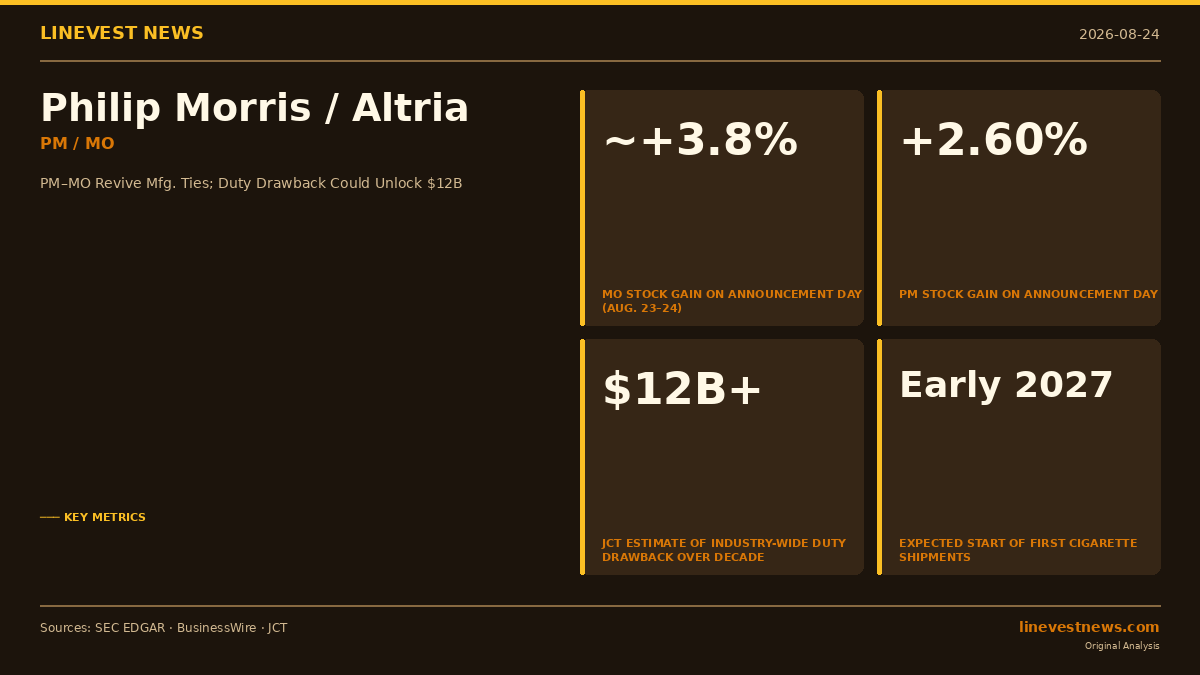
TL;DR - Philip Morris International (NYSE: PM) and Altria Group (NYSE: MO) entered a reciprocal contract manufacturing arrangement for combustible cigarettes, announced August 23–24, 2026 (Altria's Business Wire release: Aug. 23; PMI's SEC 8-K: Aug. 24). - The deal is designed to unlock the U.S. "double duty drawback" — a mechanism that lets tobacco exporters recover up to 99% of federal excise taxes. The Joint Committee on Taxation estimates the industry-wide benefit at over $12 billion over the next decade. - First shipments are expected in early 2027; neither company expects a material impact on 2026 financials. - MO gained approximately 3.8% and PM rose 2.60% on the announcement day, among the stronger single-session moves for the tobacco sector in 2026.
The Deal at a Glance
On August 23–24, 2026, Altria Group Inc. and Philip Morris International Inc. announced that their respective operating subsidiaries — Philip Morris USA (PM USA, Altria's principal operating company) and PMI's non-U.S. affiliates — have entered into a reciprocal contract manufacturing arrangement for combustible cigarettes.
The two companies, which separated via an Altria spin-off in 2008, will now act as manufacturers for each other across different geographies. PMI's international affiliates will manufacture for PM USA, and PM USA will manufacture for PMI's international markets. Both sides are explicit: this is a manufacturing relationship only, with no change to the established commercial split.
| Item | Detail |
|---|---|
| Altria announcement | August 23, 2026 (Business Wire) |
| PMI 8-K filing | August 24, 2026 (SEC EDGAR) |
| First shipments | Early 2027 (subject to operational and regulatory readiness) |
| Financial impact (2026) | Immaterial for both PM and MO |
| Commercial separation | Maintained — PMI retains no-U.S.-combustibles stance |
| Strategic alignment | Supports Altria's "2028 Enterprise Goals"; consistent with PMI's smoke-free strategy |
PMI has not commercialized combustible cigarettes in the United States since the 2008 spin-off and has stated no plans to do so. Philip Morris USA continues to handle all U.S. Marlboro commercialization and distribution under Altria's oversight. Both companies will maintain separate regulatory responsibilities.
Why Now? The Duty Drawback Catalyst
The strategic logic behind this deal hinges on an obscure but lucrative provision in U.S. tax law: the "double duty drawback" for tobacco products.
When a company imports cigarettes into the United States, it pays approximately $1.01 per pack in federal excise taxes. Under the drawback mechanism, that company can then recover up to 99% of those taxes — provided it exports a "sufficiently similar" domestically manufactured product within a specified timeframe. Critically, the same physical cigarettes do not need to be re-exported; only a similar class of domestic cigarettes must be exported to trigger the refund.
For Altria, whose Philip Morris USA subsidiary has historically manufactured exclusively for the U.S. domestic market and does not sell cigarettes internationally, this mechanism was effectively inaccessible. By establishing reciprocal manufacturing flows with PMI — importing from PMI's international facilities while exporting PM USA-made cigarettes to PMI's markets — Altria now has the structure to generate both the import duties and the export drawback claims.
The scale of the opportunity is significant. The U.S. Government Accountability Office (GAO) found that tobacco importers had filed for approximately $898 million in duty drawback refunds since fiscal year 2019. The Joint Committee on Taxation has separately estimated that the drawback mechanism could result in more than $12 billion in cigarette tax refunds industry-wide over the next decade.
One important caveat: the duty drawback mechanism has drawn Congressional scrutiny. Critics characterize it as a tax loophole that subsidizes tobacco trade. Legislative proposals to curtail the drawback have been introduced in prior sessions, and this deal's economic calculus could be disrupted if any such measure advances.
Company Profiles: PM vs. MO
| Metric | Philip Morris International (PM) | Altria Group (MO) |
|---|---|---|
| Exchange | NYSE | NYSE |
| Market Focus | International (175+ markets) | U.S. only (combustibles) |
| Q2 2026 Revenue | $11.2B (+10.4% YoY) | — (Q2 reported July 30) |
| H1 2026 Revenue | $21.3B (+9.8% YoY) | — |
| H1 2026 Adj. EPS | $4.16 (+15.6% YoY) | — |
| FY2026 Adj. EPS Guidance | $8.26–$8.41 (+9.5–11.5%) | $5.56–$5.72 (+2.5–5.5%) |
| Dividend Yield | ~3.09% | ~6.2% (at Aug. 24 close of $68.65) |
| Analyst Consensus | Moderate Buy | — |
| Avg. Analyst Price Target | ~$225 (~16.5% upside from $193.12) | — |
| Aug. 24 Stock Reaction | +2.60% to ~$193.12 | ~+3.8% to ~$68.65 |
| Smoke-Free % of Revenue | ~42% | Not applicable |
Note: MO dividend yield calculated as $4.24 annualized dividend ÷ $68.65 closing price. Sources: PMI Q2 2026 earnings release (SEC EDGAR), Altria FY2026 guidance, Bloomberg/Benzinga, TradingKey.
Investment Implications
For PM Investors
Philip Morris gains manufacturing flexibility without compromising its long-term smoke-free identity. The company has invested more than $14 billion in smoke-free product development since 2008, and smoke-free products — led by IQOS and ZYN nicotine pouches — now represent approximately 42% of total net revenues, with international smoke-free revenues growing 13.7–19.2% in the first half of 2026.
By leveraging Altria's U.S. manufacturing capacity for a portion of its international combustible volumes — rather than expanding its own factory footprint — PMI can improve capital efficiency and redirect resources toward its smoke-free pipeline. The arrangement maintains PMI's established posture of not re-entering the U.S. combustible cigarette market commercially, preserving regulatory credibility with the FDA and international health authorities.
PM currently offers a dividend yield of approximately 3.09%. Wall Street's consensus target of roughly $225 implies approximately 16.5% upside from announcement-day levels, supported by accelerating smoke-free revenue and a full-year EPS guidance range of $8.26–$8.41 (+9.5–11.5%).
For MO Investors
Altria's approximately 3.8% gain on announcement day — outpacing PM's 2.60% — signals the market's view that this deal is proportionally more valuable to the domestic-only incumbent. That read has merit.
Altria faces the structural challenge of a declining U.S. cigarette market with limited avenues for organic revenue growth. The company has navigated this environment through disciplined pricing and dividend increases — including its most recent increase announced in 2026, continuing a multi-decade track record across more than 60 dividend increases in under six decades. The current annualized dividend of $4.24 per share supports a yield of approximately 6.2% at August 24 closing prices, making MO one of the highest-yielding large-cap consumer staples in the S&P 500.
The manufacturing partnership offers two incremental levers: 1. Duty drawback income: Recoverable excise taxes from the import/export structure represent a direct cash flow benefit that Altria could not access before the PMI arrangement. 2. Manufacturing cost efficiency: Mutual use of underutilized capacity in both companies' facilities reduces unit manufacturing costs as overall cigarette volumes decline industry-wide.
Altria's FY2026 adjusted EPS guidance of $5.56–$5.72 reflects a mature, low-growth profile (+2.5–5.5%). Investors will not see measurable benefit from this deal until first shipments begin in early 2027 at the earliest, and it may take two or three annual reporting cycles before duty drawback income is visible in Altria's financials.
Risks
- Regulatory risk on duty drawback: Congressional proposals to curtail the mechanism could reduce or eliminate MO's anticipated financial benefit, more acutely than PM's since Altria is the entity seeking to capitalize on the import/export structure.
- Volume decline: Both companies' combustible segments face irreversible structural volume headwinds globally and in the United States. This deal optimizes a shrinking business — it does not reverse the volume decline trajectory.
- Timeline execution: The "early 2027" start date is conditional on operational and regulatory readiness. Any logistical or approval delays could push the first shipments to mid-2027 or later.
- Immateriality in 2026: Both companies explicitly stated the arrangement will not have a material impact on 2026 results. Near-term investors seeking a near-term catalyst may find the deal's value unclear until 2027 shipment data emerge.
Three Scenarios for Investors
| Scenario | Probability* | PM Implication | MO Implication |
|---|---|---|---|
| A — Deal executes on schedule (Q1 2027); duty drawback fully realized | 40% | Modest margin improvement; smoke-free transformation story intact | Incremental EPS uplift; dividend growth sustained |
| B — Regulatory or operational delay pushes first shipments to H2 2027 | 40% | Neutral through mid-2027; modest guidance conservatism | Duty drawback benefit deferred; EPS guidance unchanged |
| C — Congress acts to curtail duty drawback mechanism before 2027 | 20% | Minimal impact (PMI less reliant on U.S. tax structure) | Meaningful setback; forces alternative cost optimization |
Probability estimates are illustrative only and are not investment recommendations.
Bottom Line
The Philip Morris–Altria manufacturing pact is an operationally sensible arrangement for two companies managing a business in long-term structural decline. PMI gains capital efficiency; Altria gains access to a tax recovery mechanism it previously could not tap independently.
The market's reaction — MO +~3.8% vs. PM +2.60% — is the clearest signal of where the incremental value sits. But for both stocks, the long-term story remains the same: disciplined cost management, durable dividend yields, and a slow-motion smoke-free transition race where PMI — at 42% of revenues from smoke-free products — holds a clear lead.
The real test of this deal's value will arrive in 2027, when shipment data and drawback claim receipts start entering income statements.
This article is for informational purposes only and does not constitute investment advice or a solicitation to buy or sell securities. LineVest News is an independent publication and is not a registered investment adviser.
Sources: - PMI 8-K Press Release (Aug. 24, 2026) — SEC EDGAR - Altria Business Wire Announcement (Aug. 23, 2026) - PMI Q2 2026 Earnings Release — SEC EDGAR - PM Stock Alert — Barchart - Altria vs. Philip Morris — Yahoo Finance / Insider Monkey - MO stock reaction on Aug. 24 — TradingKey / Benzinga - GAO Duty Drawback Report — CPA Practice Advisor - JCT $12B Estimate — NewsVirginian