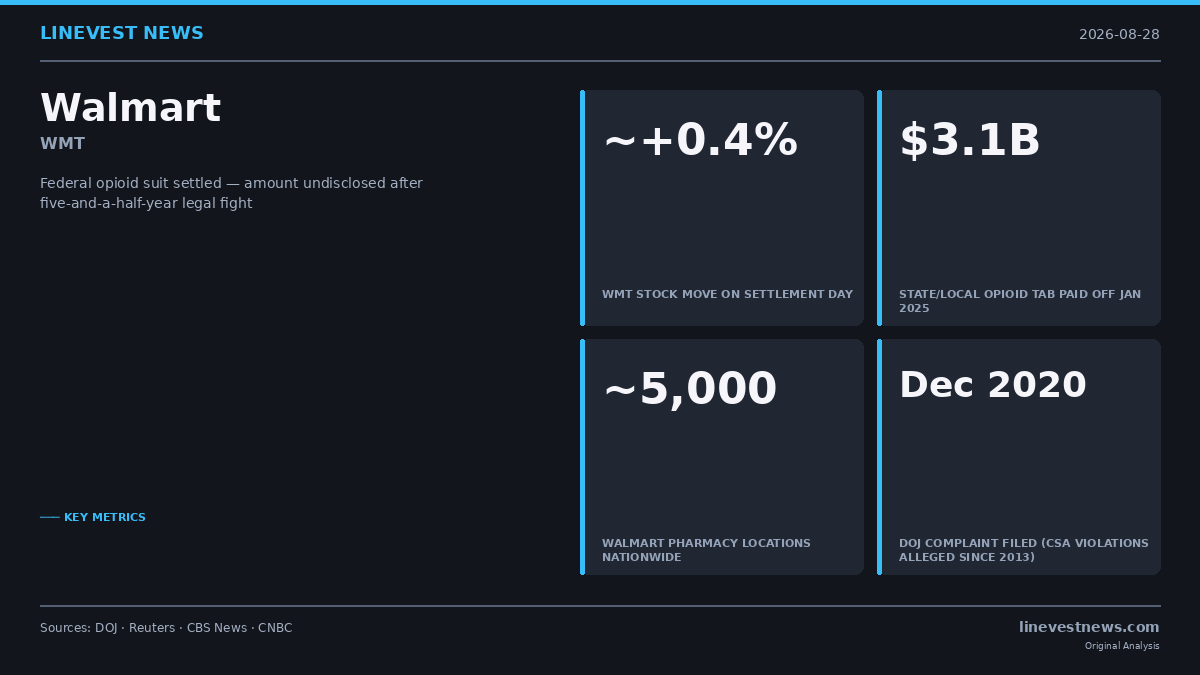
TL;DR - Walmart and the DOJ settled the federal opioid lawsuit (filed December 2020) on August 28, 2026 — amount not disclosed by either party - Government alleged CSA violations since 2013: filling invalid prescriptions; suspicious-order-reporting claims were dismissed in March 2024, narrowing the case materially - Walgreens settled a comparable federal CSA case in April 2025 for $300 million (up to $350M if sold before fiscal year 2032); CVS's parallel federal case is still being contested as of this writing - WMT stock edged up ~0.4% to ~$103.08, removing a long-standing litigation overhang - Walmart had already retired its $3.1B state/local opioid tab by January 2025
Part A: What Was Settled — And What Was at Stake
The U.S. Department of Justice and Walmart confirmed the settlement in separate statements on Friday, August 28, 2026. Neither party disclosed the financial terms.
The Original Complaint
On December 22, 2020, the DOJ filed suit in federal court, accusing Walmart of repeatedly violating the Controlled Substances Act (CSA) dating back to at least 2013. The complaint alleged two categories of conduct across Walmart's approximately 5,000 U.S. pharmacies:
- Filling invalid opioid prescriptions — The government alleged pharmacists dispensed controlled substances despite the company's compliance personnel knowing the prescriptions were illegitimate.
- Failing to report suspicious drug orders to the DEA — Walmart was accused of ignoring red flags that should have triggered mandatory DEA notification.
The CSA's statutory maximum civil penalty set the theoretical ceiling: up to $67,627 per unlawfully filled prescription and up to $15,691 per suspicious order not reported. The DOJ characterized the total potential liability as running into the billions, based on volume across both claim categories.
Case Narrowed in March 2024
U.S. District Judge Colm Connolly significantly narrowed the case in March 2024, dismissing the suspicious-order-reporting claims. What survived — and what the 2026 settlement resolves — was the narrower allegation: that Walmart pharmacists dispensed prescriptions that Walmart's own compliance personnel knew were invalid. That narrowing eliminated one of the two penalty pools before settlement talks concluded, reducing the theoretical claim universe to invalid-prescription counts only.
Prior State and Local Settlement
Separately, in 2022, Walmart agreed to pay $3.1 billion to resolve thousands of lawsuits by state and local governments over its pharmacies' opioid dispensing practices. Walmart confirmed in its FY2025 annual report that the full $3.1B had been paid by January 31, 2025 — effectively clearing its prior opioid balance sheet before the federal case closed.
Part B: Investor Analysis
Reading the Undisclosed Amount
The absence of a publicly disclosed figure is the most important fact for investors to weigh. When settlements involve amounts that would embarrass either side — too high for the defendant, too low for the regulator — confidentiality is a standard negotiating outcome. The closest federal analog is the Walgreens DOJ settlement announced April 2025: Walgreens agreed to pay $300 million (with an additional $50 million contingent on a sale, merger, or transfer before fiscal year 2032), resolving allegations of illegally filling unlawful opioid prescriptions and submitting false claims to Medicare and other federal healthcare programs under the CSA and False Claims Act.
| Comparable | Amount | Year | Type |
|---|---|---|---|
| Walmart — state/local | $3.1B | 2022 | Paid in full by Jan 2025 |
| Walgreens — federal (DOJ) | $300M (+$50M contingent) | Apr 2025 | CSA + False Claims Act |
| CVS — state combined | ~$5B | 2022 | State/local combined |
| CVS — federal (DOJ) | Ongoing | Unsealed Dec 2024 | CVS contesting |
| Walmart — federal (DOJ) | Undisclosed | Aug 2026 | CSA (narrowed post-2024 ruling) |
It is important to note that CVS has not settled its parallel federal case. The DOJ's nationwide CSA lawsuit against CVS, a complaint that was unsealed in December 2024, remains actively contested — the pharmacy industry's federal opioid litigation chapter is not entirely closed.
Financial Context: WMT Can Absorb Most Scenarios
Walmart's capacity to absorb a settlement is substantial. In Q2 FY2027 (reported August 20, 2026), Walmart posted revenues of $187.9 billion — up 5.9% year over year. For the full FY2026 (ended January 31, 2026), Walmart generated $14.9 billion in annual free cash flow.
The prior $3.1B state payment — disbursed across FY2023–FY2025 — was absorbed without lasting damage to margins or credit ratings, demonstrating Walmart's capacity to manage multi-billion opioid obligations. A federal settlement in a similar or smaller range would be a one-time charge, manageable within Walmart's capital-allocation framework.
Pharmacy: Strategic Asset Under Ongoing Scrutiny
Walmart's ~5,000 pharmacies are increasingly central to its omnichannel strategy — serving as traffic drivers and entry points into its broader healthcare services expansion, including generic drug programs and GLP-1 dispensing. The opioid litigation resolution matters not just as a balance-sheet event but as a compliance signal.
Key investor question: what non-financial terms accompany the settlement? DOJ pharmacy settlements frequently include enhanced DEA reporting obligations, compliance monitoring by independent auditors, and pharmacist training requirements — all of which add ongoing operational costs beyond the headline cash payment. Walmart's spokesperson said only that the company is "pleased to resolve this matter." Whether non-financial remedial conditions — compliance monitoring, DEA reporting upgrades — accompany the payment remains unknown pending official documentation.
The broader opioid crisis has claimed approximately 645,000 lives in the United States from 1999 through 2021, with an estimated additional 200,000+ deaths through 2024, according to CDC provisional data. With Walmart's federal case now resolved, regulatory focus may broaden to smaller regional chains and mail-order pharmacies.
Three Watch Points for Investors
- SEC disclosure: Walmart has not yet filed a settlement-related 8-K. Any material financial accrual or adjustment would appear in either a standalone 8-K or the Q3 FY2027 10-Q. Watch for guidance language and footnote disclosures.
- Compliance conditions: Non-financial settlement terms — DEA monitoring, protocol upgrades, independent audit obligations — could surface in coming weeks and represent a source of ongoing cost.
- CVS read-through: Walmart's resolution is among the latest major pharmacy chains to close a federal CSA opioid case — following Rite Aid (July 2024) and Walgreens (April 2025). CVS, whose parallel federal complaint was unsealed in December 2024, has not settled. Investors in CVS should watch whether the DOJ's success in resolving major pharmacy cases accelerates pressure toward a negotiated outcome.
This article is for informational purposes only and does not constitute investment advice. Settlement terms were not publicly disclosed as of publication; financial comparisons are based on publicly available information.
Sources: - CBS News: Walmart settles Justice Department opioid lawsuit - CNBC: Walmart settles US government's opioid lawsuit - Yahoo Finance: Walmart Ends a Federal Opioid Fight Without Naming the Price - DOJ: Walgreens agrees to pay up to $350M for opioid prescriptions (April 2025) - DOJ: Nationwide lawsuit against CVS (Dec 2024) - Walmart Q2 FY2027 Earnings Release, August 20, 2026