TL;DR - FDA approved Pfizer-BioNTech's COMIRNATY® XFG on August 27, 2026 — the 2026-2027 seasonal COVID-19 vaccine - Approved for adults 65+, and individuals 5-64 with at least one high-risk underlying condition; shipping began immediately - COMIRNATY Q2 2026 revenue: $261M, down 34% YoY — missed the $278M consensus estimate by approximately 6% - Pfizer cut its full-year COVID revenue guidance to $4 billion (from ~$5B); management expects the majority to land in Q4 - Moderna's Spikevax has been gaining U.S. COVID market share: its retail share rose from ~37% in the 2022 season to ~48% in subsequent seasons (Fierce Pharma), while Moderna's stock has materially outpaced Pfizer's in 2026
Part A — What Was Approved
On August 27, 2026, the U.S. Food and Drug Administration granted approval for the supplemental Biologics License Application for COMIRNATY® XFG (COVID-19 Vaccine, mRNA) — the 2026-2027 seasonal formulation developed by Pfizer (NYSE: PFE) and BioNTech SE (NASDAQ: BNTX).
The updated vaccine targets the XFG variant, which FDA guidance identified as the preferred composition for the 2026 fall season. Clinical, non-clinical, and real-world data submitted with the application showed strong immune responses against XFG and a slate of co-circulating lineages including XFG.1.1, NB.1.8.1, PQ.17, and PQ.2.8.1.
Who Can Get It
| Population | Status |
|---|---|
| Adults 65 and older | Approved |
| Ages 5–64 with ≥1 high-risk underlying condition | Approved |
| Children under 5 | Not indicated under this approval |
| Healthy individuals ages 5–64 | Not indicated under this approval |
Since ACIP's September 2025 vote replacing universal COVID vaccination recommendations with individualized, risk-based guidance — effective October 2025 — the eligible U.S. population has narrowed substantially relative to the peak universal-booster era. That narrowing is the central structural headwind for both PFE and BNTX.
Shipping of the XFG-formulated doses began immediately after approval, positioning pharmacies, hospitals, and clinics to begin dispensing ahead of the fall respiratory season.
Part B — What the Approval Actually Means for PFE and BNTX Investors
1. The approval arrives into a structurally compressed revenue base
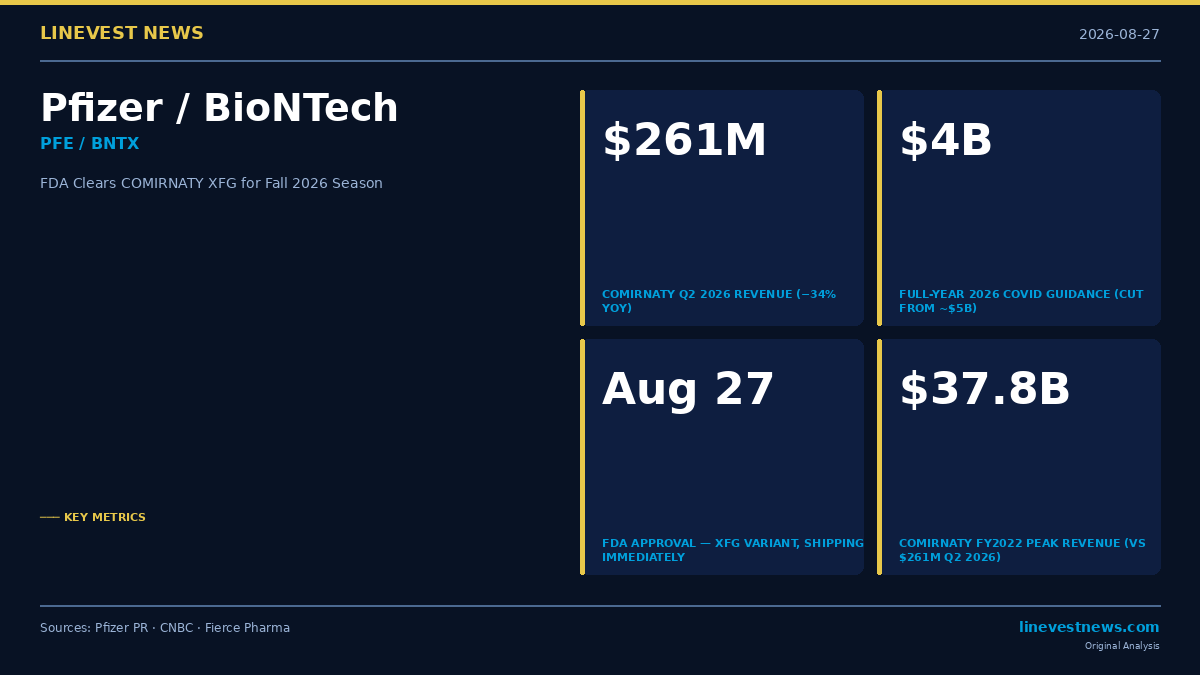
Pfizer reported COMIRNATY revenue of $261 million in Q2 2026, a 34% year-over-year decline that missed analyst consensus of $278 million by approximately 6%. The shortfall reflected lower U.S. utilization following narrower vaccination recommendations and a smaller favorable adjustment to the returns provision.
For context, COMIRNATY generated $37.8 billion in FY2022 at the height of universal COVID vaccination campaigns — its peak year. By FY2023, revenue had compressed to approximately $11.2 billion as demand normalized. The trajectory since has been a managed decline, not a recovery. What management emphasized on the August Q2 earnings call is that the majority of full-year COMIRNATY revenue will be recognized in Q4 — making the August 27 approval effectively the starting gun for PFE's most critical revenue quarter.
2. Pfizer cut COVID guidance but raised overall revenue expectations
Pfizer lowered its combined full-year 2026 COVID products guidance (COMIRNATY + Paxlovid) to $4 billion, down from approximately $5 billion previously — a $1 billion reduction. At the same time, Pfizer raised the midpoint of its overall 2026 revenue guidance by $500 million, to $61.5 billion (new range: $60.5B–$62.5B). For the net midpoint to be +$500M while COVID is cut by $1B, non-COVID segments must have added approximately $1.5 billion to offset the COVID shortfall and deliver the incremental raise.
For investors, the lowered COVID bar is a modest setup tailwind: the Q4 COMIRNATY forecast has been reset lower, reducing the probability of a downside surprise.
| Metric | Value |
|---|---|
| COMIRNATY Q2 2026 revenue | $261M (-34% YoY; missed ~$278M est. by ~6%) |
| Full-year COVID products guidance | ~$4B (cut from ~$5B) |
| Pfizer full-year revenue guidance | $60.5B–$62.5B (midpoint raised +$500M) |
| COMIRNATY FY2022 peak revenue | $37.8B |
3. Moderna has been gaining ground — market and investor sentiment both shifted
Moderna (NASDAQ: MRNA) has been steadily expanding its U.S. COVID retail market share. According to Fierce Pharma, Moderna's Spikevax grew its U.S. COVID retail market share from approximately 37% in the 2022 vaccination season to approximately 48% in subsequent seasons, reducing what had been Pfizer's dominant position. Moderna has also materially outperformed Pfizer's stock in 2026, driven by investor enthusiasm for its pipeline including the mCOMBRIAX flu/COVID combination vaccine (EC-approved April 2026) and a standalone flu candidate.
The XFG approval does not in itself shift the competitive calculus for fall 2026. Both Moderna's Spikevax XFG formulation and Pfizer's COMIRNATY XFG received FDA clearance in the same cycle, meaning product differentiation will again come down to distribution, pricing, and provider relationships.
4. BioNTech: franchise dependency risk remains acute
For BNTX, COMIRNATY is still the dominant revenue source. The XFG approval preserves BioNTech's ability to generate COVID-derived cash flows through 2027, which funds its broader mRNA oncology and infectious disease pipeline. The risk for BNTX investors is that any further erosion of COVID demand — through lower uptake rates or continued market-share loss — directly compresses the cash runway for programs that are still pre-revenue.
Pfizer and BioNTech's press release notes that more than 5 billion COMIRNATY doses have been distributed globally since authorization, demonstrating the platform's manufacturing and distribution scale. But global distribution reach has not translated into sustained U.S. commercial market share recovery.
5. Vaccination uptake rates remain the uncontrollable swing factor
Fall COVID vaccination uptake in the U.S. has declined year over year since the 2021-2022 cycle. CDC COVID vaccination surveillance data from the 2024-2025 season showed COVID booster uptake among adults at approximately 22%, far below adult influenza vaccination coverage of roughly 42% (CDC FluVaxView, 2024-25 season). Whether XFG's better variant match improves public willingness to vaccinate — particularly among the 65+ population that drives the majority of COMIRNATY revenue — is the swing variable that neither Pfizer nor investors can control.
Management has guided that "the majority" of full-year COMIRNATY revenue will land in Q4. The August 27 approval gives Pfizer's commercial team approximately nine to eleven weeks before the traditional November peak vaccination window — a workable runway if physician and pharmacy stocking proceeds on schedule.
Investor Takeaway
The COMIRNATY XFG approval is operationally necessary — without it, Pfizer and BioNTech have no seasonal COVID product to sell. But it is not a catalyst in the traditional sense. The real questions for PFE shareholders are: (1) whether Q4 COMIRNATY volumes hold near management's already-reduced $4B combined COVID forecast, (2) whether Pfizer's broader portfolio — oncology, rare disease, and other core franchises — can sustain the non-COVID offset that powered the Q2 guidance raise, and (3) whether PFE's 2026 stock underperformance relative to Moderna represents a value opportunity or a durable structural discount.
For BNTX investors, the XFG approval buys another year of COVID cash flow, but the pipeline's ability to generate the next franchise-defining product remains the long-term thesis test.
This article is journalistic reporting and does not constitute investment advice. Pfizer (PFE) and BioNTech (BNTX) are publicly traded companies; all investors should conduct independent research before making investment decisions.
Sources - Pfizer Press Release — COMIRNATY XFG FDA Approval (Aug 27, 2026) - CNBC — Pfizer Q2 2026 Earnings - Yahoo Finance — PFE Q2 Earnings, COVID Forecast Cut - Fierce Pharma — Moderna COVID Market Share Gains - Seeking Alpha — Pfizer BioNTech Win Approval for Updated COVID-19 Shot