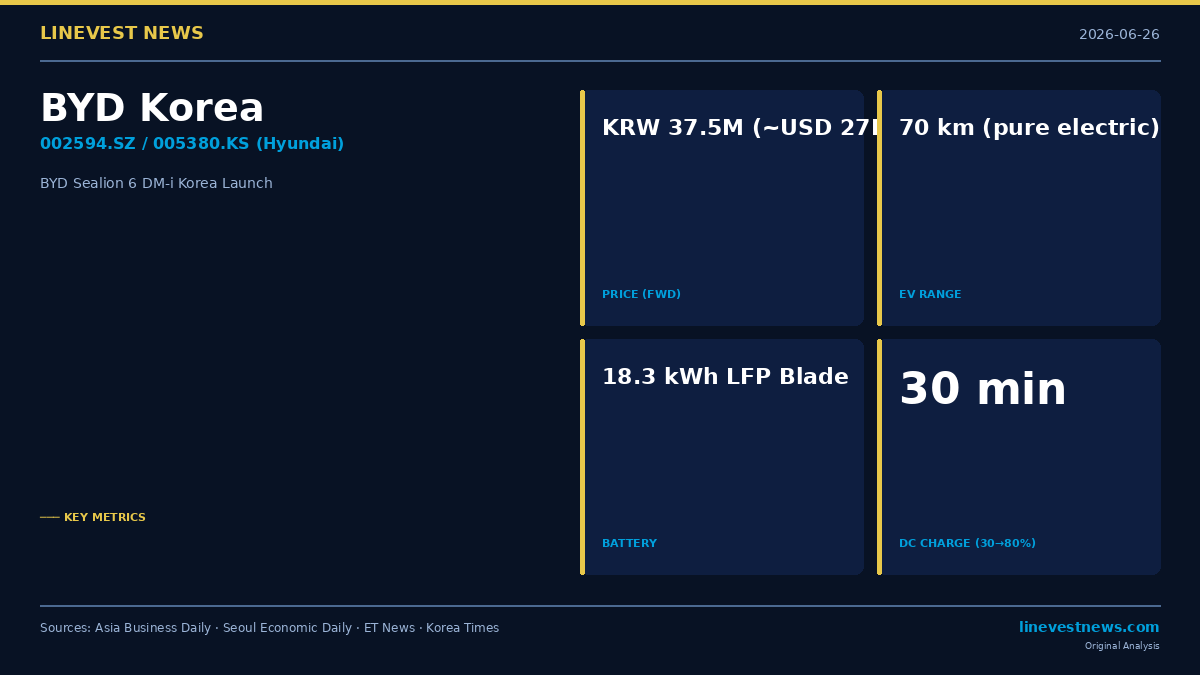
BYD Korea fired its most aggressive shot yet at the domestic passenger-car market on Thursday, unveiling the Sealion 6 DM-i plug-in hybrid at the 2026 Busan Mobility Show — the Chinese automaker's first PHEV model in Korea — priced at a competitive KRW 37.5 million (approximately USD 27,000) for the front-wheel-drive variant.
First Hybrid, Sharpest Price
The Sealion 6 DM-i brings BYD's proprietary Dual Mode-Intelligent (DM-i) powertrain to Korean consumers for the first time. The system pairs a 1.5-liter gasoline turbocharged engine (96 kW / 130 PS, 220 Nm) with a 150 kW electric motor and an 18.3 kWh lithium iron phosphate Blade Battery, enabling up to 70 kilometres of pure-electric range on a full charge.
BYD positions the vehicle as an "Electric-First Hybrid" — a design philosophy where the electric motor handles the majority of driving (81% of total mileage in typical use), with the combustion engine stepping in as a range extender. DC fast charging can replenish the battery from 30% to 80% in approximately 30 minutes, while a 3.3 kW vehicle-to-load (V2L) port adds off-grid utility for camping and outdoor use.
The FWD asking price of KRW 37.5 million — KRW 500,000 less than BYD's own Japanese launch price for the same model — puts the Sealion 6 DM-i in direct range of Hyundai Motor's (005380.KS) Tucson PHEV and Kia's (000270.KS) Sportage PHEV, both of which hover in the KRW 38–44 million band depending on trim.
A Calculated Escalation at Busan
The debut took place at BEXCO in Haeundae, where BYD Korea secured what organizers described as the largest exhibition booth at this year's show, running June 26 through July 5 under the theme "Moving Tomorrow." Pre-orders opened immediately at the venue.
The launch marks the 10th anniversary of BYD's presence in Korea. The company has accumulated approximately 15,000 registered vehicle owners in the Korean market — an installed base built almost entirely on pure battery-electric models such as the Atto 3 and Seal. Expanding into PHEV territory widens BYD's addressable market to consumers wary of range anxiety or limited charging infrastructure.
BYD Korea has set an internal annual sales target of 30,000 units across its full lineup. The DM-i model is expected to contribute meaningfully toward that objective, given that the Korean PHEV segment has grown faster than the BEV segment in the past year as buyers seek charging flexibility.
Pressure on Hyundai Motor Group
The competitive implications are most acute for Hyundai Motor Group. The conglomerate arrived at Busan with 34 vehicles in total across Hyundai, Kia, and Genesis — an imposing lineup anchored by a redesigned Avante compact sedan and the Kia Vision Mataturismo concept. Genesis debuted the Magma GT Concept and GMR-001 hypercar to reinforce its premium positioning.
Yet the market reality is stark: Chinese automakers now compete not just on price, but on specification and technology. The Sealion 6 DM-i's EURO NCAP top safety rating, 15.6-inch cockpit display, 360-degree camera system, and full suite of advanced driver-assistance technology leave little to separate it from Korean PHEV offerings on features — while undercutting them by several million won.
Kia leadership has already acknowledged the threat. CEO Euisun Chung reportedly described Chinese EV competition as "as alarming as AI disruption" in remarks to union leaders earlier this month, signalling that the response from domestic brands must extend beyond product strategy to supply chain and cost restructuring.
Market Backdrop
The 2026 Busan Mobility Show itself reflects a changing landscape. Several European premium brands — including Mercedes-Benz Korea and Renault Korea — declined to exhibit this year, focusing instead on digital launches. Automotive analysts have recommended the event double down on software-defined vehicles, AI-integrated mobility, and autonomous-driving technology to differentiate from China's Auto Shanghai, which now attracts 1,500–2,000 exhibitors and commands far greater global attention.
For KOSPI investors tracking the auto sector, the Sealion 6 DM-i debut underscores a structural shift: Chinese brands are no longer competing at the low end. At KRW 37.5 million, BYD is targeting the heart of the Korean mid-size SUV segment — the same price band where Hyundai Motor and Kia generate the bulk of their domestic margin.
Key Numbers
| Metric | Value |
|---|---|
| Price (FWD) | KRW 37.5M (~USD 27K) |
| EV Range | 70 km (pure electric) |
| Engine | 1.5L turbo, 96 kW / 130 PS |
| Motor | 150 kW / 204 PS |
| Battery | 18.3 kWh LFP Blade |
| DC Charge (30→80%) | ~30 min |
| BYD Korea owner base | ~15,000 vehicles |
| Annual sales target | 30,000 units |
| Show run | June 26 – July 5, BEXCO Busan |
Sources: Asia Business Daily, Seoul Economic Daily, ET News, Korea Times (June 26, 2026)
"