Samsung Biologics (207940.KS), the Songdo-based contract drug manufacturer that ranks as the world's largest biopharmaceutical producer by installed capacity, said on June 15 it will exhibit at the 2026 BIO International Convention in San Diego, its 14th consecutive appearance since the company was founded in 2011.
The announcement, carried by Korean outlets including ChosunBiz and Electronic Times (etnews), is on its face routine trade-show housekeeping. For a global fund manager the relevant question is not whether Samsung Biologics shows up — it always does — but what the appearance signals about the order pipeline underneath it. On that score the backdrop is unusually strong.
The event itself
BIO USA, the pharmaceutical industry's largest annual partnering event, is organized by the US Biotechnology Innovation Organization and runs June 22-25 at the San Diego Convention Center under the theme "Driven by Purpose." More than 20,000 industry officials are expected, according to Korea Biomedical Review. Samsung Biologics will staff a 140-square-meter standalone booth showcasing its end-to-end CDMO (contract development and manufacturing organization) services and its newly acquired Rockville, Maryland campus. Vice President James Choi joins a June 23 panel titled "Korea Rising: Don't Be Late to Asia's Next Innovation Hub," and Americas sales vice president Jeff Mason will hold on-site discussions on Samsung Biologics' global production capabilities, per ChosunBiz and Businesskorea.
Why the appearance carries weight this year
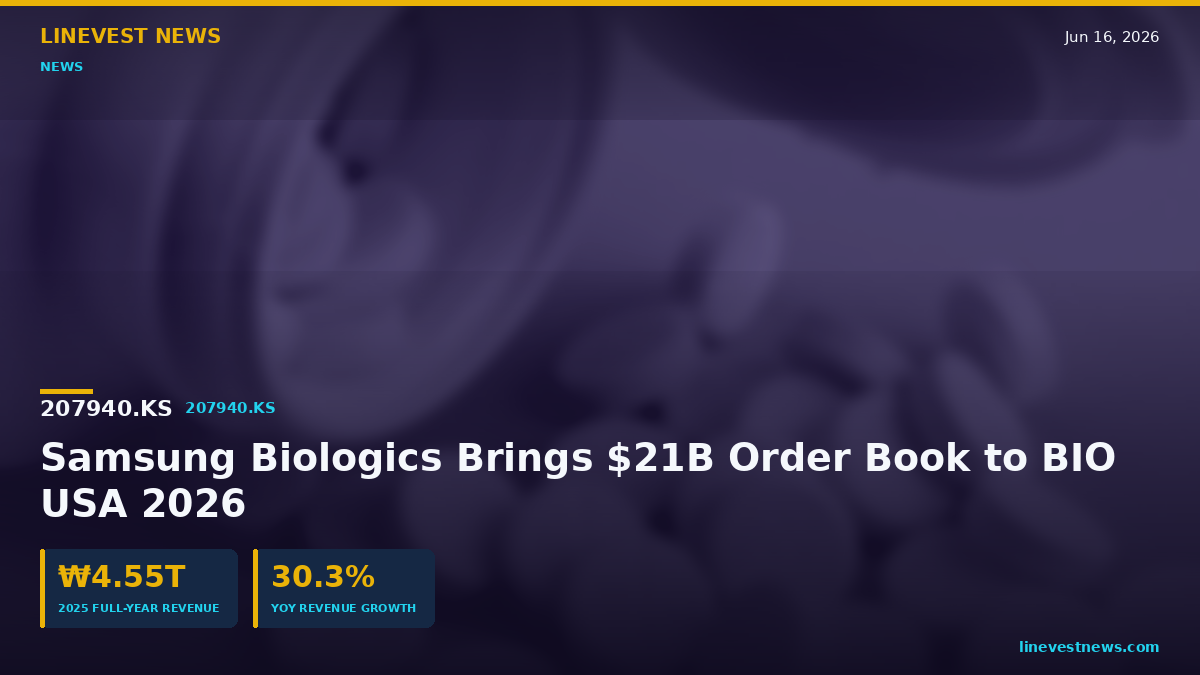
The convention is where CDMO mandates get sourced, and Samsung Biologics arrives with a stronger hand than in prior years. The company reported full-year 2025 consolidated revenue of more than ₩4.55 trillion (USD3.0 billion), up 30.3% from ₩3.49 trillion (USD2.3 billion) in 2024, driven by full utilization of Plants 1 through 3 and Plant 4 reaching full utilization in the third quarter of 2025, Pharma Manufacturing reported. Cumulative contract value has surpassed USD21 billion, the same report noted, including a ₩1.1 trillion (USD730 million) manufacturing agreement signed in the fourth quarter of 2025.
To size that backlog: at roughly USD3.0 billion in 2025 revenue, a USD21 billion cumulative order book represents about seven years of sales at the current run-rate — the kind of forward coverage that frames why management invests heavily in front-of-house presence at events like BIO.
Capacity is expanding in step. Plant 5, which added 180,000 liters and came online in April 2025, lifted Korean capacity across Bio Campus I and II to 784,000 liters; the plant began contributing to revenue in 2026, according to Pharma Manufacturing. The March 2026 completion of the GSK Rockville facility acquisition added 60,000 liters, bringing total global capacity to roughly 845,000 liters.
The competitive read
Samsung Biologics will not be the only Korean name working the floor. Korea Biomedical Review reports Celltrion is promoting its biosimilar portfolio, Lotte Biologics is pitching a dual-site Syracuse-Songdo strategy, and SK Biopharmaceuticals is exhibiting in the event's Digital Health and AI Zone. One industry observer quoted by the outlet framed the broader shift: "In the past, many Korean companies came to BIO mainly to introduce themselves, but now they are coming with clearer assets, defined partnering targets and more concrete deal structures."
What to watch
A trade-show appearance does not, by itself, move a thesis. The data point that will confirm or refute whether BIO USA momentum is translating into bookings is Samsung Biologics' Q2 2026 earnings, where Plant 5 utilization and any newly disclosed manufacturing agreements would show up. Until then, the San Diego booth is best read as a window into a CDMO operating from a position of record scale rather than a catalyst in its own right.
This article is for informational purposes only and does not constitute investment advice. Figures cited trace to company disclosures and the named publications; currency conversions use an approximate rate of 1 USD = 1,514 KRW as of June 15, 2026.