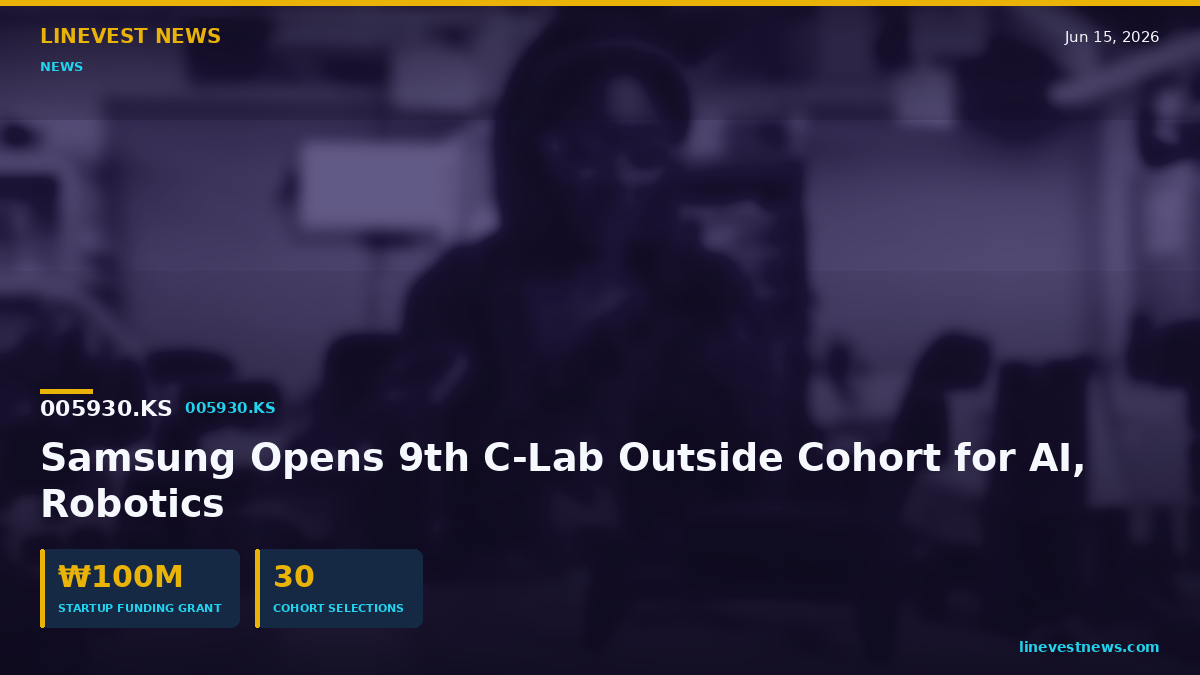
Samsung Electronics (005930.KS), Korea's largest company and the world's biggest memory-chip and smartphone maker, on June 15 opened applications for the ninth cohort of C-Lab Outside, its open-innovation program for sourcing and developing external startups. The company said it will select 30 companies, with applications running through June 26 and finalists announced in November (Samsung announcement via Chosun Biz and ET News, June 15, 2026).
For a global investor, a recurring accelerator intake is not, by itself, a stock-moving event. The more useful question is what the program actually channels into Samsung — and at what scale. C-Lab Outside is the externally facing arm of an initiative that, since its 2012 inception, has supported roughly 1,000 ventures and startups, according to Seoul Economic Daily's English-language coverage of the announcement (en.sedaily.com, June 15, 2026). The 9th cohort extends that as a structured pipeline rather than a one-off.
What the cohort covers
Samsung is recruiting across eight fields — artificial intelligence, digital health, content and services, robotics, materials and components, the Internet of Things (IoT), mobility, and ESG (environmental, social and governance) — per the company's announcement carried by ET News and Chosun Biz. Eligible applicants must be Korean-registered corporations at the Series B funding stage or earlier, and the intake runs simultaneously across four locations: Seoul, plus the regional centers of Daegu, the neighboring North Gyeongsang province (Gyeongbuk), and Gwangju in the southwest.
Selected startups receive up to ₩100 million ($73,000, at roughly 1,370 won per dollar) in business funding, dedicated workspace, free transfer or licensing of Samsung-held patents, and expert consulting, according to Chosun Biz. Samsung also funds participation in CES, the Las Vegas consumer-electronics show, and VivaTech, Europe's largest startup exhibition — channels for the cohort to meet overseas investors and partners.
How much converts to real collaboration
The relevant track record is the conversion rate from selection to actual Samsung engagement. Of the 30 companies in the 7th cohort selected last year, 17 went on to conduct proof-of-concept (PoC) technical verification with Samsung, a figure cited in both the Samsung announcement (via Chosun Biz) and Seoul Economic Daily — a conversion above 50%.
Current 8th-cohort examples cited by Chosun Biz point to where Samsung is leaning: ConfigIntelligence, a physical-AI data firm, is helping Samsung build robot-training datasets through its "Human Data Factory" platform; Exarion, a deep-tech company developing immersive 3D audio and AI image-processing semiconductor IP, is in business and verification talks; and Impactive AI, a Gyeongbuk-based firm, is refining a sales-volume forecasting model with Samsung using AI-based demand prediction. The mix — physical AI, robotics data, and semiconductor IP — tracks Samsung's stated strategic priorities.
"For startups, what matters is not only technological capability but also the chance to verify it and scale into the market," said Lee Byung-chul, an executive who heads Samsung's Creativity and Innovation Center, the unit that runs C-Lab, in remarks reported by Chosun Biz. "We will provide diverse collaboration opportunities so promising companies can advance to a bigger stage."
What to watch
The near-term confirmation point is the November finalist announcement, which will reveal the field mix of the 30 selected companies — and, over the following year, how many of them convert to PoC engagements versus the 17-of-30 benchmark set by the 7th cohort. That conversion, not the intake itself, is the measure of whether the program feeds Samsung's AI and robotics roadmap.
This article is for informational purposes only and does not constitute investment advice. Figures are sourced from the cited Samsung announcement coverage and may be subject to revision.
Sources: