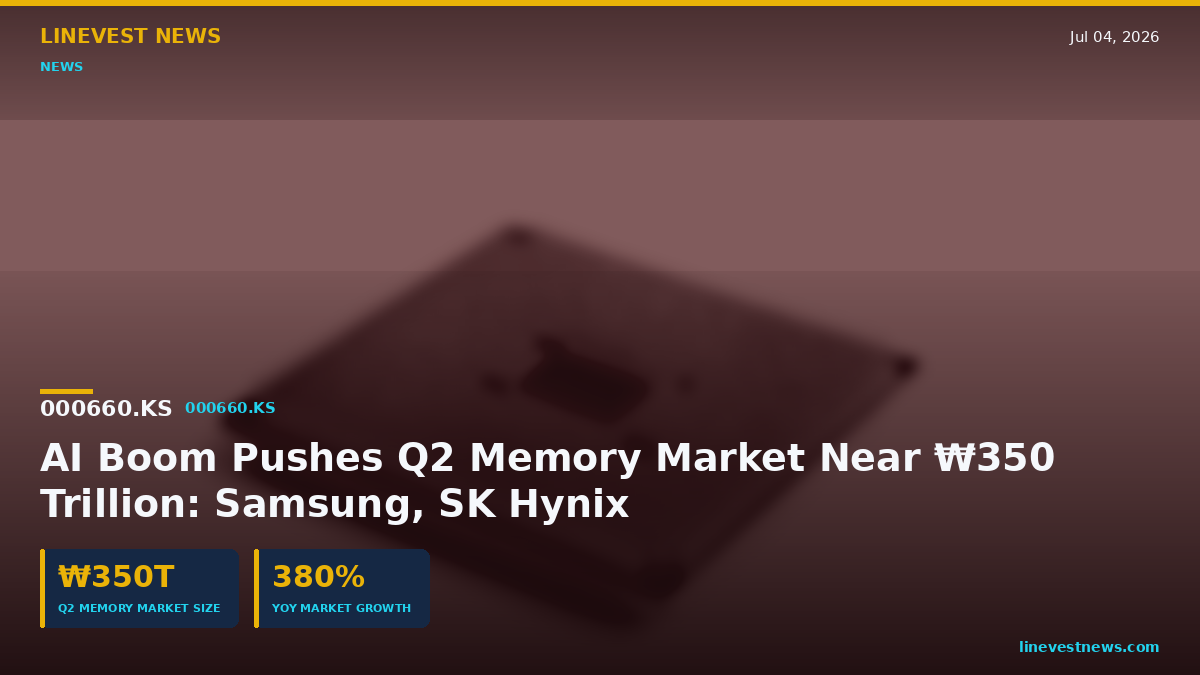
The global memory-chip market is on track to approach ₩350 trillion ($254 billion) in the second quarter of 2026, a figure that sets up record earnings for Korea's two memory giants just as both prepare to report. According to Counterpoint Research, a global technology market-research firm, the Q2 market will rise more than 60% from the first quarter and roughly 65% from a year earlier, as reported by Chosun Biz on July 3. Counterpoint's own Memory Tracker put the quarter's size at about $254.4 billion.
For a fund manager, the immediate question is how much of that surge lands in the income statements of Samsung Electronics (005930.KS), the world's largest memory maker, and SK Hynix (000660.KS), Korea's second-largest chipmaker and the leading supplier of high-bandwidth memory (HBM) used in AI accelerators. Both report within weeks: Samsung is expected to release preliminary Q2 guidance around July 7, with SK Hynix's full results due July 29, per The Korea Times and Investing.com.
The read-across from Micron is already in
The clearest advance signal came from Micron Technology, the U.S. maker that rounds out the big three alongside Samsung and SK Hynix. Micron reported record fiscal Q3 2026 revenue of $12.38 billion for the quarter ended May 28, up from $9.30 billion a year earlier — a 33% jump — with a GAAP gross margin of 43.6%, according to the company's June 24 results release. Micron said HBM4 is in high-volume shipments for its lead customer and pointed to about $100 billion in minimum contracted revenue across 16 strategic customer agreements.
Counterpoint expects Samsung and SK Hynix to outpace Micron this quarter. It projects Samsung's memory business alone will clear ₩110 trillion ($80 billion) in quarterly sales for the first time, with SK Hynix also sustaining strong growth, per the Chosun Biz report. Brokerage consensus cited by Seoul Economic Daily has Samsung's group-wide Q2 operating profit near ₩15 trillion ($10.9 billion) and SK Hynix's near ₩12 trillion ($8.7 billion) — a combined figure of about ₩27 trillion ($20 billion).
What is driving it
Counterpoint attributes the expansion to AI-fueled demand and pricing. Both DRAM and NAND flash contract prices rose more than 50% from the prior quarter, the firm said. Because memory is a commodity with high operating leverage, price moves of that magnitude flow disproportionately to the bottom line — the mechanism behind Micron's 43.6% gross margin and the reason Counterpoint sees the Korean pair topping it.
The last comparable memory upswing offers a caution on timing. In 2018, a DRAM price boom drove Samsung's chip division to record profit, only for prices to reverse sharply through 2019 and gut margins across the industry. Counterpoint flags a similar late-cycle risk this time: rising memory prices are raising the cost of finished products such as PCs and smartphones, and it sees early signs of demand softening. The firm expects market growth to moderate from the second half of 2027 as long-term supply agreements dampen price volatility.
The confirming data point
The thesis that this is a genuine super-cycle rather than a pricing spike will be tested first by Samsung's preliminary guidance around July 7, then decisively by SK Hynix's detailed Q2 breakdown on July 29 — specifically whether HBM revenue and blended DRAM pricing corroborate the 50%-plus price gains Counterpoint reported. A confirmed ₩110 trillion memory quarter at Samsung would mark the segment's highest on record; a miss would signal that spot-price strength is not yet translating into shipped, booked revenue.
Won amounts are converted at roughly 1,375 to the dollar, the rate implied by Counterpoint's paired ₩350 trillion / $254.4 billion figures.
Sources: Chosun Biz (Counterpoint Research) · Micron Q3 FY2026 Results
This article is for informational purposes only and does not constitute investment advice. Figures are drawn from Counterpoint Research (via Chosun Biz), Micron's fiscal Q3 2026 results, and brokerage consensus as cited; readers should verify against primary filings before making decisions.