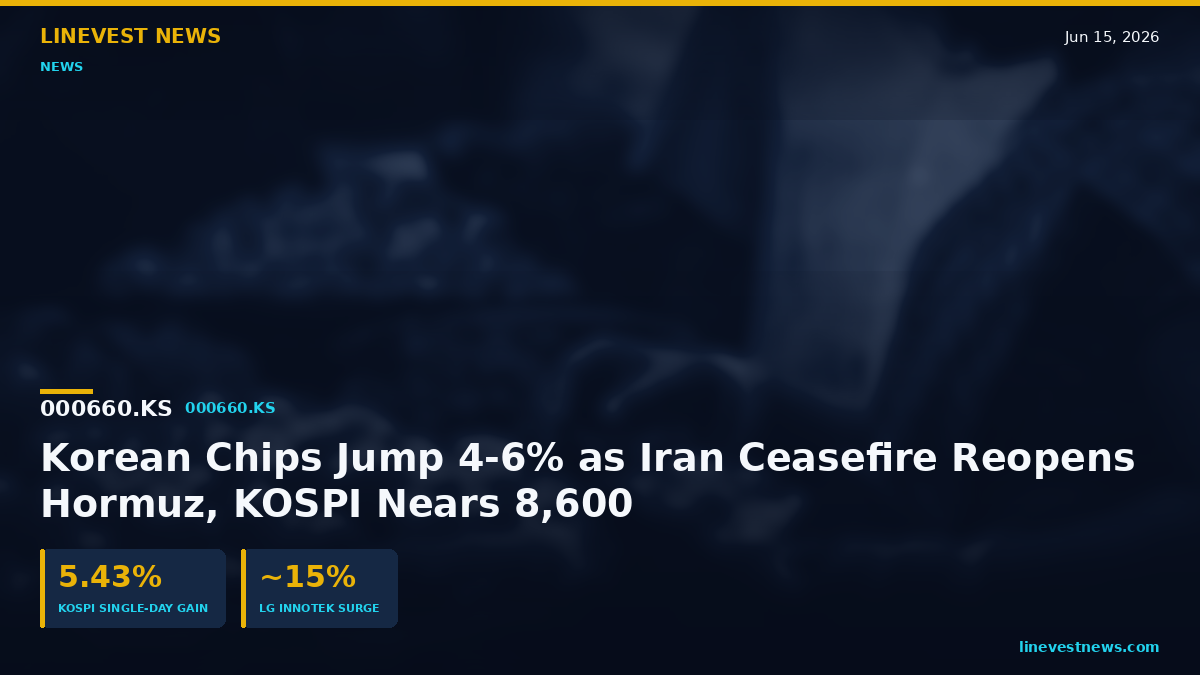
South Korea's chipmakers led a broad risk-on surge on Monday after U.S. President Donald Trump declared that negotiations on a memorandum of understanding (MOU) to end the U.S.-Iran war were complete. By 11:52 a.m. Seoul time, the KOSPI (South Korea's benchmark equity index) was up 441.12 points, or 5.43%, at 8,564.74, after touching 8,600 earlier in the session, according to Chosun Biz.
For a global fund manager, the immediate question is why a Middle East ceasefire would move Korean memory stocks specifically. The transmission runs through oil. The two sides plan to sign the MOU on June 19 and reopen the Strait of Hormuz immediately, Chosun Biz reported. The waterway handles roughly one-fifth of seaborne oil trade and had been under Iran's latest 'complete closure' order since June 11, after Tehran first sealed it on March 2 in response to US-Israeli strikes (Al Jazeera). With the chokepoint set to clear, August Brent crude fell about 4% to around $83 a barrel and July WTI dropped about 4% to near $81, Chosun Biz reported — a relief that revived appetite for risk assets and channeled flows into the index's most-favored sector.
The chip duo did the heavy lifting
Samsung Electronics (005930.KS), the world's largest memory-chip maker, rose about 4% to ₩330,000 ($241), while SK Hynix (000660.KS), the dominant supplier of high-bandwidth memory used in AI accelerators, gained about 6% to ₩2,280,000 ($1,664), per Chosun Biz. The chip pair's roughly 6-7% jump was the day's defining move, per morning trading data.
The size of that move matters in context: the KOSPI had already broken above 8,500 and 8,600 for the first time on June 1, peaking at 8,603.79, on AI-chip optimism tied to Nvidia CEO Jensen Huang's visit, according to Seoul Economic Daily. In other words, the ceasefire did not start this rally — it removed the geopolitical overhang that had capped an index already sitting at record highs.
Chip-component suppliers ran even harder than the headline names. Samsung Electro-Mechanics, Korea's largest maker of multilayer ceramic capacitors (MLCCs), jumped about 12%, and LG Innotek (011070.KS), a leading camera-module and substrate supplier, climbed about 15%, Chosun Biz reported.
Who was buying
Institutions net bought about ₩1 trillion ($730 million) and foreign investors about ₩350 billion ($255 million), while retail investors net sold roughly ₩1.3 trillion ($949 million), per Chosun Biz. Within the institutional bid, ETF-linked financial-investment accounts bought about ₩650 billion ($474 million) and pension funds nearly ₩500 billion ($365 million), the outlet reported. The KOSDAQ (Korea's tech-heavy secondary bourse) lagged, up just 6.73 points, or 0.65%, at 1,035.78, with strength in Alteogen, Ecopro BM, Ecopro and Rainbow Robotics, according to Chosun Biz.
A precedent worth weighing
Markets have priced a Hormuz reopening before. On April 8, 2026, an earlier two-week ceasefire sent the KOSPI up 5.71%, with Brent down about 15.9% to $93.38 and WTI down 16.6% to $96.39, per Gulf News — a near-identical equity reaction that later faded as the truce proved temporary and fighting resumed. That history frames the open question for this week: whether the June 19 MOU signing converts a one-day risk-on bounce into a durable removal of the Middle East premium, or whether the Strait's reopening again proves reversible.
This article is for informational purposes only and does not constitute investment advice. Figures are intraday and as reported on June 15, 2026; currency conversions use an approximate rate of 1 USD = 1,370 KRW.
Sources
- https://biz.chosun.com/stock/stock_general/2026/06/15/EC54P4SS7FATFDYEDZD2ZEYDUE/
- https://gulfnews.com/1.500499602
- https://en.sedaily.com/finance/2026/06/01/kospi-tops-8500-and-8600-on-ai-chip-optimism-from-jensen
- https://www.aljazeera.com/news/2026/6/11/iran-shuts-hormuz-strait-but-wasnt-it-already-closed