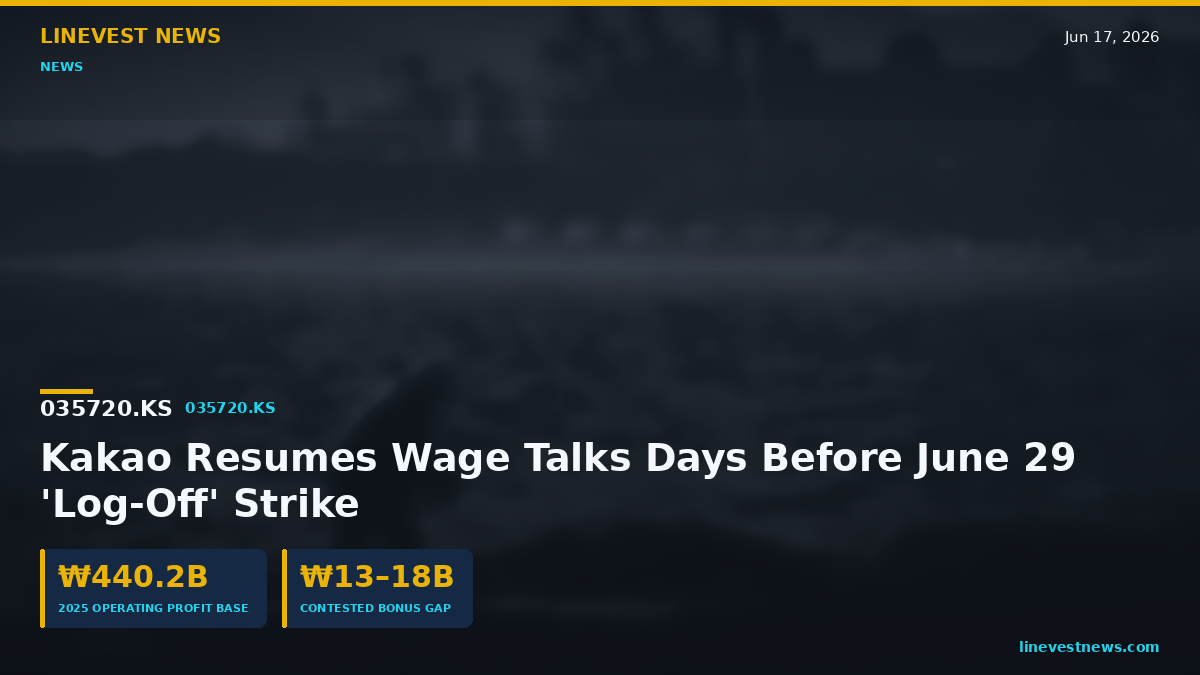
Kakao (035720.KS), operator of KakaoTalk — South Korea's dominant messaging and super-app platform — returned to the bargaining table on June 17 for its first wage talks since a June 10 walkout, the first labor stoppage in the company's history, according to Seoul's Electronic Times (etnews) and newswire Newsis. The sit-down comes 12 days before a June 29 "log-off day" threatened by the Crew Union — Kakao's branch of the Korean Confederation of Trade Unions' nationwide chemical, textile and food workers' federation — in which members would take paid annual leave and log out of internal systems en masse.
For a portfolio manager, the first question is whether that escalation can actually dent KakaoTalk, payments or earnings. On the numbers, the gap dividing the two sides is narrow.
A few percentage points of profit
The dispute centers on the size of the performance-bonus pool. The Crew Union wants cash bonuses worth 13–14% of Kakao's 2025 standalone operating profit of ₩440.2 billion (USD321 million, at ₩1,370 per dollar), with a separate ₩5 million (USD3,650) per-head grant of restricted stock units (RSUs) — equity that vests over time — kept outside that calculation, according to Herald Business (Herald Biz). Management has offered roughly 10% of the same profit base with the RSUs folded in. The English-language Korea Herald frames the union's ask at 13–15%, or about ₩10 million (USD7,300) per worker.
Three to four percentage points of ₩440.2 billion works out to roughly ₩13–18 billion (USD10–13 million) — the contested spread. For scale, Kakao's first-quarter 2026 operating profit alone was ₩211.4 billion, up 65.9% year on year, on revenue of ₩1.94 trillion (USD1.42 billion), per the Korea Herald. The money on the table is small set against that base; what is unusual is the conflict itself.
Symbolic weight over operational risk
The June 10 action was a four-hour partial walkout (10 a.m.–3 p.m.) that drew more than 1,000 of roughly 4,000 headquarters staff — about a quarter — and some 1,500 across the group, per the Korea Herald. Five entities have secured strike rights: Kakao headquarters, listed fintech arm Kakao Pay, B2B cloud-and-AI unit Kakao Enterprise, payments-terminal subsidiary DK Techin and game studio XL Games, according to The Asia Business Daily and Newsis. Two earlier rounds of government-mediated talks had failed (Korea Herald). "Kakao's real reform has to be made by its crew, not its executives," Crew Union chapter head Suh Seung-wook said (Korea Herald).
A 2024 template at Samsung
The June 29 tactic has a recent precedent. On June 7, 2024, the National Samsung Electronics Union — roughly 28,000 members — staged Samsung Electronics' first industrial action in its history by having members use paid leave simultaneously, also over demands for transparent performance bonuses. It caused no production disruption; Samsung said leave usage that day ran below the comparable day a year earlier, and a union vice-president acknowledged the action "would not create disruption in production," Al Jazeera reported. Kakao's planned logout, aimed at its roughly 5,000 union members (Korea Herald), follows the same playbook, with automation and skeleton staffing expected to keep core services running.
That pattern showed in the tape: Kakao shares fell 3.5% on the June 10 strike day to ₩38,150 and were down about 13% over the prior month, per the Korea Herald — a move that tracked the bonus headlines more than any service outage.
What confirms or refutes the thesis
The June 17 session reopens a channel that two mediation rounds could not close. The data points to watch: whether the June 29 logout proceeds or a settlement lands first, and whether the dispute spreads to the four affiliates that have banked strike rights. Kakao's second-quarter results, due in August, will show whether the standoff carried any cost beyond the headlines.
This article is for informational purposes only and does not constitute investment advice. Figures are sourced from the outlets cited inline; currency conversions use an approximate rate of ₩1,370 per U.S. dollar.