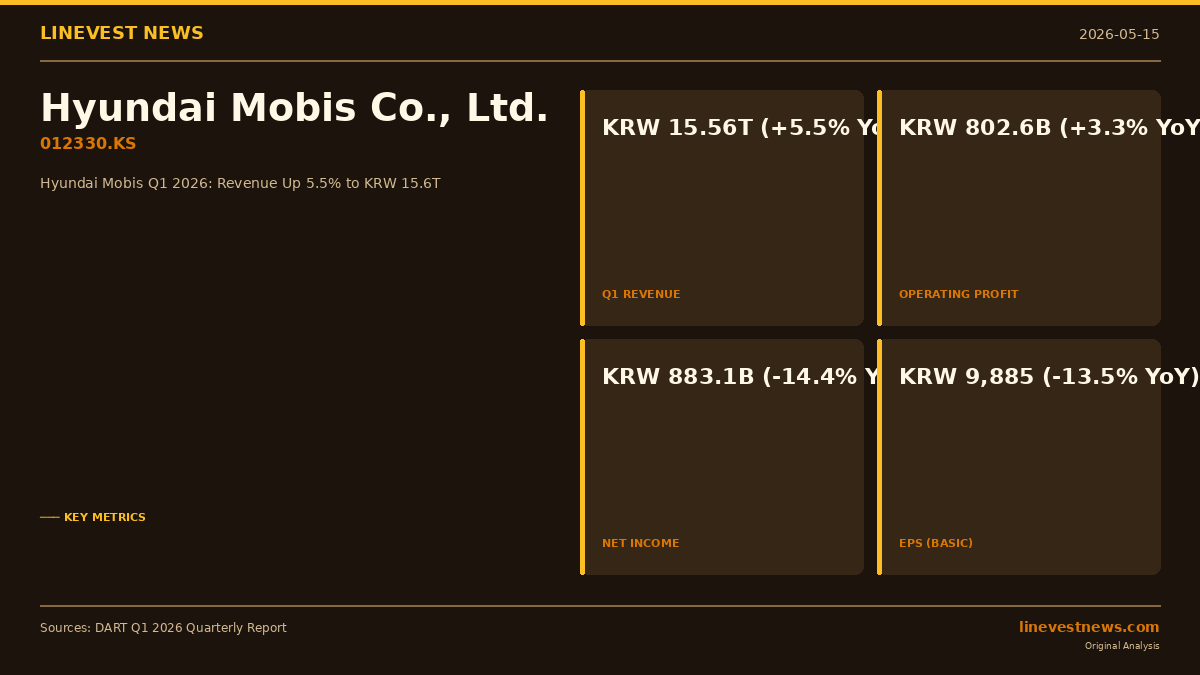
Hyundai Mobis Co., Ltd. (012330.KS) posted consolidated revenue of KRW 15.56 trillion (approximately USD 10.9 billion) in the first quarter of 2026, a 5.5% increase year-on-year, as rising electric vehicle component demand and aftermarket growth more than offset a soft global auto sales environment. Operating profit edged up 3.3% to KRW 802.6 billion (USD 561 million), though headline net income fell 14.4% to KRW 883.1 billion amid a significant decline in equity-method gains from affiliates.
Revenue: Dual Engines Fire
The company's two business lines both expanded. The core module and parts manufacturing segment — accounting for 77.4% of total revenue — generated KRW 12.04 trillion, up 4.9% from the year-earlier KRW 11.47 trillion. Management attributed the gain to higher EV production volumes at Hyundai Motor and Kia, alongside a favourable exchange rate environment.
The aftermarket (A/S) parts segment — which supplies replacement components for the roughly 2.77 million stock-keeping units the company manages across 212 vehicle models — posted revenue of KRW 3.52 trillion, a 7.4% rise reflecting sustained global demand growth. Together, the two segments delivered a combined revenue increase of KRW 808.5 billion (+5.5%) versus Q1 2025.
Geographically, domestic revenue climbed 4.2% on stronger EV and SUV production volumes, while overseas revenue expanded 6.5%, boosted by North American production gains, accelerating electrification module deliveries, and service-part growth.
Operating Profit Grows, Margin Steady
Consolidated gross profit totalled KRW 2.15 trillion, up from KRW 2.06 trillion a year earlier, implying a gross margin of 13.8% (vs. 14.0% in Q1 2025). Operating profit of KRW 802.6 billion translated to an operating margin of 5.2%, modestly below the prior-year 5.3%, as selling and administrative costs rose 4.7% to KRW 1.35 trillion in line with higher R&D expenditure.
First-quarter R&D spending reached KRW 445.7 billion — annualised roughly KRW 1.8 trillion — representing approximately 2.9% of quarterly revenue. Investment priorities remain electrification (high-voltage power systems, integrated charging control units, battery management), autonomous-driving software, in-vehicle infotainment, automotive semiconductors, and robotics components, the last underpinned by the company's 20% stake in Hyundai Motor Group's U.S. innovation holding company, HMG Global LLC.
Net Income Slides on Equity-Method Shortfall
The headline net profit figure — KRW 883.1 billion (down from KRW 1.03 trillion in Q1 2025, -14.4%) — masks a structural shift below the operating line. Equity-method investment income fell sharply to KRW 400.5 billion from KRW 582.6 billion in Q1 2025, a -31.2% decline, reflecting lower reported earnings at Hyundai Motor and Kia, among other affiliates.
Financial income also contracted, dropping from KRW 186.3 billion to KRW 141.0 billion (-24.3%). Basic earnings per share came in at KRW 9,885 versus KRW 11,422 in Q1 2025 (-13.5%).
Balance Sheet Remains Solid
At 31 March 2026, consolidated total assets stood at KRW 73.9 trillion, up from KRW 70.4 trillion at year-end 2025. Equity attributable to Hyundai Mobis shareholders was KRW 50.6 trillion, yielding a debt-to-equity ratio of approximately 46% — a conservative leverage profile. Inventory stood at roughly 9.6% of total assets, consistent with the prior quarter, suggesting stable supply-chain management.
Outlook: Navigating Tariff Headwinds with HEV Leverage
Management offered 2026 full-year guidance of revenue growth of +1.0% to +2.0%, acknowledging headwinds from U.S. tariff policy and EV growth deceleration. Hyundai Motor and Kia's combined Q1 2026 global deliveries dipped 1.1% year-on-year to 1.75 million vehicles, underscoring the constraint.
Key growth levers cited include HEV and EREV volume expansion, SDV-related per-vehicle content gains, the newly formed robotics-parts business unit, and North American battery cell joint ventures with LG Energy Solution and SK On in Georgia. On shareholder returns, the company reiterated its TSR 30%-plus target for fiscal 2026, building on a 2025 TSR of 32.8% and an annual dividend of KRW 6,500 per share.
Key Financials at a Glance
| Metric | Q1 2026 | Q1 2025 | Change |
|---|---|---|---|
| Revenue | KRW 15.56T (USD 10.9B) | KRW 14.75T | +5.5% |
| Operating Profit | KRW 802.6B (USD 561M) | KRW 776.7B | +3.3% |
| Operating Margin | 5.2% | 5.3% | -11 bps |
| Net Income | KRW 883.1B (USD 617M) | KRW 1.03T | -14.4% |
| EPS (Basic) | KRW 9,885 | KRW 11,422 | -13.5% |
| Total Assets | KRW 73.9T | KRW 70.4T (YE 2025) | +5.0% |
| R&D Spending | KRW 445.7B | — | — |
Source: Hyundai Mobis Q1 2026 Quarterly Report (DART filing, 2026-05-15). USD figures based on approx. KRW 1,430/USD average for Q1 2026.
Sources
- Hyundai Mobis Q1 2026 Quarterly Report — DART filing, 20260515002700 (2026-05-15)