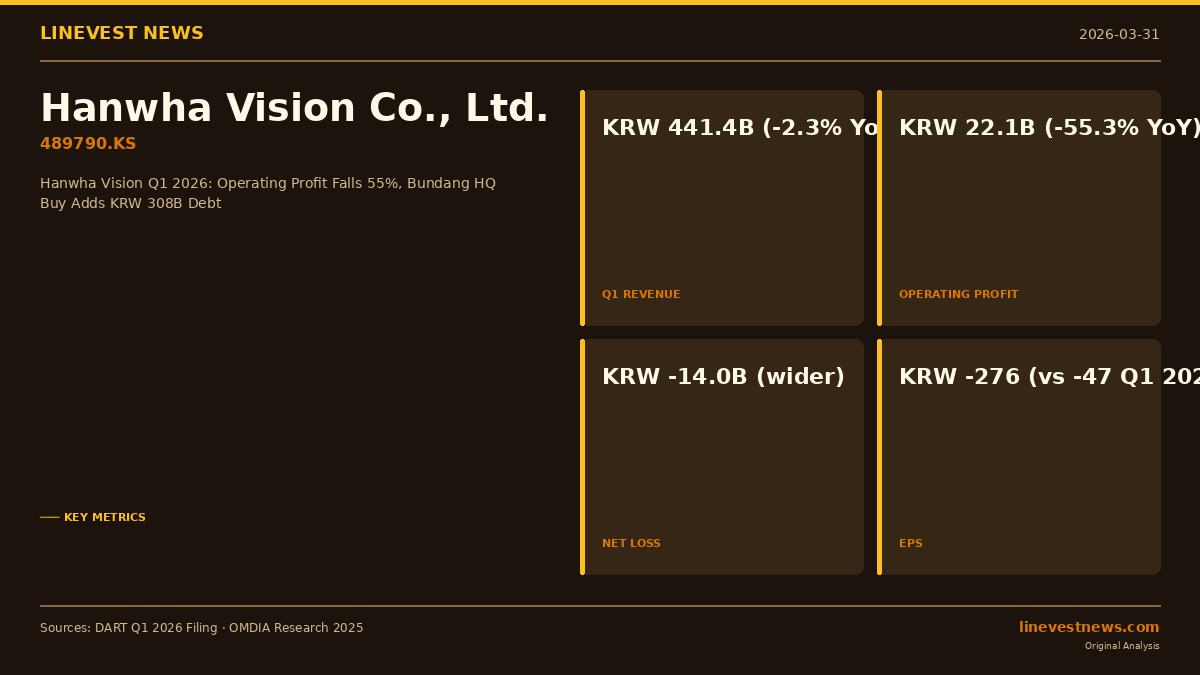
Hanwha Vision Co., Ltd. (489790.KS), South Korea's leading AI-powered surveillance and industrial equipment maker, posted a net loss of KRW 14.0B in the first quarter of 2026, widening from a KRW 3.3B loss a year earlier, as a steep contraction in operating profit combined with a large non-cash mark-to-market charge weighed on results.
Key Financials at a Glance
| Metric | Q1 2026 | Q1 2025 | Change |
|---|---|---|---|
| Revenue | KRW 441.4B | KRW 451.8B | -2.3% |
| Gross Profit | KRW 232.8B | KRW 244.6B | -4.8% |
| Operating Profit | KRW 22.1B | KRW 49.4B | -55.3% |
| Operating Margin | 5.0% | 10.9% | -5.9pp |
| Pre-tax Loss | KRW -32.6B | KRW -8.0B | widened |
| Net Loss (total) | KRW -14.0B | KRW -3.3B | widened |
| EPS | KRW -276 | KRW -47 | — |
Source: Hanwha Vision Q1 2026 Quarterly Report (DART, filed May 13, 2026). Unit: Korean Won (KRW). 1 USD ≈ KRW 1,445 (Q1 2026 average).
Operating Profit Halved Despite Stable Revenue
Revenue slipped a modest 2.3% to KRW 441.4B (approx. USD 305M), but operating profit collapsed 55.3% to KRW 22.1B. The disconnect between revenue and earnings reflects twin pressures on the cost side:
- SG&A expenses surged 8.5% to KRW 141.8B, even as the top line contracted — a sign that the company continues investing in global sales infrastructure and marketing.
- R&D spending held firm at KRW 69.0B (+7.1% YoY), representing 15.6% of quarterly revenue as Hanwha Vision deepens its AI camera and smart-factory technology roadmap.
- Combined, operating expenses consumed 47.9% of revenue (vs. 43.4% in Q1 2025), compressing margins from 10.9% to 5.0%.
Industrial Equipment Division in Deep Loss
The consolidated picture is dragged further by Hanwha Semitec, the group's chip-mounter and industrial automation unit:
| Segment | Q1 2026 Revenue | Q1 2026 Op Profit |
|---|---|---|
| Security (CCTV/AI surveillance) | KRW 582.1B* | KRW +25.4B |
| Industrial Equipment (SMT/chip mounters) | KRW 91.9B* | KRW -12.2B |
| Semiconductor Design | — (discontinued) | KRW -0.7B |
Gross figures before inter-segment eliminations. After consolidation adjustments, total revenue = KRW 441.4B.
The Security segment — which manufactures CCTV cameras, NVRs, and AI-driven video analytics under the Hanwha Vision brand — remains profitable with operating income of KRW 25.4B. It holds a 30.0% domestic market share and a 5.9% global share excluding China (OMDIA Research, 2025), underpinned by proprietary SoC chips and edge-AI capabilities.
The Industrial Equipment segment deepened its losses to KRW -12.2B from KRW -6.2B in the prior year, reflecting sluggish chip-mounter demand as global PCB assembly capex remained cautious.
KRW 60B Non-Cash Charge Amplifies Pre-Tax Loss
Beyond operating results, a KRW 60.0B mark-to-market loss on financial liabilities (기타금융부채평가손실) — classified as a financial cost — was the single largest drag on the pre-tax line. Combined with derivative trading losses (KRW 8.5B) and interest expense (KRW 5.0B), total financial costs reached KRW 77.7B for the quarter (vs. KRW 63.0B in Q1 2025).
The KRW 60B revaluation loss is a non-cash item tied to the fair-value change in financial obligations, which can fluctuate significantly quarter to quarter depending on market assumptions. Tax benefits of KRW 19.3B (deferred tax) partially offset the pre-tax loss of KRW -32.6B, producing a reported net loss of KRW -14.0B.
KRW 307.9B Bundang Headquarters Acquisition Changes Balance Sheet
The most significant balance-sheet event of the quarter was Hanwha Vision's acquisition of a new headquarters building in Bundang (Sunaedong, Seongnam, Gyeonggi Province). Contracted on January 16, 2026 with 주식회사 케이원제16호분당위탁관리부동산투자회사 (a Korean REIT), the deal totaled KRW 307.9B (approx. USD 213M):
- Land component: KRW 205.3B
- Building component: KRW 102.5B
The asset is carried under investment property (투자부동산) on the balance sheet, which implies the company may also intend to generate rental income before or alongside occupancy. To fund the purchase, the company issued KRW 109.6B in corporate bonds and drew KRW 150.0B in long-term loans — adding KRW 239.6B to long-term debt (which was zero at December 31, 2025).
| Balance Sheet Item | Q1-end 2026 | YE 2025 | Change |
|---|---|---|---|
| Total Assets | KRW 2,174.5B | KRW 1,809.4B | +20.2% |
| Investment Property | KRW 307.7B | KRW 0 | new |
| Long-term Borrowings | KRW 239.6B | KRW 0 | new |
| Total Debt (short + long) | KRW 658.3B | KRW 395.6B | +66.4% |
| Total Equity | KRW 866.5B | KRW 866.2B | stable |
The debt increase significantly raises Hanwha Vision's leverage, with debt-to-equity expanding from approximately 0.46x to 0.76x (excluding lease liabilities) in a single quarter.
Semiconductor Design Fully Wound Down
The company has now completely exited the semiconductor design business that once represented a strategic diversification effort:
- NPU (neural processing unit) design — subsidiary A123 Corporation and affiliates Neubla Korea and Neubla UK — wound down in September 2024
- Vision semiconductor design — subsidiary Visionnext — formally dissolved in October 2025
Both businesses are now classified as discontinued operations, with a residual cleanup charge of KRW 0.7B in Q1 2026. The pivot leaves Hanwha Vision fully focused on its two core verticals: surveillance cameras and industrial automation equipment.
Market Position and Outlook
Hanwha Vision ranks among the top five global surveillance camera makers (ex-China), competing against Axis Communications (Axis AB, Stockholm), Bosch Security, and Avigilon (Motorola Solutions). Its proprietary SoC technology and recent ISO/IEC 42001 AI management certification differentiate it from pure-hardware rivals.
The company did not provide formal quarterly guidance. Investors will watch whether the industrial equipment division can return to break-even — it recorded an annual operating loss of KRW 20.9B in FY2025 — and whether the Bundang headquarters, classified as investment property, will generate offsetting rental cash flows to help service the new KRW 240B long-term debt load.
This article is based on Hanwha Vision's Q1 2026 Quarterly Report (사업연도: 2026.01.01–2026.03.31) filed with Korea's Financial Supervisory Service (DART) on May 13, 2026. All figures are derived from the consolidated IFRS financial statements. Market share data: OMDIA Research 2025.
Sources: DART Q1 2026 Filing (rcept_no: 20260513000735) | OMDIA Research 2025