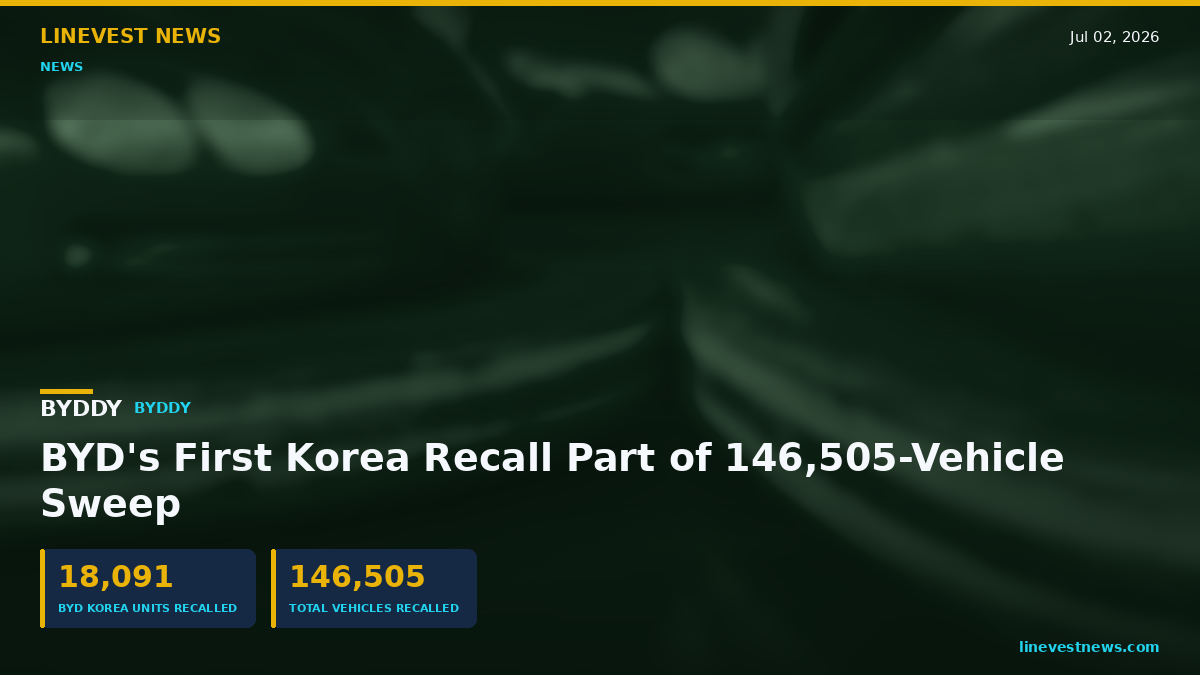
South Korea's transport regulator ordered six automakers to recall a combined 146,505 vehicles across 38 models for manufacturing defects, and buried inside the list is a milestone for the market's newest disruptor: the first recall ever issued for BYD (BYDDY), China's largest EV maker, since it began selling passenger cars in Korea.
The headline for a fund manager holding Chinese EV exposure is less about the size of BYD's slice than its symbolism. BYD Korea, the local arm of BYD, is recalling 18,091 units across six models, including the SEALION 7 mid-size electric SUV, because a seat-belt reminder warning can be hidden by other on-screen notifications, according to the Ministry of Land, Infrastructure and Transport (MOLIT, Korea's transport regulator) as reported by the Korea Herald and the Korea Times. Chosun Biz described it as BYD's first domestic recall. The defect is an advisory-software issue, not a crash-safety failure, and owners get free fixes.
The severity spectrum matters more than the total
The 146,505 headline number lumps together very different problems. The most safety-critical belongs to Jaguar Land Rover Korea, which is recalling 14,373 units across 21 models, including the Defender, over a steering-wheel airbag connector durability issue that could stop the airbag from deploying in a crash, per Chosun Biz and the Korea Herald. Volvo Car Korea, the Korean unit of Sweden's Geely-owned Volvo Cars, has the largest volume at 55,405 units across seven models including the XC60, tied to a durability fault in the 48-volt starter-generator that can trigger warning lights or block a restart after auto stop-start, per the Korea Herald.
Hyundai Motor, Korea's largest automaker, follows at 54,792 units across two models, including the Tucson, after software errors made the instrument-cluster display flicker or shut off, according to all three source outlets and MOLIT. Mercedes-Benz Korea (2,113 units of the C 300 4MATIC, a steering-wheel electronics circuit) and Stellantis Korea (1,731 units of the 300C, a high-pressure fuel-pump defect that can stall the engine while driving) round out the list, per the Korea Herald.
Sizing BYD's exposure
The recall spans more units than BYD has ever sold in a Korean calendar year. BYD's 18,091 recalled vehicles exceed its entire 2025 Korean passenger-car total of 6,107 units — the company's first full year in the market after entering in January 2025 — reflecting cumulative deliveries across models since launch, as reported by CnEVPost. The SEALION 7, which arrived in September 2025 priced from ₩44.9 million (about $32,800 at 1,370 won per dollar), sits at the center of a lineup that pushed BYD into Korea's top five monthly import registrations for the first time in November 2025, when it registered 1,164 vehicles, per CnEVPost.
That momentum frames the question the recall raises: does a first stumble dent a fast-rising brand, or is it routine? Precedent leans routine. BYD has absorbed far larger actions elsewhere — a recall of more than 115,000 Tang PHEV and Yuan Pro vehicles in China in October 2025 over drive-motor-controller and battery-sealing defects, as reported by SoyaCincau — without derailing its global volume growth. A software-obscured seat-belt reminder is at the mild end of that history.
What to watch
BYD's remedy has been underway since June 19, while Hyundai's begins August 6, according to Chosun Biz; Volvo said it will act as parts become available. The cleaner read on whether the recall matters commercially will come from BYD Korea's monthly import-registration figures in the months ahead — the same data that showed its November 2025 top-five breakthrough. A continued climb would confirm the recall was a footnote; a stall would be the first sign it was not.
Sources: Korea Times · Korea Herald · Chosun Biz · CnEVPost
This article is for informational purposes only and does not constitute investment advice. Figures are drawn from cited news reports and MOLIT disclosures; currency conversions use an approximate rate of 1,370 won per U.S. dollar.