Hanwha, Hyundai Pledge Combined KRW 97 Trillion to Transform Yeongnam Into Defense-Aerospace Hub
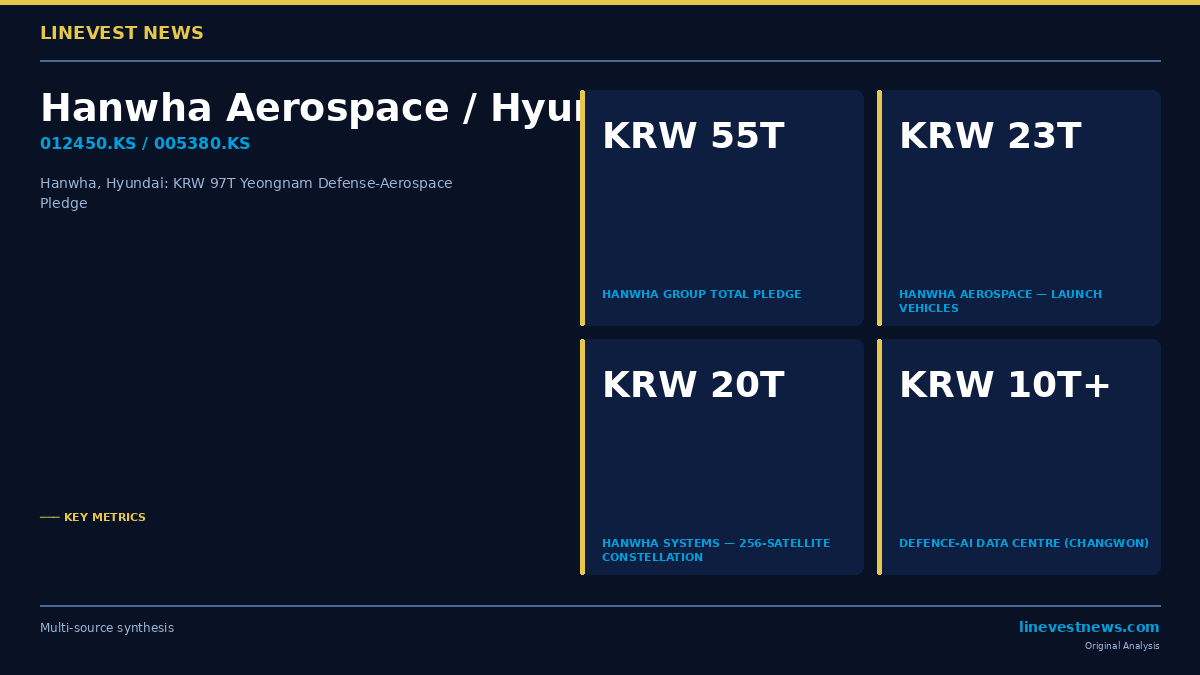
Korea's two largest non-semiconductor conglomerates staked out their roles in a sweeping 312-trillion-won regional investment programme on Friday, with Hanwha Group committing KRW 55 trillion to independent space-launch capability and a 256-satellite constellation through 2040, and Hyundai Motor Group pledging KRW 42 trillion to anchor next-generation electric vehicles, advanced air mobility and clean energy in the south-eastern Yeongnam region.
Hanwha: Space Sovereignty at KRW 55 Trillion
Vice Chairman Kim Dong-kwan anchored Hanwha Group's presentation around a strategic imperative: "The first step toward securing 'space sovereignty' is developing our own launch vehicle." That ambition carries a KRW 23 trillion price tag at Hanwha Aerospace (012450.KS), earmarked for domestically designed reusable launch vehicles, ground-test infrastructure and launch facilities — positioning Korea alongside Japan and the European Space Agency as one of the few countries building end-to-end indigenous access to orbit.
Hanwha Systems (272210.KS) receives the second-largest slice — KRW 20 trillion — to build a combined constellation of 64 synthetic-aperture radar (SAR) satellites operational by 2031 and 192 communications satellites by the mid-2030s. At 256 craft, the constellation would give Korea persistent all-weather imagery of the Korean Peninsula and surrounding waters without relying on US or European satellite operators, a capability with obvious dual-use value given ongoing tensions on the peninsula.
The remaining KRW 12 trillion is split between a KRW 10+ trillion defence-AI data centre in Changwon — the traditional home of Korea's defence manufacturing base — and a KRW 2 trillion AI-native defence operating system to unify targeting, logistics and command-and-control software across Hanwha's platform portfolio.
Hyundai Motor Group: KRW 42 Trillion for Next-Gen Mobility and Clean Energy
Hyundai Motor Group (005380.KS) laid out a parallel KRW 42 trillion decade-long programme spanning four fronts:
- Electric vehicles: A new Ulsan EV-dedicated plant launches later in 2026, with Hyundai Mobis adding battery-module assembly in Ulsan and motor/controller manufacturing lines in Daegu (North Gyeongsang Province)
- Advanced air mobility (AAM): US-based subsidiary Supernal co-develops electric air taxis targeting intra-city routes in the Yeongnam metropolitan corridor
- Clean energy: The group will invest in small modular reactors (SMRs), offshore wind and hydrogen refuelling infrastructure, complementing Korea's national push to decarbonise heavy industry
- Thermal management: Hyundai Wia extends EV thermal-management systems production into Changwon
Vice Chair Chang Jae-hoon said the combined investments aim to "transform the region into a hub for future industries," echoing Seoul's goal of anchoring advanced manufacturing away from the Seoul-Incheon corridor.
Context: KRW 312 Trillion Total Yeongnam Commitment
The Hanwha-Hyundai announcement was the final regional chapter of President Lee Jae Myung's "New Industrial Map" initiative, held in Jinju, South Gyeongsang Province on July 3. The event follows similar ceremonies for the Honam (southwest) and Chungcheong (central) regions.
At the full-programme level, the Yeongnam pledges now stand at KRW 312 trillion ($204 billion) over the coming decade:
| Conglomerate | Pledge (KRW) | Primary Focus |
|---|---|---|
| SK Group | 140T | AI hyperscale data centres (15 GW national target) |
| Samsung Group | 60T | Humanoid robots, all-solid-state batteries, server substrates |
| Hanwha Group | 55T | Launch vehicles, satellites, defence AI |
| Hyundai Motor Group | 42T | EVs, AAM, SMRs, hydrogen |
| LG Group | 9.4T | HVAC R&D, AI chip substrates, next-gen displays |
| Doosan | 5.1T | Small modular reactors, gas/hydrogen turbines |
Hanwha's 55T is notable for being concentrated almost entirely in defence and space — sectors with longer development cycles and higher geopolitical sensitivity than the data-centre and battery investments dominating competitor pledges.
Investment Thesis
Hanwha Aerospace closed Thursday at KRW 715,000 (market cap approximately KRW 47.8 trillion). The KRW 23 trillion launch-vehicle programme alone represents roughly half the company's market capitalisation, suggesting management is making a multi-decade bet on sovereign space access rather than optimising near-term returns. Analysts at Mirae Asset and Korea Investment & Securities have in recent weeks flagged Hanwha Aerospace as a structural beneficiary of Korea's defence budget expansion, with the domestic defence budget set to exceed KRW 60 trillion by 2027.
For Hanwha Systems, the 64-satellite SAR programme overlaps directly with Korea's "425 Project" military reconnaissance constellation — broadening the commercial and governmental revenue base simultaneously.
Hyundai Motor Group's 42T commitment, spread across EVs, AAM and clean energy, reflects a strategy of hedging across transportation-decarbonisation vectors rather than concentrating on any single propulsion technology.
Sources: Korea Herald · Hanwha Group Investor Relations · DART / KRX
"