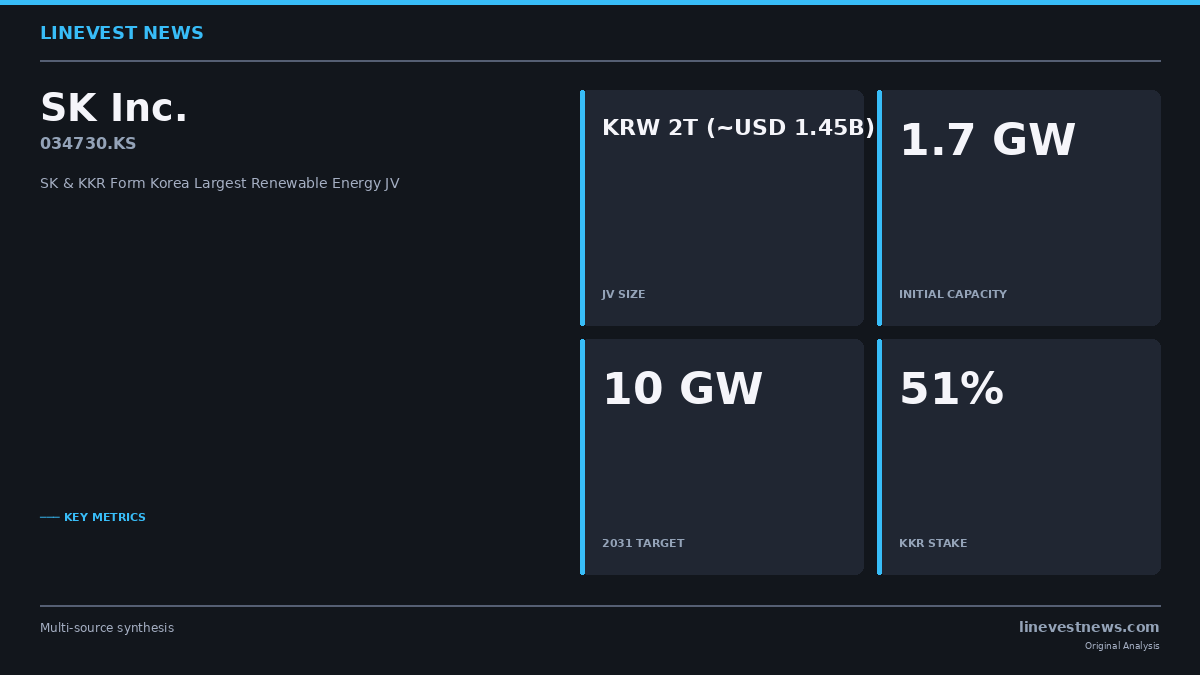
SK Inc. (034730.KS) and global private equity firm Kohlberg Kravis Roberts & Co. (KKR) have signed a definitive agreement to launch Korea's largest renewable energy holding company, valued at approximately KRW 2 trillion (about USD 1.45 billion), the companies announced on July 1.
The new entity, tentatively named "HoldCo," will consolidate renewable energy assets currently scattered across three SK Group affiliates — SK Innovation (096770.KS), SK Eco Plant, and SK Discovery — into a single integrated platform. The joint venture is expected to launch by end-2026, with KKR holding a 51% controlling stake and SK Inc. retaining 49%.
Scale and Portfolio
Upon launch, the combined entity will operate approximately 1.7 gigawatts (GW) of renewable energy capacity, encompassing solar, onshore and offshore wind, and fuel cells — making it the largest renewable energy operator in Korea at inception. Hydrogen-related businesses are explicitly excluded from the scope.
The two partners plan to expand total capacity to 10 GW by 2031 through a pipeline of additional development projects. Their primary target customers are South Korea's most power-hungry industries: AI data centers, semiconductor fabrication lines, and advanced manufacturing facilities facing increasing corporate renewable energy procurement commitments.
Why the Deal Now
The transaction reflects the capital-intensive nature of the renewable energy industry. Individual SK affiliates faced rising financial pressure funding capacity expansions through their own borrowing or equity issuance. By pooling assets under a single entity backed by KKR's global infrastructure capital, SK gains a more efficient funding structure for long-term growth.
"South Korea is one of Asia's most attractive renewable energy markets, with robust corporate demand for clean power from semiconductors, data centers, and manufacturing broadly," said Kim Yang-han, KKR's Head of Infrastructure for Northeast Asia. "This platform will enable us to meet surging domestic clean energy demand at scale."
SK Inc. framed the deal as proactive portfolio rebalancing, aiming to improve the sustainability and competitiveness of its renewable energy business through KKR's capital strength and SK's domestic execution capabilities. Initial operating control rests with KKR, though the agreement leaves open the possibility of SK Inc. eventually negotiating to reclaim majority control.
KKR's Track Record
KKR brings substantial infrastructure credentials. The firm manages over USD 100 billion in infrastructure assets globally and has invested more than USD 31 billion in energy transition and renewable energy infrastructure since 2011. The Korea JV will be primarily funded through KKR's Asia-Pacific infrastructure strategy.
Strategic Context
The deal comes as South Korea accelerates efforts to scale domestic renewable energy amid surging electricity demand from the country's semiconductor mega-projects. The government recently unveiled the KRW 896 trillion Southwest Semiconductor Megaproject, which will require significant clean energy supply to support corporate renewable procurement targets. Samsung Electronics and SK Hynix are both anchor tenants of the new Gwangju cluster.
SK's three contributing affiliates — SK Innovation, SK Eco Plant, and SK Discovery — are currently in the process of transferring renewable energy assets and stakes to KKR as part of the transaction.
Sources: Chosun Biz — SK-KKR JV Announcement · Chosun Biz — Deal Size and Scope