South Korea's Korea Fair Trade Commission (KFTC) has formally moved against Alphabet's Google, releasing an examiner's report on Wednesday that accuses the U.S. tech giant of abusing its dominant position in the Korean app marketplace through a developer subsidy scheme internally known as "Project Hug."
The commission's Market Surveillance Bureau identified Google's Games Velocity Program (GVP)—active from at least July 2019—as the centerpiece of the alleged violation. Under the program, Google offered financial support to game developers for adopting Google services including Cloud, Ads, and YouTube, while simultaneously binding recipients to launch their titles on Google Play under terms "at least as favorable" as those offered to competing platforms.
What the KFTC Found
The examiner's report covers the period from July 2019 to March 2026 and flagged three competition concerns:
- Tying financial incentives to exclusivity: Developers that received GVP subsidies were effectively pressured to prioritize Google Play over rival platforms such as One Store or Galaxy Store.
- Progressively escalating incentives: The program structured benefits to grow as developers generated more revenue through Google Play, creating a lock-in mechanism that made switching platforms increasingly costly.
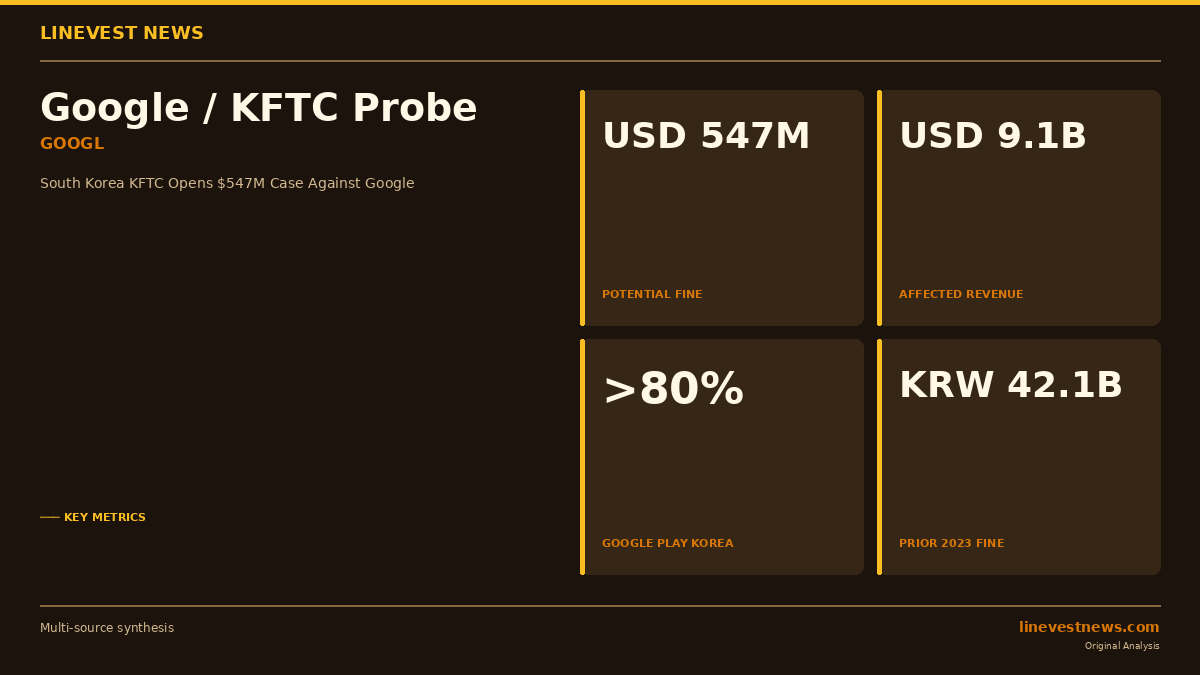
- Dominant market leverage: With Google Play commanding more than 80% of South Korea's Android app market, regulators argue developers had little practical ability to refuse Google's terms.
The bureau has recommended corrective measures and financial penalties, giving Google eight weeks to file a written response before the full commission votes on the case.
Potential Fine and Prior Record
If the KFTC rules against Google, the company faces a fine of up to 6% of the affected revenue. The GVP agreements cover approximately KRW 14.16 trillion (USD 9.1 billion) in sales, setting a maximum penalty of roughly KRW 849.6 billion (USD 547 million).
The exposure may be higher still. A related KFTC fine of KRW 42.1 billion was imposed on Google in 2023 for similar app store practices. Korean fair trade law allows a 20–40% surcharge on repeat violations occurring within a five-year window—a provision that could apply here.
Context: Korea's Big-Tech Scrutiny
This investigation follows a pattern of Korean regulatory action against global technology platforms. South Korea enacted some of the world's first legislation directly limiting app store power, with the 2021 amendment to the Telecommunications Business Act—often called the "Anti-Google Law"—barring platforms from forcing developers to use proprietary payment systems.
The new KFTC case targets a broader angle: the alleged use of cloud and advertising subsidies as indirect instruments of market foreclosure, a theory of harm that goes beyond payment system mandates and could, if sustained, require structural changes to how Google runs developer-incentive programs globally.
Market Implications
Google has no primary listing on a Korean exchange, but the case carries implications for domestic publishers. Kakao Games (293490.KS), Krafton (259960.KS), and NCSOFT (036570.KS) are among Korean developers with significant Google Play exposure whose distribution-cost structures could ease if a remediation order mandates genuine multi-platform access on equal commercial terms.
Any corrective order, if upheld, is expected to take effect within six to twelve months of a final KFTC ruling. Google has previously contested Korean regulatory decisions in domestic courts and is widely expected to challenge any adverse finding.
Sources: Korea Times · Investing.com