SK Inc., the holding company of South Korea's SK Group, and U.S. private equity giant Kohlberg Kravis Roberts (KKR) have signed a binding agreement to establish a joint venture that will become Korea's largest integrated renewable energy company, the group announced Wednesday.
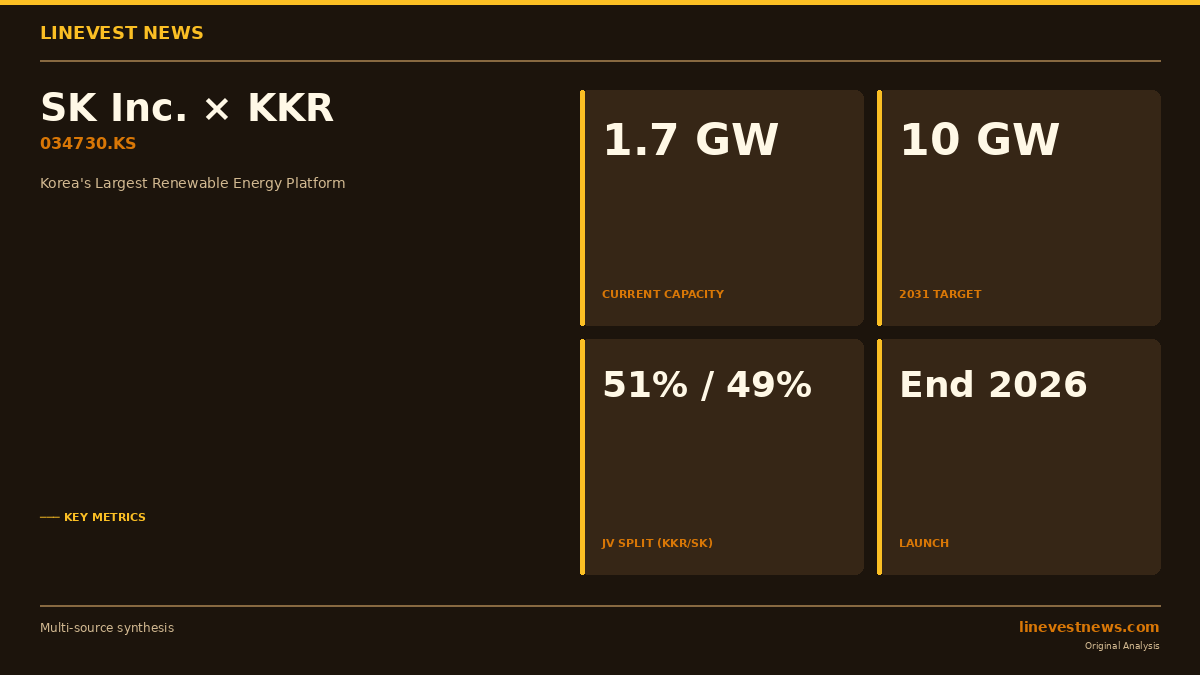
Under the deal, KKR funds will hold a 51% stake in the new entity—tentatively named "HoldCo"—while SK Inc. retains 49%. KKR assumes initial management rights, though SK Inc. reserves the option to renegotiate control at a later stage.
Deal Architecture
Three SK Group affiliates are currently in the process of carving out and transferring their respective renewable energy assets into the JV through a combination of business and share transfers:
- SK Innovation (096770.KS) — the group's energy and chemicals arm
- SK ecoplant — engineering and green infrastructure
- SK Discovery — diversified holding with power assets
The combined portfolio covers every major renewable generation category except hydrogen: solar power, offshore and onshore wind, fuel cells, and energy storage systems (ESS). The JV is scheduled to officially launch before the end of 2026.
Scale and Growth Targets
At inception, HoldCo will manage roughly 1.7 gigawatts (GW) of operating renewable capacity—already the largest domestic pool of its kind—with plans to scale to 10 GW by 2031, representing a nearly six-fold expansion over five years.
"Through this cooperation, the two companies will build a large-scale renewable energy platform that can stably respond to the high electricity demand of domestic industries," said Kim Yang-han, KKR's Head of Infrastructure for Northeast Asia.
Strategic Context
South Korea's power grid faces intensifying demand pressure from semiconductor mega-clusters, AI data centers, and government net-zero pledges. Capital-intensive renewable build-outs have strained the balance sheets of individual conglomerates relying solely on debt, making strategic equity partnerships with global infrastructure investors increasingly attractive.
For SK Group, the JV accelerates a broader portfolio rebalancing: by monetizing renewable assets into a KKR-backed platform, the group frees capital to direct toward higher-return bets in AI chips, batteries, and biotech. For KKR—which manages over USD 600 billion in assets globally—the deal deepens its already sizeable South Korean infrastructure footprint.
No financial valuation for the asset transfers or the JV equity has been disclosed.
What to Watch
- Regulatory clearance: The asset transfers among SK Innovation, ecoplant, and Discovery require Korean Fair Trade Commission (KFTC) and energy regulator sign-off.
- HoldCo IPO: An eventual listing of the JV would be a natural exit path for KKR and a capital-efficiency lever for SK.
- Hydrogen gap: The JV explicitly excludes hydrogen, leaving SK ecoplant's hydrogen ambitions on the sidelines—watch for a separate vehicle.
Sources: Korea Times · ETNews