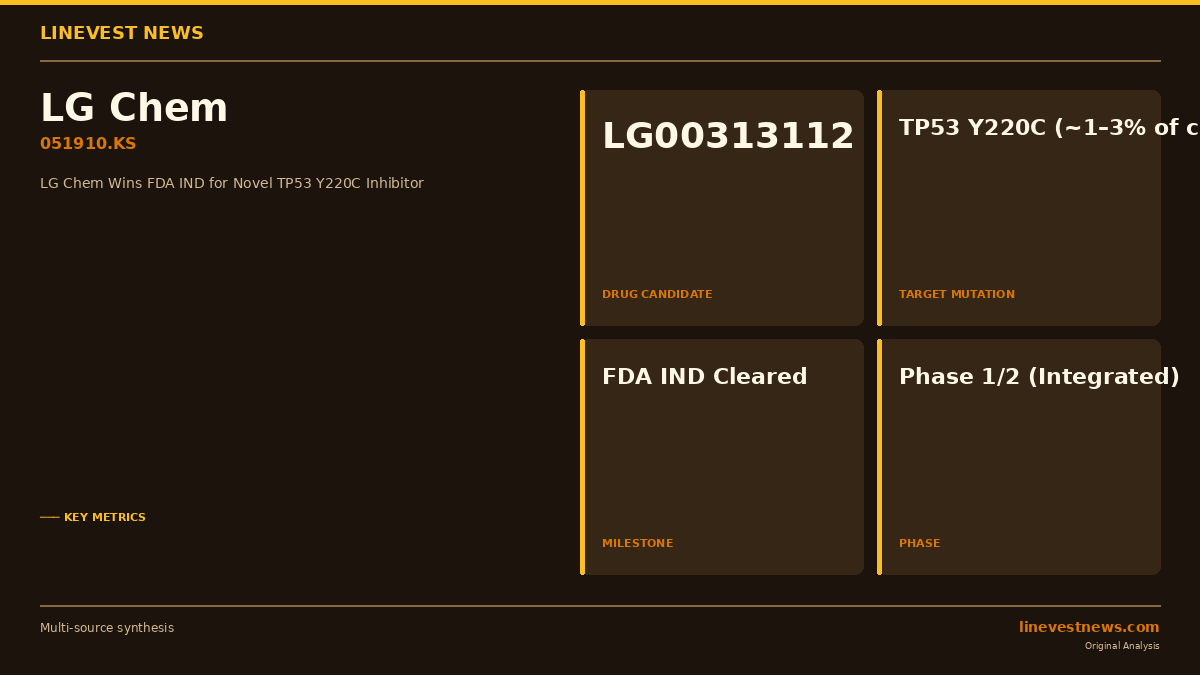
LG Chem (051910.KS), South Korea's largest chemicals and life-sciences conglomerate, announced on June 30 that the U.S. Food and Drug Administration has cleared the Investigational New Drug (IND) application for LG00313112, an oral small-molecule candidate targeting the rare TP53 Y220C gene mutation found in approximately 1–3% of all cancer patients. The clearance opens the path to a combined Phase 1/2 human trial, marking LG Chem's most advanced precision-oncology asset to date.
The Science: Restoring a Broken Tumour Suppressor
TP53 encodes p53, the so-called "guardian of the genome." The Y220C substitution destabilises p53's thermodynamic fold without destroying its DNA-binding domain, leaving a druggable cleft that small molecules can occupy to restore the protein's tumour-suppressor function. Despite the clear biology, no TP53 Y220C-directed drug has yet been commercialised.
LG Chem licensed LG00313112 from Frontier Medicines (San Francisco) in April 2026, securing exclusive global development and commercialisation rights outside Greater China. The compound is designed as a covalent binder—the first in its class—meaning it forms an irreversible bond at the Y220C cleft, improving target engagement and prolonging pharmacodynamic activity compared with reversible competitors in early development.
Pre-clinical data shared at the announcement show robust anti-tumour efficacy at low doses and, critically, maintained activity in tumour models carrying co-occurring KRAS mutations, a historically difficult co-mutation that renders many targeted agents ineffective. The compound also demonstrated sustained drug response, suggesting a durable mechanism of action.
Clinical Blueprint and Patient Population
LG Chem has designed an integrated Phase 1/2 protocol to accelerate development. Phase 1 will evaluate safety, tolerability, maximum-tolerated dose and recommended Phase 2 dose, alongside initial efficacy signals. Phase 2 will confirm anti-tumour activity in the expansion cohort.
Eligible patients carry TP53 Y220C-mutant advanced solid tumours, including: - Ovarian cancer - Non-small cell lung cancer (NSCLC) - Breast cancer
The mutation's clinical urgency is underlined by survival data from The Cancer Genome Atlas (TCGA): patients with TP53 mutations have a median post-treatment survival of 29 months, roughly half the 63 months seen in wild-type patients.
"We will raise the probability of development success through a biomarker-based precision medicine approach that selects patients most likely to respond," said Kim Hye-jin, head of LG Chem's Clinical Development Group. "We intend to accelerate development to provide new treatment options for cancer patients with limited therapeutic choices."
Strategic Context for LG Chem
LG Chem has been pivoting resources toward pharmaceuticals and advanced materials as its petrochemical and battery-materials businesses face margin pressure. The company's life-sciences unit is separately tracked by investors as a potential spin-off or value-unlocking catalyst.
The Frontier Medicines licence is part of a broader deal-sourcing push: LG Chem has signed multiple in-licensing agreements since 2023 across oncology and immunology. Securing FDA IND clearance within roughly two months of licensing LG00313112 signals unusually rapid regulatory execution.
Key risk: The unmet-need case is compelling but the addressable patient population is small (roughly 1–3 in 100 cancer cases carry Y220C). Phase 2 enrolment may be slow without global multi-site collaboration, and first-in-class covalent TP53 programmes have historically faced development timelines of five-plus years.
Key Figures
| Metric | Value |
|---|---|
| Drug candidate | LG00313112 |
| Target | TP53 Y220C mutation |
| Patient prevalence | ~1–3% of all cancers |
| Median survival (TP53 mut) | 29 months vs 63 months (WT) |
| Mechanism | Covalent p53 stabiliser (first-in-class) |
| Clinical design | Integrated Phase 1/2 |
| Tumour types | Ovarian, lung, breast |
| Licensor | Frontier Medicines (San Francisco) |
| Rights | Global ex-Greater China (exclusive) |
| Licence date | April 2026 |
Sources: Yonhap News · ChosunBiz · Hankyung