Korea's Battery Trio Moves Fastest to Claw Back US Tariff Cash as Hyundai Stays on the Sidelines
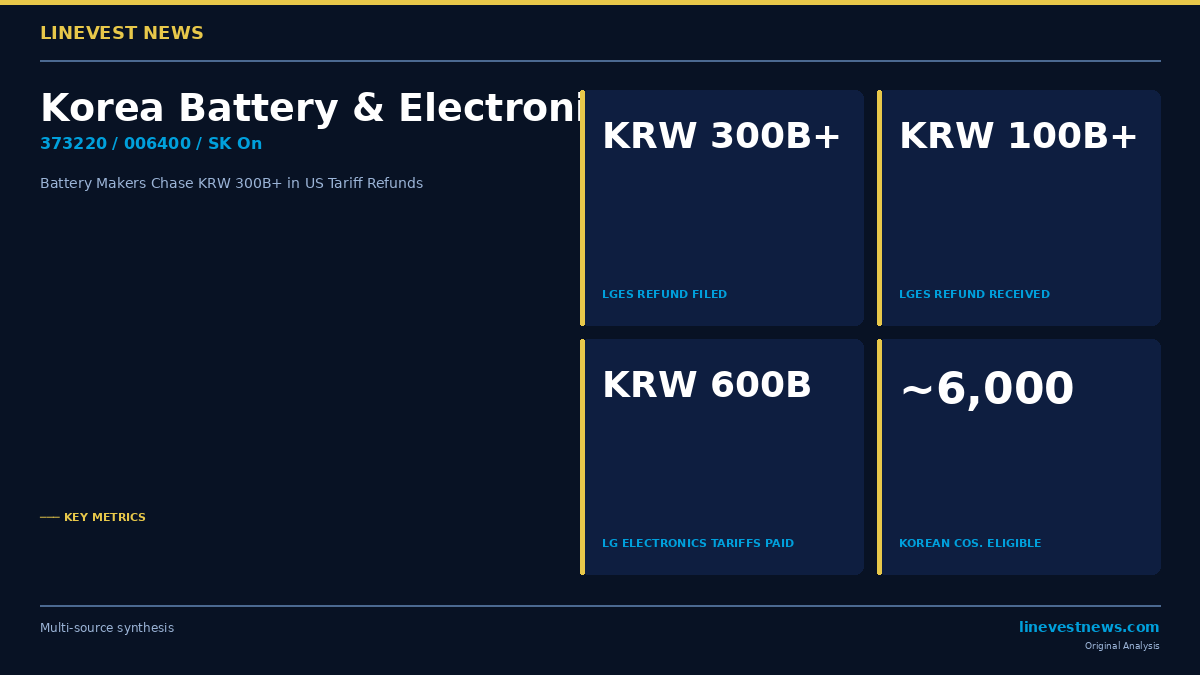
LG Energy Solution has already recovered more than KRW 100 billion of a KRW 300 billion-plus refund claim filed against the United States government, making it the most aggressive Korean company to act on a February 2026 Supreme Court ruling that struck down the Trump administration's sweeping reciprocal tariffs. Samsung SDI has filed its own claim, SK On is finalizing paperwork, and LG Electronics could book as much as KRW 600 billion in refunds as early as the second quarter — yet Hyundai Motor Group is standing conspicuously still, weighing the risk that Washington retaliates against anyone it deems ungrateful for the tariff reprieve.
The Ruling That Opened the Refund Window
On February 20, 2026, the US Supreme Court ruled that the International Emergency Economic Powers Act (IEEPA) does not authorize the president to impose blanket tariffs on trading partners — invalidating the reciprocal tariff regime that the Trump administration imposed on South Korean goods from early 2025. The decision triggered a refund process for duties already paid, with claims formally eligible starting April 2026. Tariffs that remain in force under separate product-specific statutes — covering automobiles, steel, semiconductor materials, and aluminum — are not subject to refund.
Battery Sector Leads the Charge
LG Energy Solution (373220.KS) moved within days of the April window opening. The company filed for KRW 300 billion or more in refunds and has received KRW 100 billion-plus so far — a pace that outstrips any other Korean manufacturer, according to industry sources. LGES's US factories rely heavily on Korean- and third-country-sourced materials; that supply-chain structure meant high reciprocal-tariff exposure but equally large refund eligibility.
Samsung SDI (006400.KS) has submitted its refund application and is awaiting disbursement. SK On, the battery unit of SK Group, is completing its paperwork and plans to file shortly. Enchem, which supplies electrolyte solutions to the battery chain, has already received partial repayments. Korea Tire (000240.KS) has also cleared its initial application.
Daol Investment Securities estimated that LG Electronics (066570.KS) paid roughly KRW 600 billion in reciprocal tariffs across 2024 and 2025 and could see Q2 2026 earnings benefit from refund inflows if claims proceed on schedule.
Hyundai's Strategic Pause
Hyundai Motor (005380.KS) and Kia (000270.KS) are in a different position structurally: their finished vehicles were always subject to product-specific auto tariffs, not reciprocal ones, and therefore fall outside the refund scope. Their parts subsidiaries — Hyundai Mobis (012330.KS) and Hyundai Wia (011210.KS) — do have eligible tariff exposure and are still calculating refund amounts before committing to applications.
The group's caution goes beyond legal calculation. President Trump said in an April CNBC interview that he would "remember" companies that choose to seek refunds — and threatened unspecified retaliation. Hyundai is acutely sensitive to that message: its Georgia and Alabama plants give it a high public profile in the US, and its vehicles are already on the administration's watch list for the 25% auto tariff still in effect.
Industry observers say Hyundai is following what one executive called a "two-track" strategy — group leadership will set the direction, with each subsidiary deciding independently — a formulation that gives the conglomerate room to delay without visibly defying the court's ruling.
Government Takes a Back Seat
The Korean government, which mounted an aggressive diplomatic push in 2025 to limit tariff damage, is this time declining to coordinate. Officials at the Ministry of Trade, Industry and Energy and the Korea Customs Service have told companies that refund claims are their own responsibility, and have not published guidance or compiled statistics on the scale of eligible exposure. Estimates from business groups put the number of eligible Korean exporters at roughly 6,000.
Industry representatives argue the hands-off posture leaves smaller exporters — who lack in-house customs teams capable of navigating complex US procedures — without direction at a moment when procedural errors could forfeit recoverable cash.
What It Means for Earnings
For battery manufacturers, the refunds are a material tailwind arriving at an uncertain moment. LG Energy Solution and Samsung SDI both posted operating losses or compressed margins in the US market in 2025 as tariffs squeezed materials costs. A KRW 100 billion-plus receipt for LGES — equivalent to roughly one-third of its operating loss in its North American business last year — partially offsets accumulated headwinds without requiring incremental revenue. LG Electronics' potential KRW 600 billion benefit is larger in absolute terms and could flip the trajectory of its Home Appliance and Air Solution division's North American performance.
For Hyundai, the strategic cost of abstention is harder to measure. The group's tariff-related earnings impact came primarily through product-specific levies that remain in place regardless of the Supreme Court ruling. Still, Hyundai Mobis and Hyundai Wia's eligible parts exposure could represent a recoverable amount that the group is voluntarily leaving unclaimed — at least until it judges the political climate safer.
Sources: Chosunbiz — 美 관세 환급에 분주한 재계