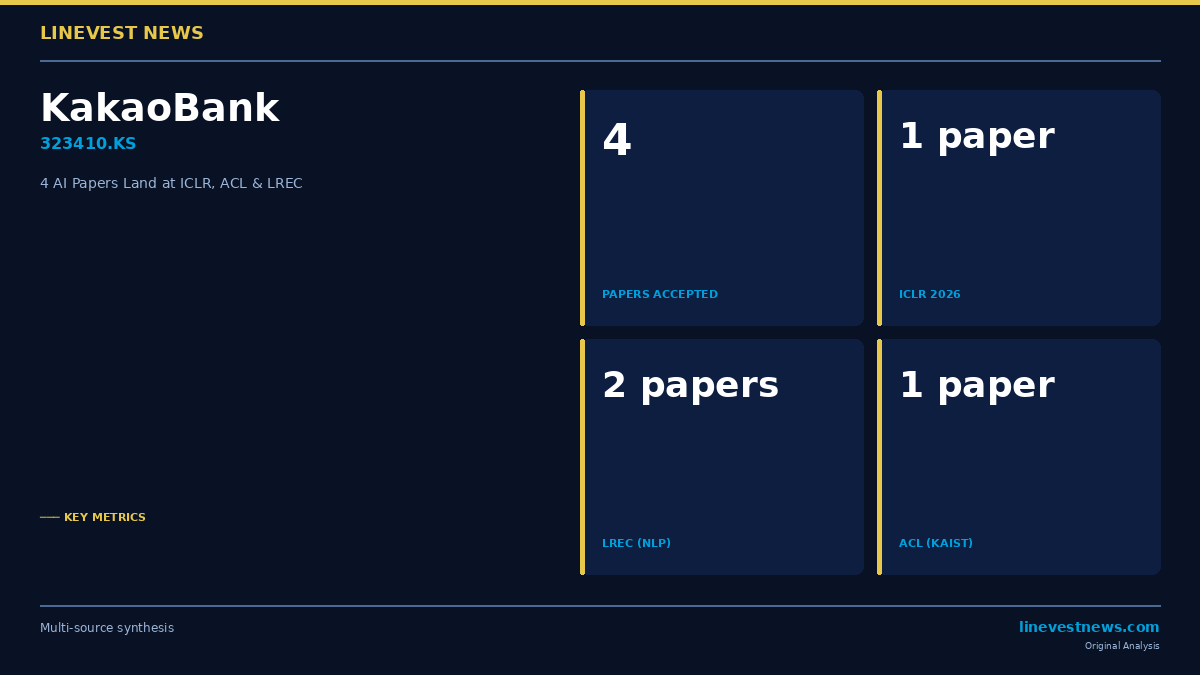
KakaoBank Corp. (323410.KS) said Monday that its in-house Financial Technology Research Institute placed four peer-reviewed papers at leading international AI conferences in the first half of 2026, a run of acceptances that puts the South Korean digital lender alongside academic institutions in the competitive field of large-language-model safety research.
What Was Accepted and Where
ICLR 2026 (April): One paper, presented at the International Conference on Learning Representations — broadly regarded as one of the most selective venues in machine learning — described techniques for detecting prompt-injection and jailbreak attacks directed at generative-AI systems deployed in financial and legal settings. The threat is commercially real: adversarial inputs can cause LLM-based compliance or advisory tools to bypass guardrails and expose sensitive client data or generate misleading guidance.
LREC (May): Two papers appeared at the Language Resources and Evaluation Conference, a leading natural-language-processing forum. Both focused on improving security and factual accuracy in domain-specific financial AI — addressing a recurring criticism that general-purpose models hallucinate figures or miss jurisdictional nuances when applied to banking workflows.
ACL Industry Track (May): The most operationally pointed of the four was co-authored with the Korea Advanced Institute of Science and Technology (KAIST). The paper proposes a structured taxonomy for evaluating AI safety risks in financial environments, categorising failure modes across voice phishing, fraud orchestration and personal-data exfiltration. Acceptance in ACL's industry track — which filters for research with near-term deployment relevance — signals that the framework is positioned for direct integration into KakaoBank's own product pipeline.
Why a Bank Is Writing ML Papers
KakaoBank ended Q1 2026 with roughly 24 million registered customers and approximately KRW 40 trillion in total assets, making it the country's dominant online-only retail bank. Its foray into academic publishing reflects a strategy that treats AI safety as a competitive differentiator rather than a regulatory checkbox.
South Korea's Financial Services Commission has been drafting guidelines for generative-AI use in banking, creating regulatory pressure for banks to demonstrate systematic safety testing. An internally developed, conference-vetted evaluation framework — such as the ACL/KAIST paper — gives KakaoBank an argument that its models have been rigorously audited, which may shorten approval cycles for new AI-assisted products.
The KAIST co-authorship also signals the bank's intent to recruit from top Korean academic programs, an important positioning move in a labour market where AI talent competes against global technology firms.
Investor Angle
The direct revenue impact of four academic papers is negligible in the near term. The longer-run read-through is that KakaoBank is building proprietary AI safety infrastructure that could: (1) reduce liability exposure from AI-assisted mis-selling or data-breach events; (2) lower the cost of regulatory compliance as AI governance rules tighten across Korea and the EU; and (3) differentiate KakaoBank's AI product roadmap from incumbent commercial banks that rely on vendor models without equivalent in-house safety layers.
KakaoBank shares (323410.KS) closed at KRW 27,450 on June 27, near the midpoint of their 52-week range of KRW 23,400–KRW 33,550. The stock trades at roughly 1.2× book value, a premium the market has historically tied to the bank's superior digital-customer-acquisition economics.
Sources: Chosun Biz · Yonhap Economy · ETNews