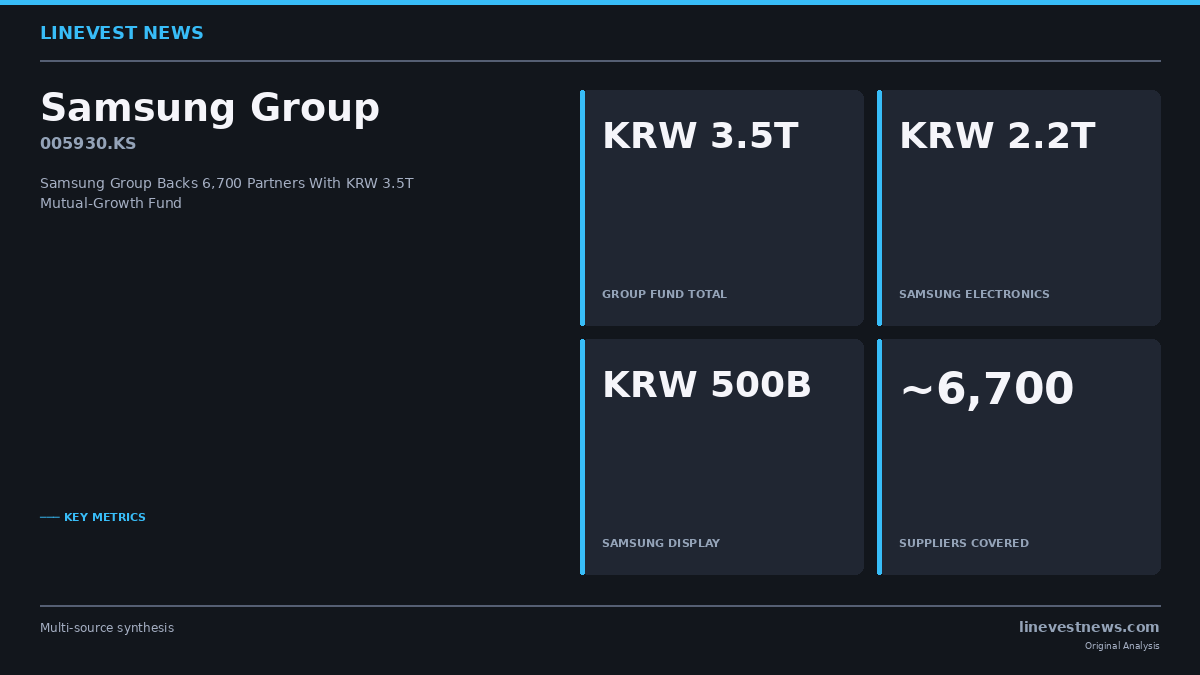
Samsung Group's twelve operating affiliates, led by Samsung Electronics (005930.KS), formally signed mutual-growth cooperative agreements on June 29 covering approximately 6,700 companies across their collective supply chain, backed by a combined KRW 3.5 trillion (approx. USD 2.5 billion) fund earmarked for supplier welfare and ESG upgrades, according to South Korea's Fair Trade Commission.
Fund Breakdown by Affiliate
| Affiliate | Fund Size |
|---|---|
| Samsung Electronics (005930.KS) | KRW 2.2 trillion |
| Samsung Display | KRW 500 billion |
| Samsung Electro-Mechanics (009150.KS) | KRW 110 billion |
| Nine additional Samsung affiliates | Combined balance |
| Group total | KRW 3.5 trillion |
Payment Terms and Cost-Sharing
The pact formalises two long-demanded structural changes in Korea's industrial supply chain. First, Samsung affiliates must settle first-tier supplier invoices within ten days of month-end closing. Second-tier suppliers — small and mid-sized manufacturers one step further down the chain — must be paid within thirty days, tightening the existing default of 60 days common among second-tier payers.
Perhaps more significant is a forward-looking clause on input-cost pass-through: surges in energy bills and statutory minimum-wage increases will be proactively factored into contracted supply prices rather than absorbed by smaller firms as margin compression. This mechanism has historically been one of the sharpest friction points between chaebol anchor companies and their SME suppliers.
Partner companies that meet the mutual-growth standards will receive enhanced scoring on Samsung's annual cooperative-partner evaluations, unlocking faster access to the broader KRW 3.5 trillion fund pool and priority grade upgrades in Samsung's tiered supplier classification system.
Regulatory and Policy Context
South Korea's Fair Trade Commission framed the announcement as a structural imperative, stating that tight supply-chain cooperation is essential for Korea to become a technology-leading nation. The June 29 signing coincides with President Lee Jae-myung's unveiling of the tri-polar mega-project — Samsung's KRW 800 trillion southwestern semiconductor hub plus SK Hynix's parallel commitment in Yongin and Cheongju. FTC officials noted that supply-chain institutional capacity is what converts headline capex into durable industrial competitiveness.
Sectoral Coverage
Samsung Electronics' KRW 2.2 trillion tranche is the single largest commitment and extends across its semiconductor and consumer electronics component network. Samsung Display's KRW 500 billion allocation targets OLED panel and flexible glass suppliers, while Samsung Electro-Mechanics' KRW 110 billion covers its multi-layer ceramic capacitor (MLCC) and camera-module supplier base. The nine additional affiliates — which include Samsung SDI (006400.KS) and Samsung C&T (028260.KS) — extend the programme to energy materials, construction, and logistics supply chains.
For investors watching Korea's semiconductor capex cycle, the supply-chain guarantee structure reduces execution risk: if Samsung's 6,700 partner firms can price in stable payment timelines and cost pass-throughs, the broader ecosystem is better positioned to absorb the accelerated spending commitments announced alongside the mega-project.
Sources: Newsis — Samsung Group 12 affiliates sign mutual growth pact, KRW 3.5T financial support