South Korea's President Lee Jae-myung on Sunday formally unveiled the country's largest-ever private-sector investment programme, anchored by Samsung Electronics (005930.KS) and SK Group (000660.KS), at a nationally televised ceremony that put two of Asia's most powerful corporate chairmen on stage alongside four cabinet ministers.
The Ceremony
At a government policy event titled "Tripolar Mega Projects for a Great Leap" — held at 2 p.m. KST on 29 June — Samsung Chairman Lee Jae-yong and SK Group Chairman Chey Tae-won formally committed to a decade-long buildout spanning semiconductors, AI data centres, advanced displays and biotech. Four ministry heads — Industry, Science & Technology, Climate-Energy and Land & Infrastructure — committed parallel infrastructure support.
The three "tripolar" pillars target absolute competitiveness in semiconductors, physical AI and data centres, areas the administration has designated as decisive for South Korea's position in the emerging AI economy.
Samsung: Up to KRW 1,000 Trillion Across Four Regions
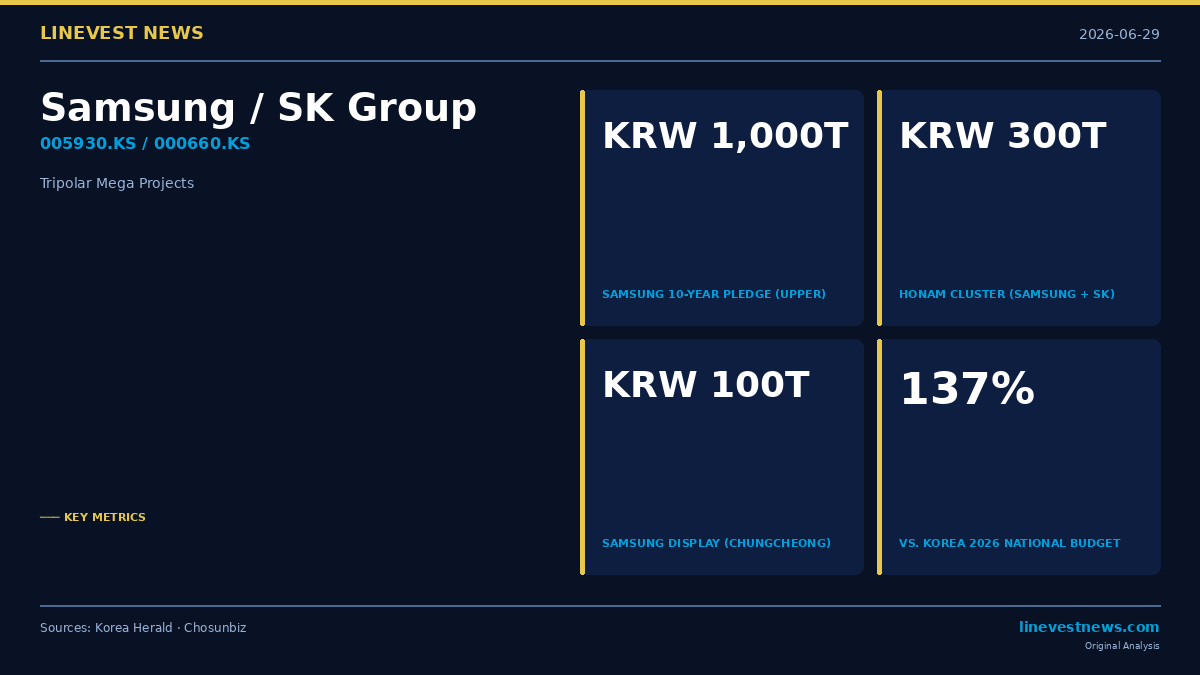
The Samsung group pledge reaches up to KRW 1,000 trillion (approximately USD 651 billion) over 10 years across five segments and four geographic regions — a commitment that, at its upper bound, exceeds South Korea's entire 2026 national budget of KRW 728 trillion and would stand as the largest investment promise ever made by a Korean conglomerate.
| Affiliate | Region | Focus |
|---|---|---|
| Samsung Electronics | Honam (southwest) | Front-end semiconductor fabrication cluster |
| Samsung Display | Chungcheong (central) | OLED and next-gen displays (~KRW 100T over decade) |
| Samsung SDI + Electro-Mechanics | Chungcheong | Battery cells, advanced packaging, substrates |
| Manufacturing AI, capacitors, ESS | Yeongnam (southeast) | Factory automation, energy storage |
| Samsung Biologics | Incheon | Biotech campus expansion |
Chairman Lee described biopharmaceuticals as a potential "second semiconductor" for the group, signalling that the Incheon biotech cluster may see the sharpest proportional ramp-up if demand follows the semiconductor playbook.
The Honam front-end fab presents the most complex challenge: the southwestern region currently lacks the stable large-scale power supply, water-treatment capacity, waste-management infrastructure and deep engineer base that semiconductor fabs require at commercial scale.
SK Group: Honam Cluster and AI Ecosystem
SK Group, which in June confirmed a Nasdaq ADR issuance targeting up to KRW 45.5 trillion to fund its flagship Yongin chip campus, is also committing a major position in the new Honam cluster. Analysts and government briefings point to a combined Samsung-and-SK Honam investment of approximately KRW 300 trillion — a figure that would rank among the largest single-region industrial buildouts globally.
SK separately expanded its K-AI Alliance to 50 member companies at a Silicon Valley event last week, reinforcing the group's parallel bet on software and AI infrastructure alongside its hardware commitments.
Government Infrastructure Pledges
Each of the four participating ministries committed specific support tracks. The Ministry of Trade, Industry and Energy is co-ordinating site permitting. The Ministry of Science and ICT is funding joint research programmes. The Ministry of Climate and Energy has committed to securing a dedicated power and water supply for the Honam fabs — the most critical bottleneck. The Ministry of Land, Infrastructure and Transport is fast-tracking road and logistics connectivity to the planned fab sites.
Political Fault Lines
The investment plan surfaced sharp political divisions. The People Power Party (PPP), the main opposition, labelled the initiative "corporate coercion," with floor spokesperson Kim Tae-gyu saying the government was "using private money to invest in a specific region for a specific voter base." He drew a parallel to the controversial "Yellow Envelope Law," arguing that having already constrained management through labour legislation, the administration was now dictating where companies invest.
President Lee countered on social media that the Honam cluster "is not preferential treatment for a specific region" but a corrective for "double discrimination" that southwestern Korea has faced for decades. The ruling Democratic Party framed the broader plan as economic rebalancing rather than politics.
Market Context
The announcement lands three weeks after South Korea's worst single-day market shock in years: a 9.99% KOSPI plunge on 23 June triggered partly by circuit-breaker activity in leveraged ETFs for Samsung and SK Hynix. Regulators subsequently moved to tighten weekly-options rules for single-stock products on both names.
Sentiment may receive an additional boost from Micron Technology's quarterly results. Better-than-expected Micron earnings have led analysts to upgrade their Samsung Q2 2026 earnings estimates, with one consensus figure pointing to Samsung operating profit of KRW 86 trillion — a year-on-year increase of roughly 1,740%.
Sources: Korea Herald — President Lee Mega Projects · Korea Herald — Samsung Investment Plan · Chosunbiz (Korean)