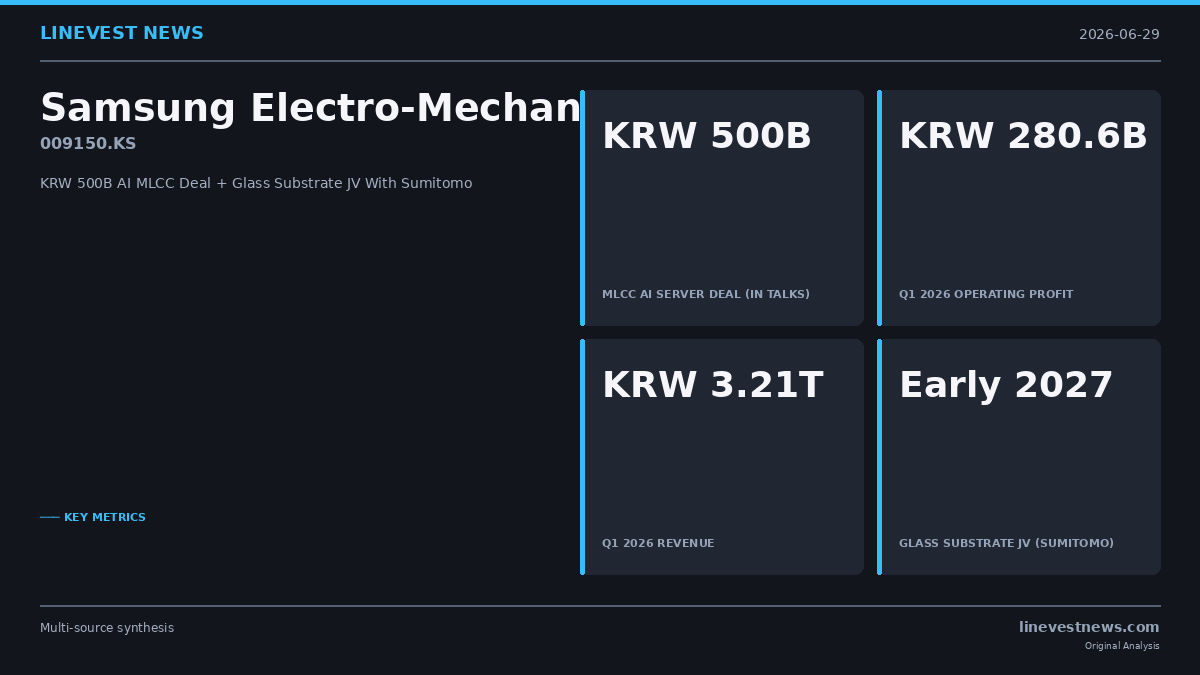
Samsung Electro-Mechanics (009150.KS) is in final-stage talks to supply approximately KRW 500 billion (USD 340 million) worth of multilayer ceramic capacitors (MLCCs) for AI servers to a major US technology company, while separately moving to formally establish a glass substrate joint venture with Japan's Sumitomo Chemical, according to KED Global reporting on June 29.
The prospective MLCC contract — representing roughly 10% of the company's components division annual revenue — is expected to serve one of the large US cloud service providers racing to build out AI data-center infrastructure. Industry observers have pointed to Google, Amazon Web Services, and Meta as the most likely counterparties, though Samsung Electro-Mechanics has not disclosed the customer's identity.
Why AI Servers Drive Outsized MLCC Demand
The deal underscores a structural demand shift that has reshaped SEMCO's order book since late 2025. A single AI server computing board requires between 15,000 and 25,000 MLCCs — a figure that dwarfs smartphone requirements by an order of magnitude. With leading hyperscalers deploying racks containing up to 20 such boards, the component count per installation runs into the hundreds of thousands.
SEMCO reported first-quarter 2026 operating profit of KRW 280.6 billion (+40% year-on-year) on revenue of KRW 3.21 trillion (+17%), both above consensus. The components division — home to its MLCC business — grew 16% to KRW 1.41 trillion, while the package solutions segment, which produces flip-chip ball-grid-array (FC-BGA) substrates for AI accelerators, surged 45% to KRW 725 billion and posted the steepest growth in the portfolio.
The company had already secured a separate KRW 1.557 trillion silicon capacitor supply contract with a US big-tech firm in May 2026, with volume shipments of network-use substrates to a new hyperscaler client beginning in the second quarter.
Glass Substrate Joint Venture Targets Early 2027
Alongside the MLCC talks, SEMCO is finalizing the establishment of a glass substrate JV with Sumitomo Chemical Co., Japan's second-largest chemical producer. The venture will manufacture glass cores — the foundational material for next-generation chip packaging substrates — with production targeted to begin at Dongwoo Fine-Chem's Pyeongtaek site in early 2027. Samsung Electro-Mechanics is expected to hold a majority stake in the new entity.
Glass cores offer lower coefficient of thermal expansion and superior surface flatness relative to conventional ABF (Ajinomoto Build-up Film) resin substrates, enabling the high-density, large-area chip packaging required for AI and high-performance computing chips. SEMCO's move into glass core manufacturing positions it alongside Intel's IGS (Intel Glass Substrates) initiative and Corning's glass substrate program as early movers in what analysts expect to be a multibillion-dollar market segment by 2028–2029.
Market Context
SEMCO shares have appreciated approximately 1,000% from their 2025 lows as the AI component supercycle broadened beyond memory semiconductors into the passive component and substrate supply chain. On June 26, shares added 2% on speculation that US asset manager Roundhill's SEC filing for an "MLCC & Printed Circuit Board (PCB) ETF" could channel fresh institutional inflows into the stock.
The two June 29 developments — a major supply deal in final stages and a concrete JV timeline — reinforce SEMCO's positioning as the highest-leverage Korean equity play on AI server build-out, sitting one tier below the semiconductor fabless and memory names but with significantly lower geopolitical risk exposure.
Sources: KED Global · Korea Herald · Seoul Economic Daily