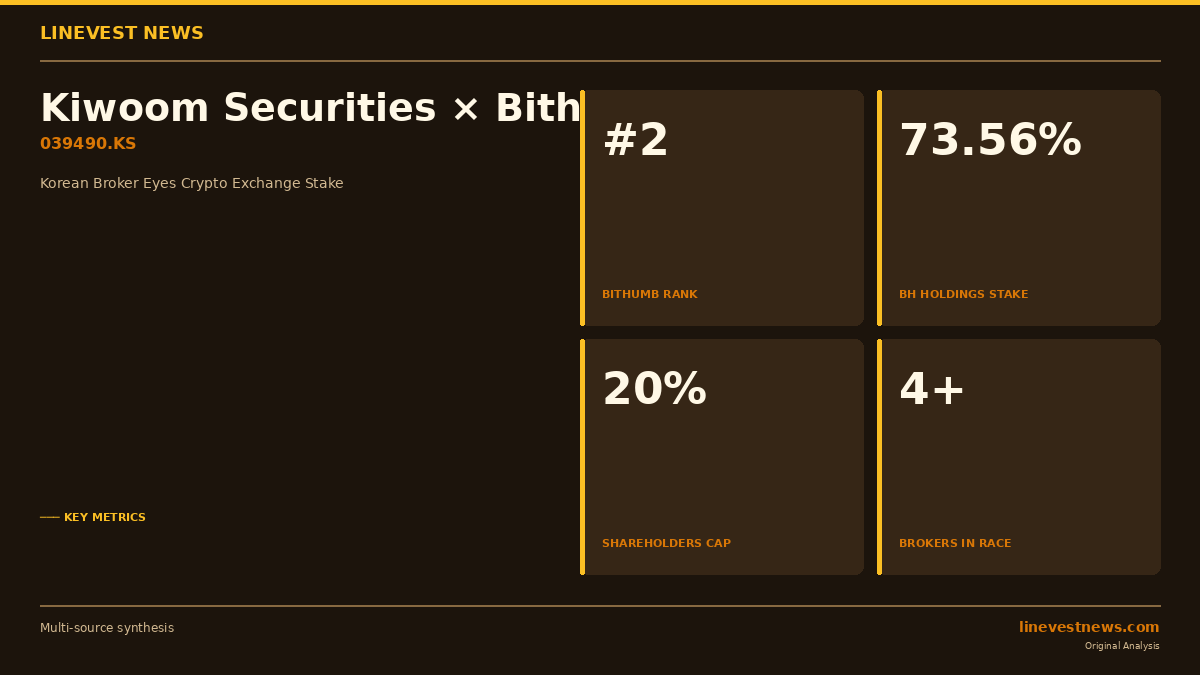
South Korea's Kiwoom Securities (039490.KS) is in discussions to acquire a stake in Bithumb, the country's second-largest cryptocurrency exchange, through a third-party new share issuance, sources in the investment-banking and virtual-asset industry confirmed on Sunday.
The deal, if completed, would make Kiwoom the latest in a string of major Korean brokerages to gain direct ownership in a domestic crypto exchange. Samsung Securities, Mirae Asset Securities, and Korea Investment & Securities have already entered the sector, accelerating a race for digital-asset positioning ahead of imminent regulatory change.
Exact stake percentages and investment amounts remain under negotiation.
Regulatory Pressure Drives the Rush
Two forces are pushing securities firms toward crypto exchanges.
First, the Financial Services Commission (FSC) is advancing Phase 2 virtual-asset legislation that would cap any single major shareholder's stake in a crypto exchange at 20%, with exceptions permitting up to 34% in certain circumstances. Bithumb Holdings, which currently controls 73.56% of Bithumb, would need to shed more than 50 percentage points to comply. Welcoming a strategic investor such as Kiwoom is one route to achieving that reduction.
Second, brokerages view crypto exchange stakes as essential infrastructure for competing in Security Token Offering (STO) and stablecoin markets—both actively being institutionalised under Korean law. For exchanges, partnerships with regulated financials provide access to capital and the internal-control frameworks regulators increasingly demand.
Governance Cleanup and IPO Ambitions
Bithumb has carried longstanding governance liabilities. Founder Lee Jung-hoon's camp, operating through the entity DAA, rose to become the controlling shareholder of Bithumb Holdings, largely resolving a protracted management dispute with another significant holder, Vidend (비덴트). However, Vidend itself is navigating potential delisting from the Korea Exchange on allegations of embezzlement and breach of trust, and has been trying to sell its remaining Bithumb Holdings position. A fresh capital injection via Kiwoom's share purchase would further dilute Vidend's residual influence.
Separately, Bithumb is pursuing a KOSDAQ initial public offering, with Samsung Securities acting as lead underwriter. The company plans a corporate split that separates core exchange operations (remaining under the Bithumb brand) from a new-business entity dubbed "BithumbA," with the goal of crystallising value ahead of a listing. Whether Kiwoom's proposed deal constitutes a pre-IPO strategic investment or a longer-term partnership is a central issue in the negotiations.
Why It Matters for the Broader Market
The Kiwoom-Bithumb talks are a microcosm of South Korea's financial-sector realignment. As digital assets migrate from retail speculation to regulated financial infrastructure, traditional brokerages face mounting pressure to establish direct exchange footholds rather than simply offering crypto exposure through products.
For Kiwoom, already the dominant platform for Korean retail equity and derivatives trading by volume, an ownership stake in Bithumb could deliver data, fee-sharing, and product-development advantages when STO markets open to mainstream investors.
The final size and structure of any deal will turn on how the FSC calibrates the Phase 2 ownership cap. A strict, swift 20% enforcement would compress Bithumb Holdings' options and strengthen Kiwoom's negotiating hand. A more gradual phase-in could allow legacy shareholders—including Vidend—to arrange their own exits first, potentially changing the dynamics.
Sources: Chosun Business