SEOUL, June 29, 2026 — About 2,100 unionized employees at Kakao Corp. and four of its affiliates staged a full-day walkout on Monday, escalating a wage standoff that has pushed the Korean internet giant's stock to a 52-week low even as the company posts record profits.
Log-Off Day: Strike by Another Name
The action — internally called a "Log-off Day" — required participants from Kakao's headquarters, payment arm Kakao Pay, cloud-services unit Kakao Enterprise, IT firm dk techin, and game developer XLGAMES to take simultaneous annual leave and sign out of all internal work platforms, effectively suspending duties for the day.
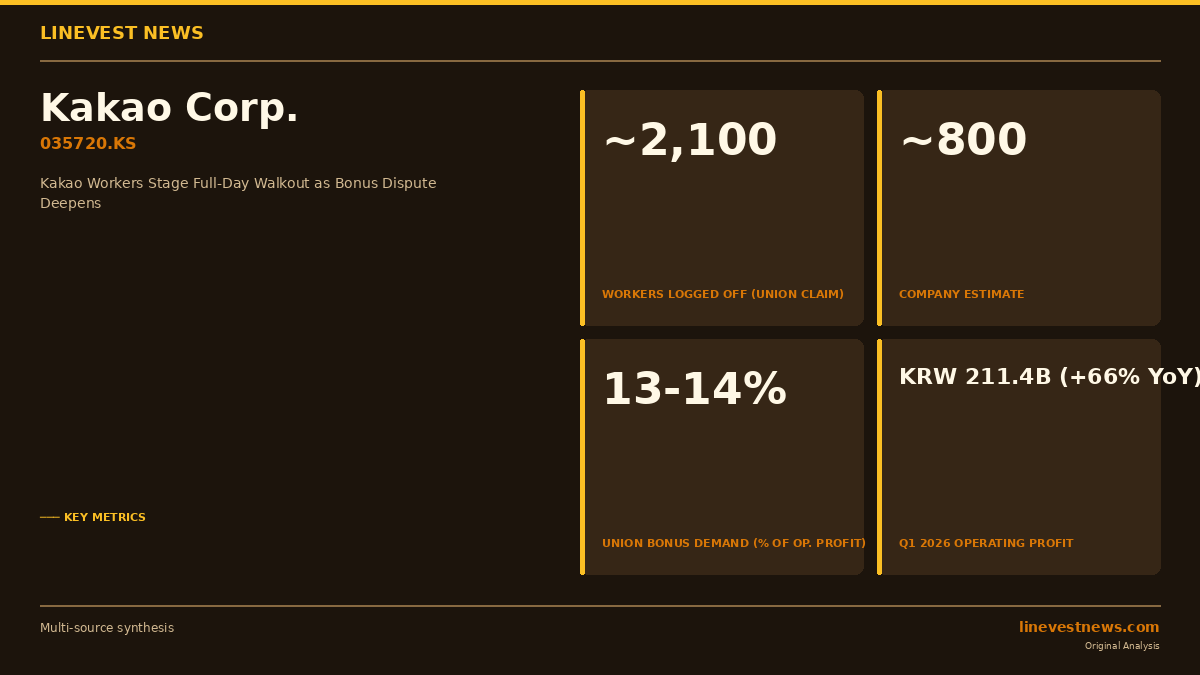
Crew Union, which represents Kakao staff, said approximately 2,100 members took part, representing nearly half of its roughly 5,000-strong membership. Kakao estimated the figure at about 800, with the company arguing that the remainder used scheduled personal leave rather than formally joining the strike.
No major service disruptions were reported. KakaoTalk — Korea's dominant messaging application — and Kakao Pay both ran normally; Kakao said it activated emergency operations teams to maintain continuity.
"Negotiations are underway, but we have yet to reach a level where an agreement can be made," a union representative said.
Second Collective Action in Three Weeks
Monday's walkout follows Kakao's first-ever labor strike on June 10, when roughly 1,500 union members staged a four-hour partial walkout near the company's headquarters in Pangyo, south of Seoul. That action marked the first collective labor protest in the company's 20-year history.
At the center of the dispute are performance bonuses. The union is demanding that Kakao guarantee bonuses equivalent to 13–14% of annual operating profit, and wants restricted stock units — valued at roughly KRW 5 million (USD 3,600) per employee — excluded from those calculations. The union is also seeking greater wage transparency, stronger job-security provisions, and back pay for overtime logged during the recent major overhaul of the KakaoTalk application.
Kakao's management has rejected the bonus formula outright, saying it would impose an excessive financial burden on the company. The standstill has persisted since May, with no date set for the next round of formal talks.
The Kakao Paradox: Record Profits, 52-Week Low
The labor unrest adds a new variable to what market watchers have called the "Kakao paradox." The company posted its highest-ever annual results for 2025 — revenue of KRW 8.10 trillion and operating profit of KRW 732 billion — and then surpassed those figures again in the first quarter of 2026, when quarterly revenue climbed 11% year-on-year to KRW 1.94 trillion and operating profit surged 66% to KRW 211.4 billion, driven largely by cost efficiencies and subsidiary restructuring.
Yet Kakao shares fell to an intraday 52-week low of KRW 32,250 on June 26, even as the broader Korea Composite Stock Price Index was logging all-time highs. The company's market capitalization, now roughly KRW 14 trillion, has contracted from a peak of more than KRW 70 trillion in June 2021.
Analysts say investors broadly accept the cost-cutting gains behind the profit improvements but are skeptical that Kakao has identified a new revenue-growth engine. Management has pointed to an AI-integration strategy centered on embedding artificial-intelligence assistants in KakaoTalk and partnering with global technology firms, yet that plan has not yet produced measurable top-line acceleration.
The union's focus on distributing current profits — rather than helping build future ones — risks deepening that skepticism. The union said it is "evaluating subsequent actions" while continuing negotiations, leaving the dispute's endpoint unclear.
Sources: Korea Times · MK Economy · Yonhap · ETNews · Chosunbiz