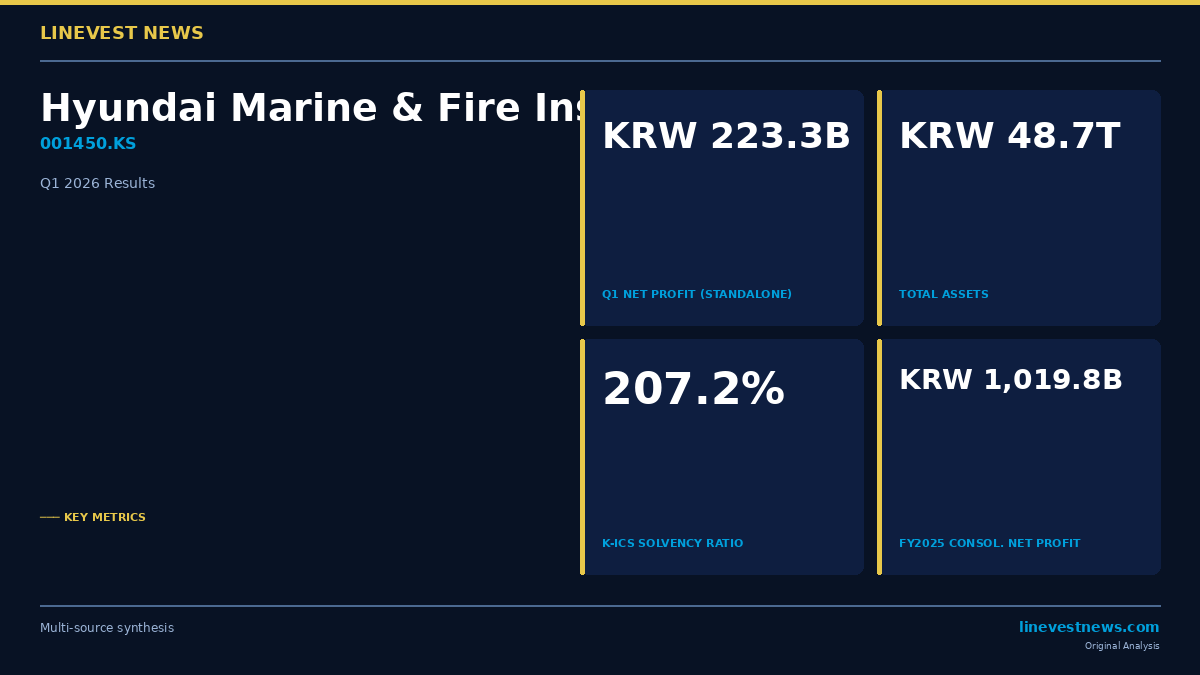
Hyundai Marine & Fire Insurance Co. (현대해상화재보험, 001450.KS), South Korea's third-largest non-life insurer by assets, reported first-quarter 2026 standalone net profit of KRW 223.3 billion (approximately USD 161 million) while its Korea Insurance Capital Standard (K-ICS) solvency ratio improved sharply to 207.2%, continuing a three-year upward trend that began at 157.0% in fiscal 2024.
Q1 2026 Financial Highlights
On a standalone basis for the three months ended March 31, 2026:
| Metric | Q1 2026 |
|---|---|
| Total Operating Revenue | KRW 4.622 trillion |
| Net Profit | KRW 223.3 billion |
| Earnings Per Share | KRW 2,847 |
| Total Assets | KRW 48.66 trillion |
| Investable Assets | KRW 46.11 trillion |
| Shareholders' Equity | KRW 5.285 trillion |
| K-ICS Solvency Ratio | 207.2% |
On a consolidated basis — encompassing subsidiaries including loss adjuster Hyundai Hi-Car, asset manager Hyundai Investment, and IT services unit Hyundai HDS — the company recorded total revenue of KRW 4.670 trillion, operating profit of KRW 324.5 billion, and net profit of KRW 236.4 billion, with diluted EPS of KRW 3,015.
Insurance underwriting revenue on a consolidated basis reached KRW 3,567.5 billion for the quarter.
Solvency Ratio: Three-Year Improvement
The K-ICS solvency ratio — Korea's primary regulatory capital metric for insurers, replacing the prior RBC framework — has risen steadily:
| Period | K-ICS Ratio | Available Capital | Risk Capital |
|---|---|---|---|
| Q1 2026 | 207.2% | KRW 14.5 trillion | KRW 7.0 trillion |
| FY2025 | 190.1% | KRW 14.0 trillion | KRW 7.3 trillion |
| FY2024 | 157.0% | KRW 12.4 trillion | KRW 7.9 trillion |
The 17.1 percentage-point improvement from end-2025 to Q1 2026 reflects a combination of accumulated retained earnings and a reduction in required risk capital, which fell from KRW 7.34 trillion at year-end 2025 to KRW 6.999 trillion at end-March 2026. Korea's Financial Supervisory Service mandates a 100% minimum with a 130% recommended threshold; the company's 207.2% ratio provides a buffer of more than 77 percentage points above the recommendation.
Full-Year 2025 Performance and Earnings Divergence
For fiscal year 2025 (January–December), consolidated net profit reached KRW 1,019.8 billion, a 19.9% increase from KRW 850.5 billion in fiscal 2024. The strong consolidated result was partly offset at the standalone level, where standalone net profit fell to KRW 561.1 billion from KRW 1,030.7 billion in 2024 — a divergence largely attributable to intercompany dividend and investment income treatments under IFRS 17.
Consolidated operating profit edged up to KRW 1,261.0 billion in 2025 from KRW 1,244.1 billion in 2024, indicating stable core underwriting and investment performance year-over-year.
Industry Context
The Korean non-life insurance market grew 4.4% in 2025, with industry-wide gross written premiums reaching KRW 106.2 trillion, up from KRW 101.7 trillion in 2024 (4.2% growth) and KRW 97.6 trillion in 2023 (3.7%). Long-term insurance products continued to drive market expansion. Domestic insurers — led by Samsung Fire & Marine, DB Insurance, Hyundai Marine & Fire, and KB Insurance — collectively held more than 97% of the market.
Hyundai Marine & Fire, ranked 133rd by market capitalisation on KOSPI, maintains a contract retention rate that the company describes as "best-in-class," with 13-month and 25-month policy retention rates of 86.9% and above as of Q1 2026.
Balance Sheet and Capital Structure
Total consolidated assets stood at KRW 49.5 trillion as of March 31, 2026 (end-2025: KRW 50.4 trillion), with the decline reflecting mark-to-market changes in fixed-income holdings under IFRS 17/9. Consolidated insurance contract liabilities were KRW 32.86 trillion, and investment contract liabilities KRW 4.36 trillion.
The company's investable asset base of KRW 46.1 trillion (standalone) is allocated primarily across government and corporate bonds (상각후원가측정금융자산 KRW 11.3 trillion consolidated) and FVOCI securities (KRW 24.5 trillion), supporting an investment-led income model within Korea's persistently low-volatility rate environment.
Sources: DART Quarterly Report – Hyundai Marine & Fire Insurance Q1 2026 (No. 20260515) · Korea Financial Supervisory Service K-ICS Framework · Korea Non-Life Insurance Association 2025 industry statistics
"