Binance, the world's largest cryptocurrency exchange by volume, is offering Korean retail investors leveraged derivative products tied to Samsung Electronics, SK Hynix, and Hyundai Motor at multiples that are flatly illegal on domestic regulated markets — exposing a widening regulatory blind spot that Korean financial authorities acknowledge they cannot directly police.
What Binance Is Selling
The offshore platform lists perpetual futures contracts denominated in Tether (USDT) against three of Korea's most actively traded blue-chips:
| Contract | Max Leverage | Volume (Jun 2–26) |
|---|---|---|
| SAMSUNGUSDT | 50x | Not disclosed |
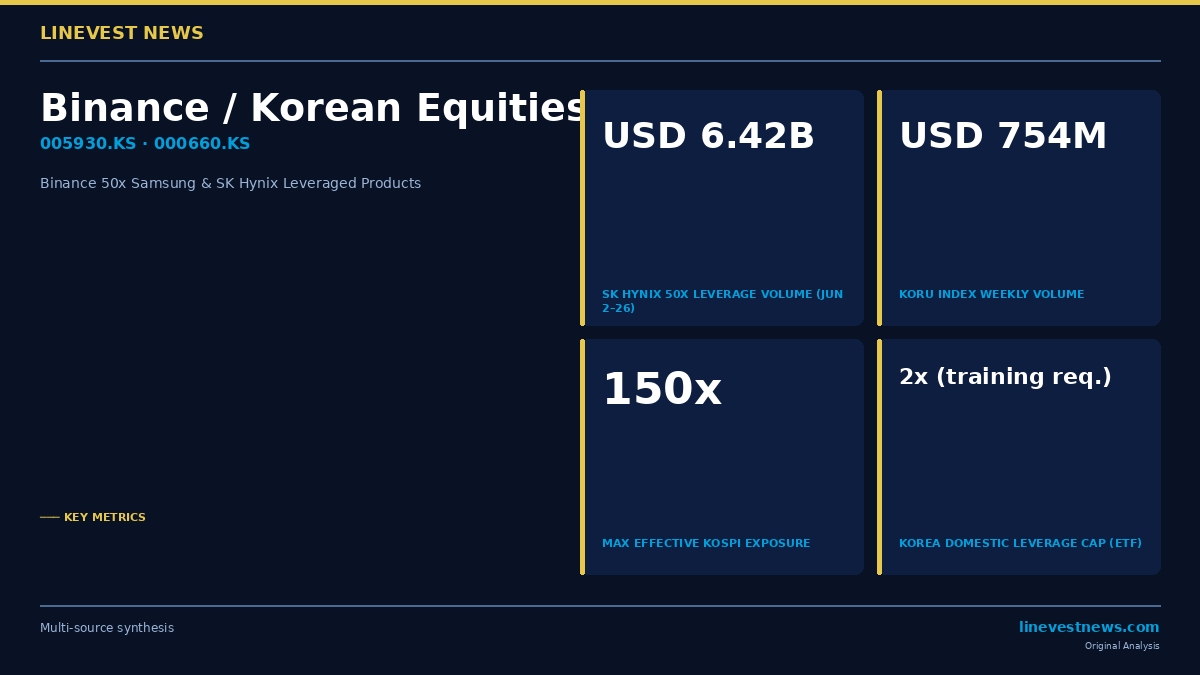
| SKHYNIXUSDT | 50x (raised from 20x) | USD 6.42B (KRW 9.86T) |
| HYUNDAIUSDT | 20x | Not disclosed |
A fourth product, KORUUSDT, tracks KORU — a US-listed 3x leveraged Kospi ETF — and adds another layer of leverage on top. Combined, a position in KORUUSDT can carry the equivalent of 150x daily exposure to the Kospi index. Weekly volume on that contract reached USD 754.4M (KRW 1.16T) in the most recent period tracked.
The Domestic Contrast
Under Korean capital market rules, retail investors must complete mandatory financial-literacy training before they are permitted to trade even a 2x leveraged ETF. Products at 50x leverage do not exist on any FSC-regulated exchange in Korea. A Korean Financial Services Commission official noted the asymmetry plainly: "No comparable safeguards exist on Binance."
How Investors Route Around the Gap
Because Binance does not accept Korean won directly, domestic investors convert KRW to Tether through licensed Korean crypto exchanges — primarily Upbit and Bithumb — before transferring funds offshore. The route is frictionless: a retail investor can be fully exposed to 50x leveraged Samsung futures within minutes of starting with Korean won in a domestic bank account.
Spillover Risk for KOSPI
Market analysts flag a systemic risk that regulators say they are monitoring. If a sharp price movement forces mass liquidations in SKHYNIXUSDT positions — where aggregate open interest has reached the billions — the resulting secondary selling in actual SK Hynix shares on KOSPI could amplify volatility for all participants, including domestic pension funds and foreign institutional investors who have no position in the Binance products.
The concern is not hypothetical: SK Hynix shares fell more than 2% in one session last week as global risk appetite shifted, and SKHYNIXUSDT contract volume spiked simultaneously, according to data reviewed by Korea Herald.
Regulatory Response
Korean financial regulators currently have no direct authority over offshore cryptocurrency derivatives platforms. Domestic crypto exchanges (Upbit, Bithumb, Coinone, Korbit, Gopax) are subject to the Act on Reporting and Using Specified Financial Transaction Information, but that framework covers domestic AML/KYC obligations, not the derivative products offered by foreign platforms to which Korean investors send funds.
The Financial Services Commission has indicated it is studying whether the fiat on-ramp — the KRW-to-USDT conversion at licensed domestic exchanges — could serve as a regulatory choke point. No formal measures have been announced.
Key Numbers
- USD 6.42B — SK Hynix leveraged derivatives traded on Binance, June 2–26
- USD 754.4M — KORU/Kospi index derivative weekly volume
- 50x — maximum leverage on Samsung and SK Hynix contracts
- 150x — effective Kospi exposure via 3x-embedded KORUUSDT at max leverage
- 2x — Korea's domestic leverage cap for retail ETF products (requires training)
Sources: Korea Herald · Financial Services Commission — Leveraged ETF Retail Rules
"