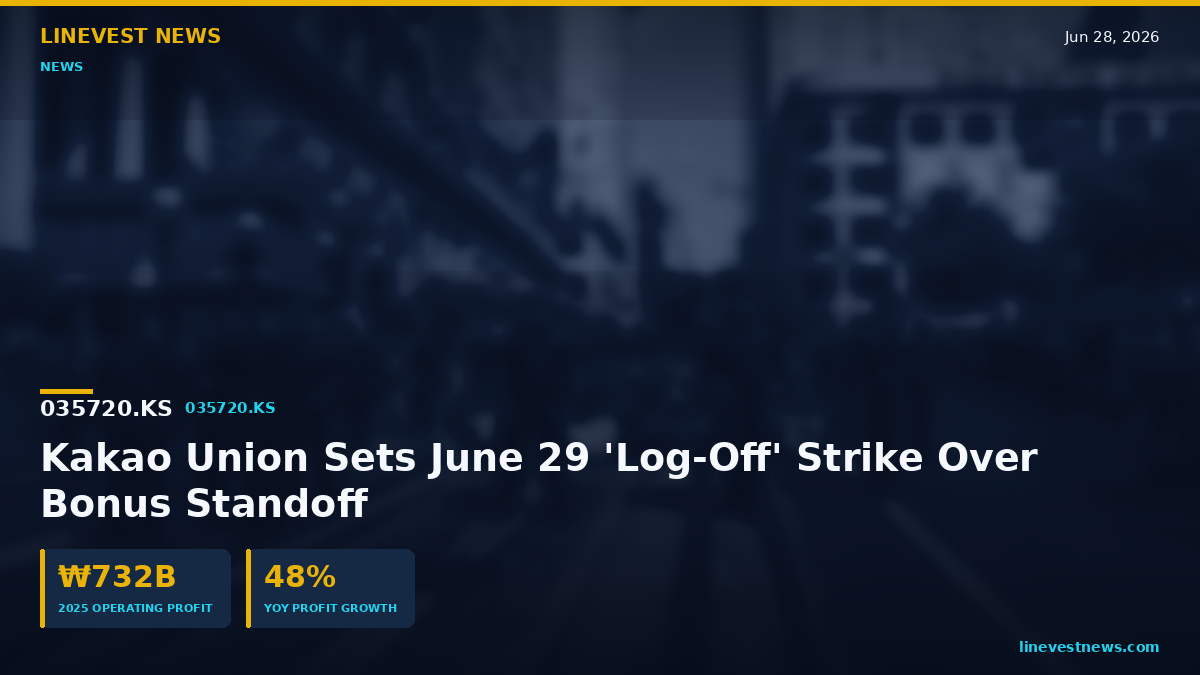
Kakao (035720.KS), the operator of KakaoTalk — South Korea's dominant mobile messenger — faces a fresh escalation of the first labor conflict in its history. Its Crew Union said members will stage a company-wide "Log-Off Day" on June 29, collectively refusing work in what the union calls effectively a full-day strike, after talks over performance pay collapsed, according to Yonhap and The Elec.
For a global investor, the question is narrow: how much money and operational risk is actually at stake? On both counts the immediate exposure looks contained — but the dispute is widening across Kakao's affiliates with no clear resolution date.
The money in dispute is small against record profit
The fight centers on how Kakao's performance bonus is calculated. Crew Union — the Kakao chapter of the Korean Chemical, Textile, Food and Allied Industries Workers' Union, with roughly 5,000 members across the parent and affiliates — wants the bonus pegged at 13–15% of operating profit, while management has offered about 10.5%, The Korea Times reported.
A second sticking point is restricted stock units (RSUs) worth about ₩5 million ($3,650) per employee a year: the union wants them counted separately, while management wants them folded into a combined package of roughly ₩10 million ($7,300), per The Elec.
The financial gap is modest relative to Kakao's scale. The company posted record 2025 operating profit of ₩732 billion ($534 million), up 48% year on year, on revenue that topped ₩8 trillion for the first time at ₩8.10 trillion ($5.9 billion), according to Seoul Economic Daily and Telecompaper. A 2.5-percentage-point gap between the two bonus positions implies on the order of ₩18 billion ($13 million) if applied to that profit base — though neither side has specified which entity's operating profit the formula would use. Operating momentum favors management: Q1 2026 operating profit jumped 66% to ₩211.4 billion ($154 million), an all-time first-quarter high, per Pickool.
Operational risk is about coordination, not outages
The June 29 action is a leave-and-refuse-work protest rather than a systems shutdown, and the roughly 5,000 union members are a minority of Kakao's total workforce. That limits the threat to KakaoTalk's core service, which underpins the high-margin TalkBiz advertising business.
The relevant precedent sits entirely within this dispute: on June 10, 2026, the union held the first strike in Kakao's history — a five-hour partial walkout from 10 a.m. to 3 p.m. drawing an estimated 1,500–2,000 workers from Kakao, Kakao Pay, Kakao Enterprise, DK Techin and XL Games, plus an 800-person sit-in and march, The Korea Times and Asia Business Daily reported. That action produced no deal; the June 29 escalation is the result.
What to watch
Mediation has failed twice, and negotiations resumed around June 19 amid a leadership gap — CEO Chung Shin-a and founder Kim Beom-su have said little publicly, and Chief Product Officer Hong Min-taek departed unexpectedly, The Elec reported. The next concrete signals are whether the resumed talks produce a settlement around the June 29 action, and Kakao's Q2 2026 results, due in early August, which will show whether the standoff is denting the cost line as the company pushes its AI "Agent Commerce" strategy.
This article is for informational purposes only and does not constitute investment advice.
Sources: Yonhap News · The Elec · Korea Times · Seoul Economic Daily · Asia Business Daily