Samsung Biologics Co. (207940.KS), South Korea's largest contract drug manufacturer, moved beyond its manufacturing-first identity at BIO USA 2026 in San Diego this week, presenting four next-generation drug delivery and production platforms it plans to commercialize through technology licensing deals — a strategic pivot that could reshape its revenue mix as global CDMO competition intensifies.
The Announcement
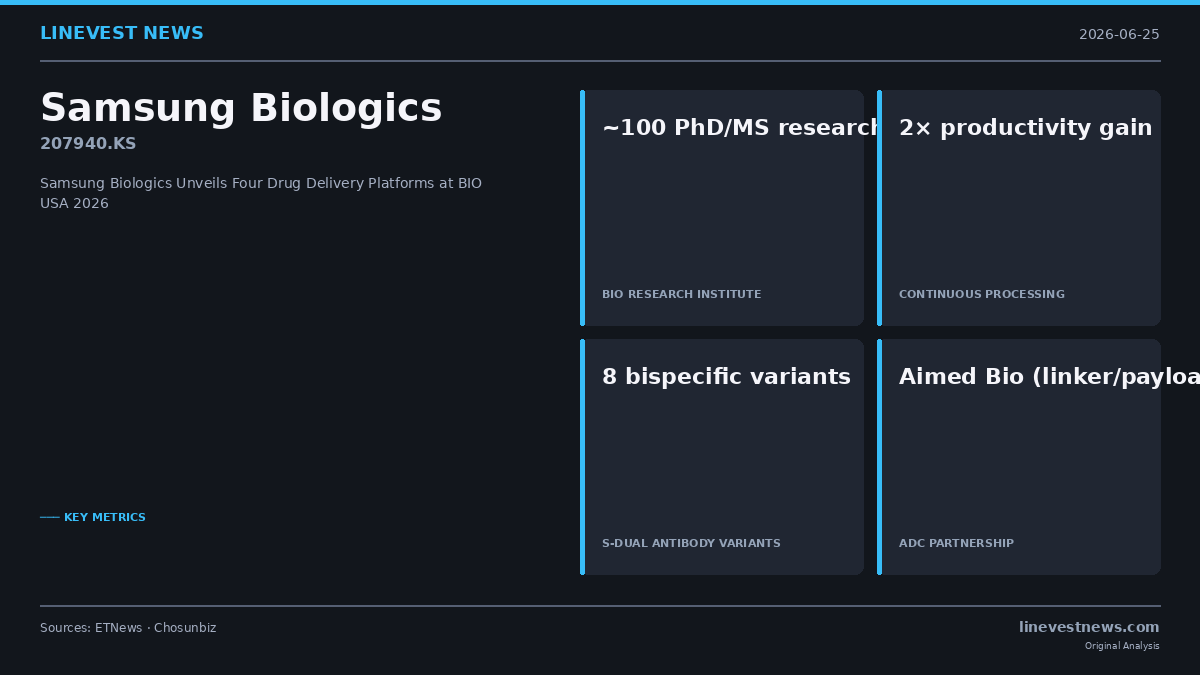
At the conference — the industry's largest gathering for biotech partnerships, held June 23–26 — Samsung Biologics unveiled the ambitions of its Bio Research Institute, a roughly 100-person unit of PhD and Master's-level scientists established in July 2022 across seven research disciplines.
Park Jung-nam, vice president and head of the Bio Research Institute, said the company plans to generate new revenue streams by licensing platform technologies to drug developers, not just by manufacturing their compounds. "Competing CDMOs also provide platform technologies to drug developers," Park said. "We'll drive future growth by resolving technical challenges through platforms."
The four platforms spotlighted:
Continuous Processing: Samsung's system achieves double the productivity of existing continuous manufacturing methods, while its hybrid architecture ensures compatibility with conventional batch processes — a key selling point for clients unwilling to overhaul established production lines.
S-Dual Antibody Platform: A proprietary bispecific antibody architecture that stabilizes the molecule's structure compared with traditional methods, yielding eight viable variants from a single engineering campaign. The platform has shown efficacy in gastric and breast cancer mouse models, giving it a near-term clinical pathway.
ADC (Antibody–Drug Conjugate) Technology: Developed in collaboration with domestic biotech Aimed Bio, the program focuses on novel payload and linker chemistry — the most technically challenging elements of ADC construction and among the fastest-growing segments of the global oncology market.
BBB Shuttle Platform: Designed to ferry therapeutics across the blood-brain barrier, which has long frustrated CNS drug development. The platform addresses a structural market gap that major pharma has struggled to solve.
Why It Matters for Investors
Samsung Biologics is already the world's largest biopharmaceutical contract manufacturer by capacity, with four plants at its Incheon campus producing more than 600,000 liters annually. Its existing client roster spans Pfizer, Moderna, AstraZeneca, and dozens of global biopharma companies.
The platform strategy represents a significant revenue diversification play. CDMO margins — while healthy — are structurally tied to utilization rates and client pipeline timelines. Technology licensing and co-development fees, by contrast, tend to be higher-margin and more predictable, de-linking top-line growth from manufacturing throughput.
The move also puts Samsung Biologics directly in competition with platform-heavy CDMOs such as Lonza, Wuxi Biologics, and domestic rival Celltrion, all of which have been accelerating proprietary technology programs as the global biologics outsourcing market approaches USD 70 billion by 2030.
For KOSPI investors, the platform pivot matters for two reasons. First, it could raise Samsung Biologics' valuation multiple if recurring licensing fees begin contributing meaningfully to earnings. Second, the ADC collaboration with Aimed Bio represents an early-stage domestic ecosystem bet — a signal that Samsung Biologics is prepared to co-invest in Korean biotech discovery alongside its manufacturing scale.
The company also disclosed plans to develop mRNA, CAR-T, and AAV manufacturing platforms internally, with Samsung Life Sciences — the group's dedicated biotech venture arm — expected to provide early technology sourcing. These three modalities account for some of the fastest-growing segments in next-generation biologics manufacturing.
Samsung Biologics did not disclose licensing revenue targets or specific partnership timelines at BIO USA, leaving the financial magnitude of the platform push uncertain. Nonetheless, the conference presentation marks the company's clearest public articulation yet of a strategy that extends beyond contract manufacturing — and toward becoming a technology originator in its own right.
Sources: ETNews, Chosunbiz