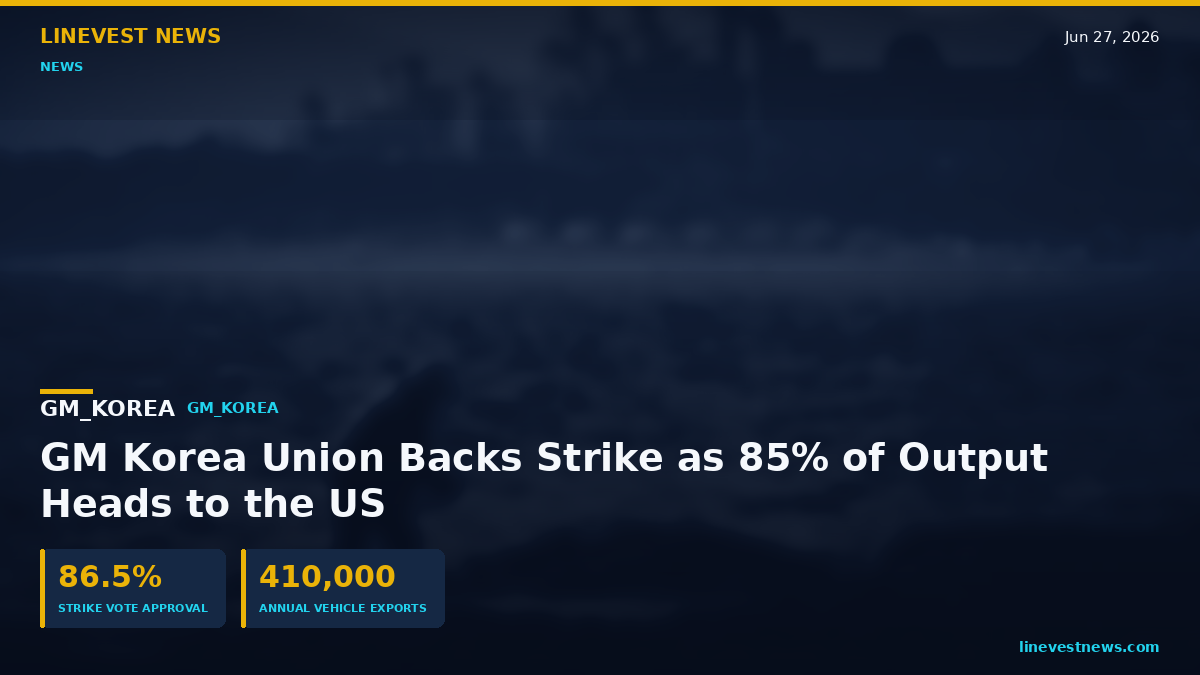
GM Korea, the South Korean manufacturing arm of General Motors (NYSE: GM), saw its labor union authorize a walkout by 86.5% — the highest vote share on record according to The Korea Times, with The Korea Herald placing the figure slightly higher at 88.2% — after nine rounds of wage talks collapsed. The number that makes this a board-level problem rather than a local pay dispute is geographic: GM Korea exports roughly 410,000 vehicles a year, and about 85% of them head to the United States (The Korea Herald).
The exposure
Apply that mix and roughly 348,500 US-bound units a year (410,000 × 85%) ride on assembly lines whose workforce has just authorized industrial action. GM Korea builds these vehicles — led by the Chevrolet Trax and Trailblazer crossovers — mainly at its Bupyeong plant in Incheon and a second assembly site in Changwon. The unit is also absorbing the full cost of the US auto tariff itself rather than passing it to parent GM or to customers, which is the backdrop the union cites for management's reluctance on pay (The Korea Times).
The squeeze already on the books
That tariff burden is visible in the financials. GM Korea's 2025 operating profit fell about 64% year over year to roughly ₩489.8 billion (about $358 million at ₩1,370/$), down from around ₩1.36 trillion ($993 million) the prior year (The Korea Times). The relevant US Section 232 auto tariff was cut from 25% to 15%, effective November 1, 2025, under the US–Korea Strategic Trade and Investment Deal (S&P Global Mobility) — so even after relief, a 15% levy on an export book that is overwhelmingly US-facing remains a direct drag on the unit GM Korea operates.
What the union is asking, and what is blocking a deal
The union represents about 6,851 members (The Korea Times; The Korea Herald). Its demands include a monthly base-pay increase of ₩141,300 (about $103) and a performance bonus of ₩41.36 million (about $30,200) per worker (The Korea Herald). The harder obstacle is not the wage line but an asset dispute: the union opposes management's plan to sell GM Korea's nationwide service centers and unused facilities at the Bupyeong site, and has demanded withdrawal of that sale plan as a precondition for resuming wage negotiations (The Korea Herald). No strike date had been set as of the reports.
Precedent
The last time GM and its Korean union reached this level of confrontation, the outcome was structural. In February 2018, GM moved to close its Gunsan plant, eliminating about 2,000 direct jobs as part of a restructuring of the loss-making Korean operation (GM Authority). Historically the union has favored partial strikes to limit production damage rather than full stoppages, which is the pattern a New York or London desk would weigh against the unusually high 86.5% authorization this time.
The open question
Two data points will show whether this escalates. The first is whether the union sets and executes an actual walkout date, versus using the mandate as negotiating leverage. The second is the broader Korean auto-labor cycle: "If Hyundai Motor's union decides to go on a strike, the chances for GM Korea's unionized workers to follow in their footsteps will increase," an auto industry official told The Korea Times. With GM having instructed the Korean plants toward full-capacity output — a 500,000-unit target for 2026 (just-auto) — any sustained stoppage would collide directly with that production plan.
This article is for informational purposes only and does not constitute investment advice. Figures are drawn from the cited reports; currency conversions use an approximate rate of ₩1,370 per US dollar unless a source specifies otherwise.