Samsung Electronics (005930.KS) and SK Hynix (000660.KS) face a new test of their most prized customer relationship after Apple Inc. lobbied the Trump administration for approval to source memory chips from ChangXin Memory Technologies (CXMT) — China's largest DRAM producer and a company listed on the Pentagon's military-linked blacklist — the Financial Times reported Saturday.
Apple first approached the Commerce Department more than a month ago, seeking assurances that CXMT will not be added to the far more restrictive Entity List. Under current rules, CXMT's 1260H designation — categorising it as a company with alleged ties to the People's Liberation Army — does not bar commercial transactions. Apple chief executive Tim Cook is reported to have said "everything needs to be on the table" regarding alternative chip sourcing.
Why Apple Is Moving Now
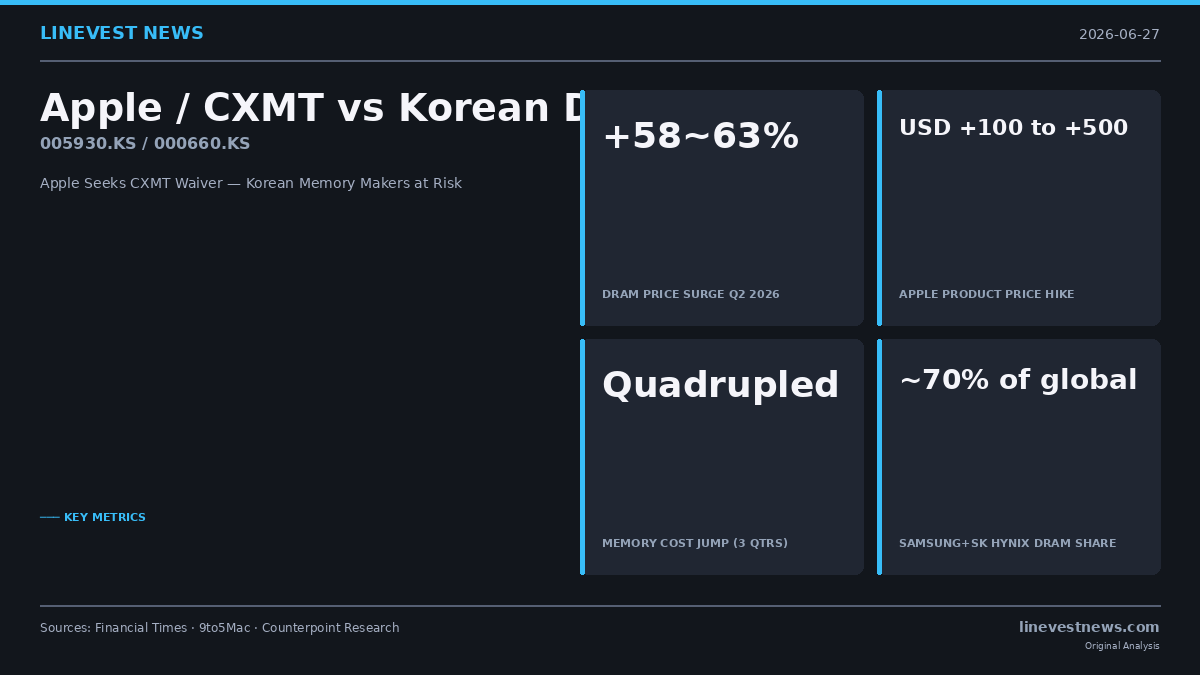
The immediate trigger is a memory-cost crisis. DRAM contract prices surged +58% to +63% in Q2 2026, with Counterpoint Research estimating memory costs quadrupled over the three preceding quarters. The root cause: Samsung, SK Hynix, and Micron have collectively redirected manufacturing capacity from commodity DRAM to high-bandwidth memory (HBM) chips demanded by AI data-centre accelerators, creating a severe shortage in the consumer DRAM market that supplies MacBooks, iPhones, and iPads.
Apple raised prices across its Mac, iPad, and home device lineups on June 25, with increases ranging from USD 100 to USD 500 per product. The MacBook Air 13-inch climbed from USD 1,099 to USD 1,299 (+USD 200 / +18%). "We can no longer absorb the increased costs," the company signalled.
Korea's Exposure
Samsung Electronics and SK Hynix together control roughly ~70% of global DRAM output. Apple has historically relied on both Korean firms — alongside U.S.-based Micron — for commodity DDR5 used in consumer devices, giving the Korean duo significant revenue exposure to Apple's procurement cycles.
CXMT has already been supplying DDR5 memory to Western hardware brands including Corsair, at prices that undercut the Korean-U.S. oligopoly. A White House green light for Apple would represent the first time a premium-tier device maker formally diversifies away from the incumbent three-vendor structure, potentially compressing consumer DRAM margins for Korean producers at precisely the moment they need cash flow to fund HBM capacity expansion.
Qualification cycles for new memory suppliers typically run 12–18 months, meaning near-term volume displacement is limited. But the strategic signal — that Apple sees CXMT as a credible fourth supplier — could accelerate pricing pressure across the commodity DRAM segment.
Regulatory Outlook
CXMT's regulatory status remains ambiguous. Reuters separately reported that CXMT, DeepSeek, and more than 100 other Chinese companies completed the interagency review process but have not yet appeared on the published Entity List — a deliberate hold by the Trump administration. A final decision on Apple's request would require coordination across the Commerce Department, the National Security Council, and the Pentagon, whose own 1260H listing underscores ongoing security concerns about the company.
CXMT's technology gap versus Samsung and SK Hynix remains meaningful at the leading edge (HBM, EUV-based nodes), but for DDR5 commodity memory — the target of Apple's interest — analysts estimate CXMT has closed to within approximately one process node of the incumbents.
Sources: Financial Times · 9to5Mac · The Next Web · Bloomberg · Counterpoint Research