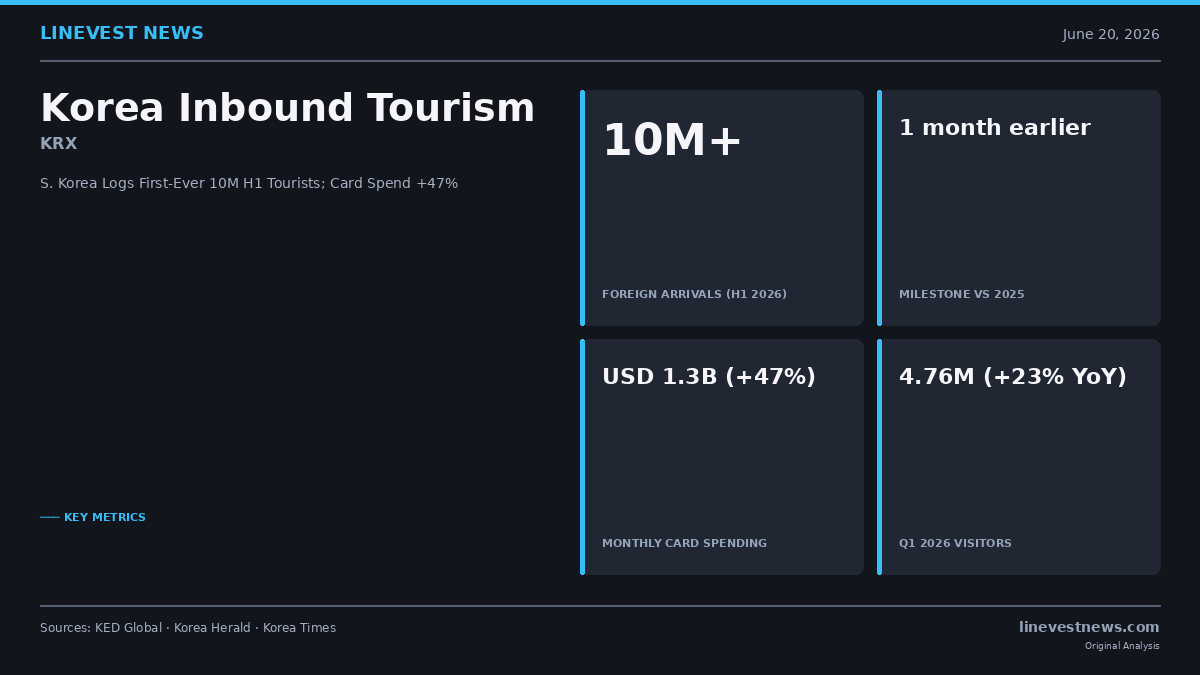
South Korea crossed the 10-million foreign-visitor mark on June 20, 2026—the first time in history the threshold was cleared before the end of the first half of any year. The milestone arrived roughly one month ahead of 2025, when the same benchmark was reached in mid-July, underscoring an acceleration in inbound momentum that is reshaping the country's consumer and hospitality sectors.
The Ministry of Culture, Sports and Tourism confirmed the figure on Thursday, citing cumulative arrival data from immigration authorities. China and Japan accounted for the largest share of arrivals, with Chinese visitors reaching 560,000 in May alone, followed by 360,000 Japanese and 210,000 American tourists. First-quarter inflows hit a record 4.76 million—up 23% year-on-year—while May's 1.95 million entries represented a 19.4% increase from the prior year.
Spending surge lifts retail and duty-free
The visitor influx is translating directly into consumer spending. Foreign credit card transactions hit a monthly record of USD 1.3 billion, up 47% from a year earlier. Tourism industry observers noted that the spending profile is shifting toward premium retail: high-end department stores, K-beauty chains, dermatology clinics, and fashion flagships are capturing disproportionate wallet share.
Department store groups operating flagship properties in Seoul's prime corridors are among the clearest beneficiaries. The Hyundai Seoul (operated by Hyundai Department Store, 069960.KS), Lotte Department, and Shinsegae (004170.KS) have all reported higher foot traffic from foreign visitors. CJ Olive Young beauty stores and Daiso discount outlets are also frequently cited as high-traffic destinations for Chinese and Southeast Asian tourists.
Duty-free operators, which rely heavily on inbound Chinese group tours and individual travelers, stand to see material revenue recovery. Hotel Shilla (008770.KS), which operates both premium hotels and one of Korea's largest duty-free networks at Incheon International Airport and downtown Seoul, is a direct proxy for the trend.
Incheon Airport on pace for record year
Incheon International Airport—a government-owned corporation and one of Asia's busiest international hubs—processed 19.78 million passengers in Q1 2026, a 7% year-on-year increase and the highest first-quarter volume in 16 years. The airport recorded 74.07 million total passengers in 2025; management has indicated that 2026 is on course to surpass that level.
Aviation demand is also supporting domestic flag carrier Korean Air (003490.KS), which has expanded long-haul and intra-Asia frequencies to capture rebounding inbound flows. Budget operator Jeju Air (089590.KS) is likewise benefiting from higher load factors on popular China-Korea short-haul routes.
Full-year target: 22 million
The Korea Culture and Tourism Institute (KCTI) projects approximately 22 million foreign arrivals for full-year 2026, a figure that would establish a new all-time annual record. Korea received roughly 17.5 million international visitors in 2024. If KCTI's forecast proves accurate, Korea's inbound tourism sector would expand by more than 25% in two years, reaching a USD 22 billion annual spending economy according to industry estimates.
The surge is underpinned by multiple structural tailwinds: the global popularity of Korean pop culture (K-drama, K-pop), the easing of remaining COVID-era protocols, the won's relative weakness against the dollar and yen, and direct air route expansion from secondary Chinese cities. The K-beauty treatment tourism segment—medical aesthetics, dermatology, and wellness—has emerged as a particularly high-value category, attracting visitors willing to combine leisure with elective medical procedures.
Investment implications
For equity investors, the tourism acceleration opens several plays alongside the pure hospitality proxies. AmorePacific (090430.KS) and LG H&H (051900.KS), Korea's leading cosmetics groups, benefit from both higher domestic tourist volumes and rising brand visibility among first-time Korean visitors who subsequently become repeat buyers in their home countries. Korean Air and Jeju Air gain from higher load factors on popular regional routes.
The 47% card-spending growth suggests the tourism recovery is high-quality rather than purely volume-driven—average spend per visitor is rising, which is particularly positive for premium retail operators and five-star hospitality groups. Whether the full-year 22-million projection proves achievable will depend partly on whether China continues to relax group-tour restrictions and whether geopolitical headwinds between Seoul and Beijing remain contained.
Sources: Korea Ministry of Culture, Sports and Tourism; Korea Culture and Tourism Institute (KCTI); KED Global (June 25, 2026); Korea Herald (June 24, 2026); Korea Times (June 24, 2026).