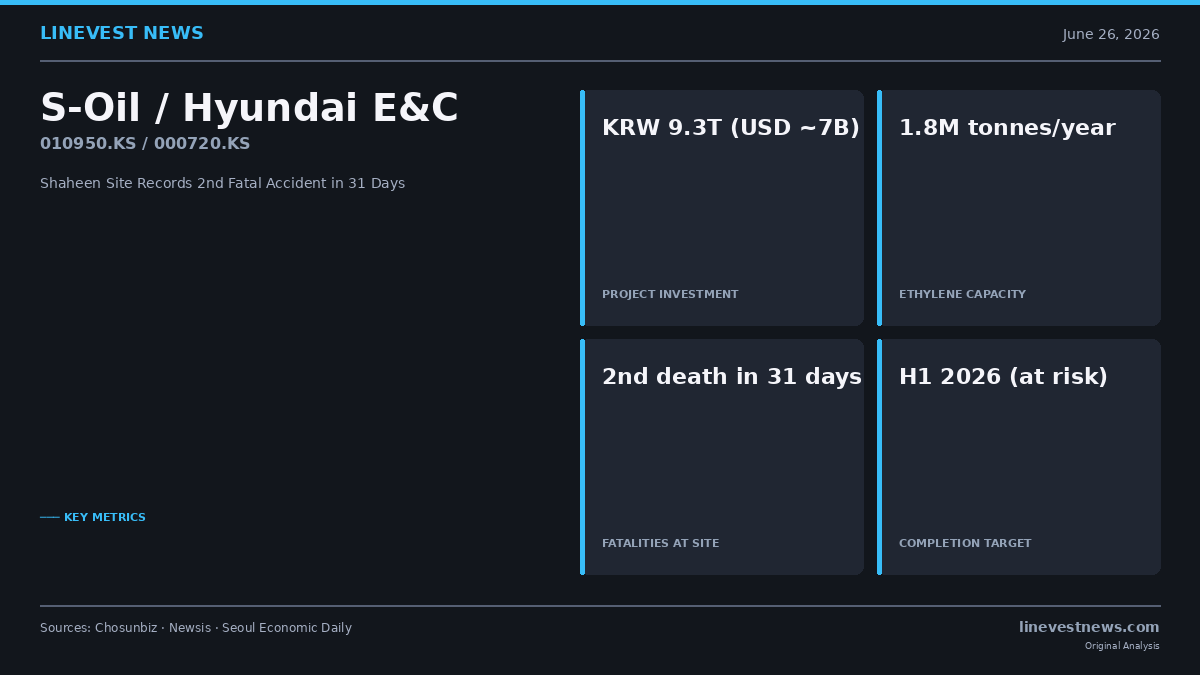
Ulsan, South Korea — June 26, 2026 — A fatal soil collapse at S-Oil Corporation's (010950.KS) KRW 9.3 trillion (USD 6.7 billion) Shaheen ethylene complex has claimed a second worker's life within 31 days, intensifying scrutiny under South Korea's Serious Accidents Punishment Act and raising questions about the flagship petrochemical project's completion timeline.
What Happened
Hyundai Engineering & Construction (000720.KS), the lead contractor for Package 1 (PKG1) of the Shaheen project, disclosed on June 26 that one worker was killed when soil collapsed onto him during the removal of formwork for an underground cable protection structure. The accident occurred at the Onsan National Industrial Complex in Ulsan.
Police and the Ministry of Employment and Labor are conducting on-site inspections to determine the exact cause.
A Pattern of Fatalities at Shaheen
Thursday's death is the second fatal accident at the Shaheen site within a month. On May 26, a worker died at the same complex in a portion overseen by DL E&C — another member of the Shaheen consortium. In the wake of that incident, DL E&C suspended work across all its sites for mandatory safety audits before resuming operations.
The Shaheen project's construction consortium comprises Hyundai E&C (lead), Hyundai Engineering, Lotte E&C, and DL E&C, covering the steam cracker complex, downstream chemical units, and storage infrastructure.
Project Stakes
Shaheen is among the most consequential energy investments in Northeast Asia. S-Oil — 76.5% owned by Saudi Aramco — is investing KRW 9.3 trillion (approx. USD 7 billion) to build what is designed to be the world's largest mixed-feed steam cracker, with annual nameplate capacity of 1.8 million tonnes of ethylene, alongside 770,000 tonnes of propylene and 880,000 tonnes of polyethylene.
The project also marks the first commercial-scale deployment of Saudi Aramco's proprietary Thermal Crude-to-Chemicals (TC2C) technology.
Upon completion, S-Oil targets doubling its petrochemical revenue contribution from roughly 12% to 25% of total sales — a structural pivot critical to the company's long-term margins as traditional refining margins remain compressed.
Legal and Regulatory Exposure
South Korea's Serious Accidents Punishment Act (중대재해처벌법), in force since January 2022, imposes criminal liability — including imprisonment of up to one year — on company executives whose failure to uphold safety standards results in a worker's death. With two fatalities at the same site in four weeks, both S-Oil (as the project owner) and the relevant contractors face potential criminal investigations.
The law has already prompted high-profile convictions in Korean construction and manufacturing. Analysts note that recurrence at the same large project site draws heightened regulatory attention.
Completion Timeline at Risk
S-Oil had targeted first-half 2026 for Shaheen's mechanical completion, with commercial production set to follow in the second half. The repeat fatalities — and any resulting work stoppages or mandatory safety audits ordered by the Ministry of Employment and Labor — could push commissioning into late 2026 or beyond.
For S-Oil shareholders, a delay in Shaheen startup represents deferred revenue from the company's highest-margin growth driver. The project carries an interest expense burden from project financing drawn over the multi-year construction phase.
Companies mentioned: S-Oil Corporation (010950.KS), Hyundai Engineering & Construction (000720.KS), DL E&C (000215.KS)
Sources: Chosunbiz (June 26, 2026), Newsis (June 26, 2026), Seoul Economic Daily (May 26, 2026), Korea Herald, Oil & Gas Journal