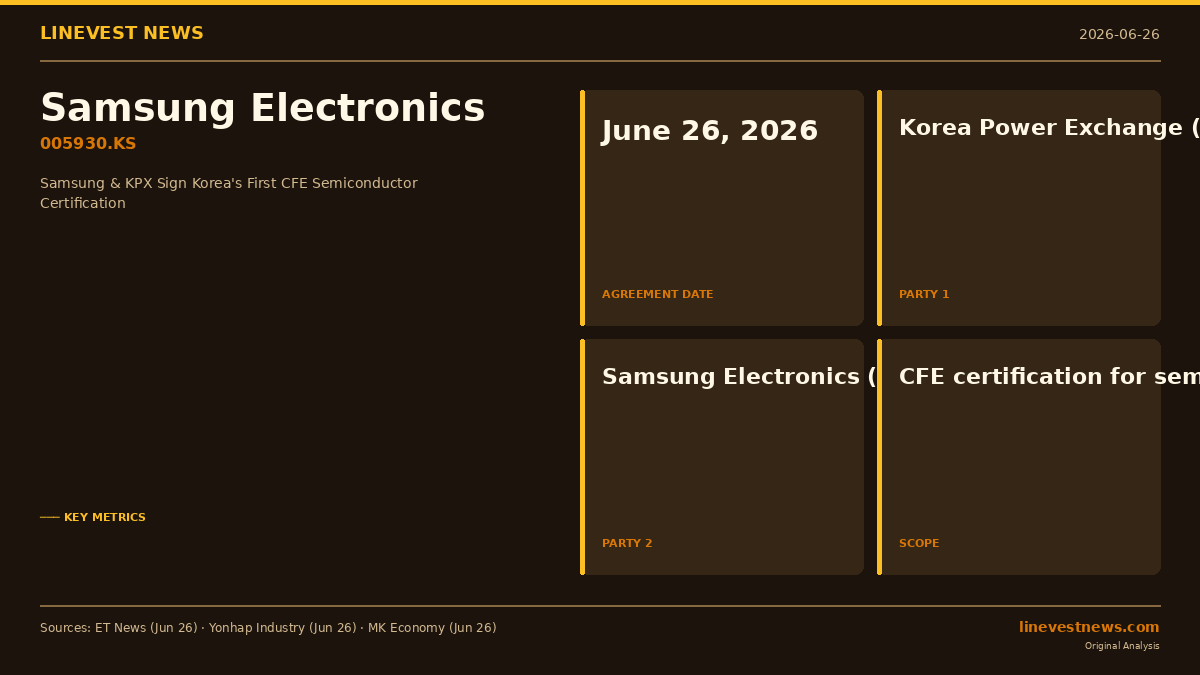
Samsung Electronics (005930.KS) and Korea Power Exchange (KPX) on Thursday signed a memorandum of understanding establishing carbon-free electricity (CFE) usage verification at Samsung's domestic semiconductor factories — the first national certification system of its kind in South Korea for chip-making facilities.
Under the agreement, KPX will analyse real-time electricity transaction data broken down by energy source to provide objective verification of CFE usage rates at Samsung's plants, with the Hwaseong semiconductor complex designated as the initial pilot site.
The CFE framework differs meaningfully from the RE100 standard in that it recognises all zero-carbon electricity sources, including solar, wind, and nuclear power — a significant distinction for a country where nuclear accounts for roughly 27% of total grid generation.
KPX President Kim Seong-jin said the deal marks "our first step in supporting domestic companies" in obtaining credible environmental power documentation for overseas clients.
Why It Matters for Investors
Supply-chain ESG pressure is accelerating. Major technology buyers — Apple, Microsoft, Google, and TSMC customers broadly — have embedded CFE or RE100 requirements into supplier contracts. Samsung's semiconductor division generates roughly USD 95 billion in annual revenue, and verifiable clean-power credentials are increasingly a prerequisite rather than a differentiator for high-margin logic and memory contracts.
Nuclear inclusion is a structural Korean advantage. South Korea's grid supplies approximately 27% of electricity from nuclear plants, the lowest-marginal-cost zero-carbon source available. By certifying nuclear power under the CFE umbrella, Korean manufacturers can claim a materially higher effective clean-energy share than competitors relying on renewable-only mandates such as RE100. That gap is relevant as AI-era production of HBM4 and advanced logic consumes ever-larger amounts of power.
The pilot sidesteps KEPCO's balance sheet. The CFE verification model is designed to operate within Korea's existing grid structure, requiring no additional green power procurement or premium tariff subsidies. That matters because KEPCO (015760.KS) already carries KRW 206.2 trillion (USD 139 billion) in net debt following years of regulated price caps. The certification does not add strain to the state utility.
AI data-centre scrutiny is rising. As hyperscalers embed scope-3 emissions reporting into procurement, semiconductor manufacturers face growing pressure to document the carbon footprint of fab operations. A nationally recognised Korean CFE standard gives Samsung and potential future participants a credible, auditable framework to share with overseas clients.
What's Next
KPX indicated the Hwaseong pilot will provide a template for expanding the certification to other Samsung facilities and, eventually, to other Korean chipmakers. LG Electronics (066570.KS), which has committed to RE100 compliance by 2030, could adopt a similar verification pathway under the same framework.
Korea Power Exchange is a state-owned entity and is not listed. The direct listed beneficiary is Samsung Electronics (005930.KS), which trades on the Korea Stock Exchange (KOSPI). Shares were at KRW 73,400 as of Thursday's close.
Sources: ET News (Jun 26, 2026), Yonhap Industry (Jun 26, 2026), MK Economy (Jun 26, 2026), Chosunbiz (Jun 26, 2026)