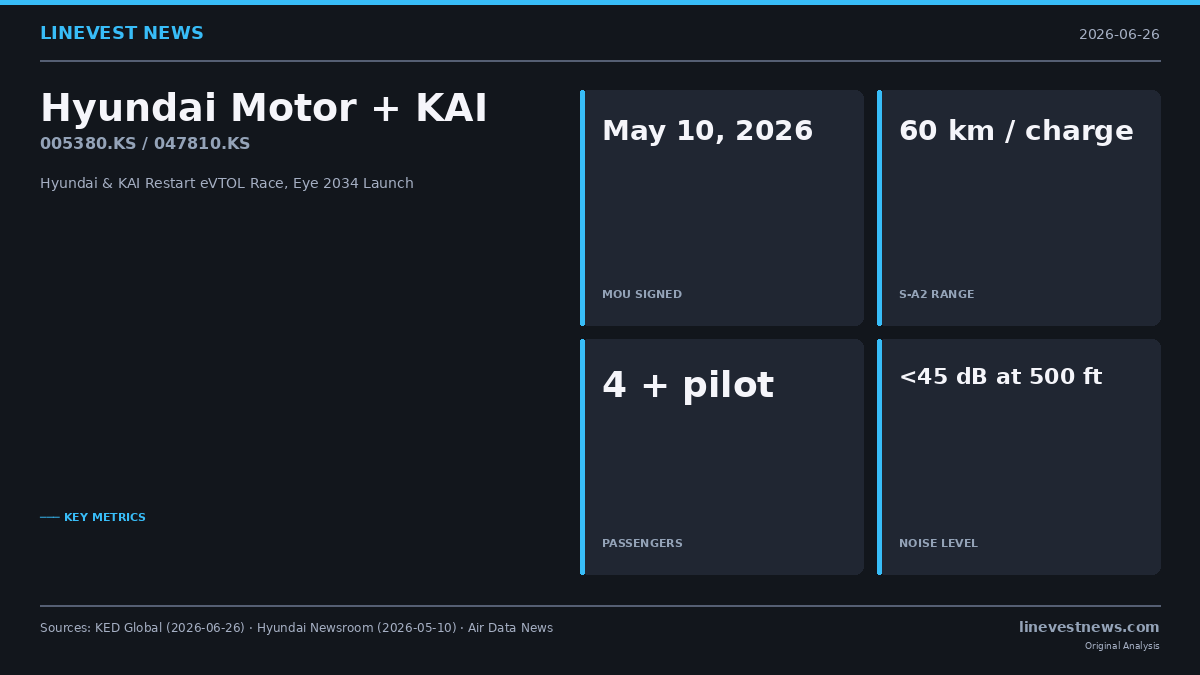
South Korea's two leading conglomerates in automotive and aerospace are combining forces to revive the nation's electric vertical take-off and landing (eVTOL) ambitions. Hyundai Motor Group (005380.KS) and Korea Aerospace Industries (KAI, 047810.KS) signed a memorandum of understanding on May 10, 2026, to jointly develop an advanced air mobility (AAM) platform — marking Hyundai's comeback after its U.S. subsidiary Supernal shuttered development in September 2025 and cut roughly 80% of its workforce.
From Grounded to Airborne Again
Supernal's pause last September came as a blow to South Korea's air mobility aspirations. The Irvine-based subsidiary had laid off approximately 296 employees across its California facilities and Mojave test site, abandoning its aggressive target of debuting a commercial air taxi at the 2028 Los Angeles Olympics. The original timeline had positioned Hyundai to be among the first automakers to offer eVTOL passenger service, making the suspension a significant strategic retreat.
The new partnership recasts the program on firmer ground. Instead of Supernal racing alone, Hyundai is pairing its electrification expertise with KAI's battle-tested aerospace manufacturing capabilities — the same organization behind the KT-1 trainer and KF-21 Boramae fighter jet programs.
Division of Labor
Under the collaboration, Supernal retains leadership over aircraft design and engineering, while KAI brings airframe development, integrated fixed-wing and rotorcraft systems know-how, and critically, the certification process alignment essential for commercial aviation approval. The two sides also plan to coordinate on supply chains and share their respective global customer networks.
On the powertrain front, Hyundai's Aviation Powertrain Sub-Division will translate the group's electric vehicle expertise into aviation-grade propulsion systems — a natural extension of the company's decade-long EV investment but a technically distinct challenge given aviation's far stricter weight, redundancy, and reliability standards.
To anchor the technical rebuild, Supernal in early May appointed Dr. Farhan Gandhi as Chief Technology Officer. Gandhi brings more than 30 years of rotorcraft research experience, signaling a pivot toward aeronautical rigor over startup speed.
The S-A2 Aircraft
At the center of the joint effort is the S-A2 eVTOL concept, which Supernal first unveiled at CES 2024 and refined at the Paris Air Show 2025. Key specifications:
- Configuration: 4 passengers plus pilot
- Range: 60 km per charge
- Cruise speed: approximately 120 mph
- Noise floor: below 45 dB(A) at 500 feet — quieter than a typical air conditioning unit
New 2034 Timeline
Rather than rushing toward an Olympic showcase, the Hyundai–KAI partnership is targeting commercial operations by 2034 — a more measured runway that reflects the certification timelines typical of civil aviation programs. Regulatory approval from aviation authorities such as Korea's Korea Civil Aviation Safety Authority (CASA) and the U.S. Federal Aviation Administration (FAA) can take years, and the extended schedule allows for systematic testing and airworthiness demonstration.
The global AAM market is projected to reach USD 20.4 billion by 2034, expanding from USD 3.1 billion in 2025 at a compound annual growth rate of 24.5%, according to market research firm MarketIntelo. Korea's partnership structure — pairing an automotive giant's scale with a national aerospace champion's certification track record — could prove to be a competitive differentiator if execution follows intent.
KOSPI Angle
Both Hyundai Motor (005380.KS) and KAI (047810.KS) are KOSPI-listed companies. KAI has attracted heightened strategic attention in 2026: Hanwha Aerospace raised its stake in KAI to 9.04% in June, signaling that South Korea's defense-aerospace complex is consolidating ahead of a new era of civilian air mobility. The Hyundai collaboration adds another layer of industrial alignment around KAI's civilian expansion ambitions.
Executive statements at the MoU signing underscored the strategic ambition. Gang Hyun Seo of Hyundai Motor Group said the partnership aims to "expand the boundaries of mobility into the skies," while KAI CEO Jong-chool Kim called it "an important milestone in our ambition to emerge as a game changer in the global civilian mobility market."
Sources: KED Global (June 26, 2026); Hyundai Newsroom (May 10, 2026); Air Data News; Aviation Week; MarketIntelo AAM Market Research Report 2034