South Korea Locks In Its Biggest Chip Bet: Presidential Meeting, KRW 300T Honam Deal, and a 10-Year Yongin Pull-Forward
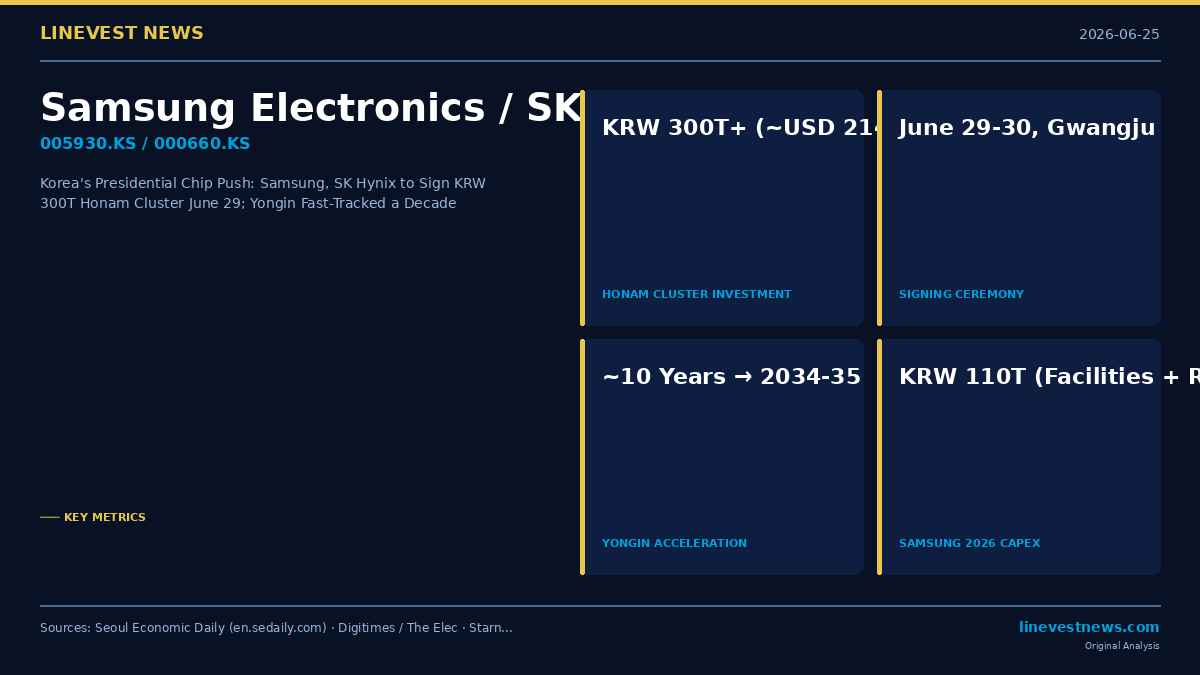
South Korea is moving to formalize its most ambitious semiconductor investment push in a generation, with President Lee Jae-myung meeting Samsung Electronics Chairman Lee Jae-yong on Wednesday (June 25) to align on a KRW 300 trillion-plus (approximately USD 214 billion) semiconductor cluster deal in the Gwangju-South Jeolla region. An official signing ceremony is scheduled for June 29-30.
Samsung Electronics (005930.KS) and SK Hynix (000660.KS) have committed to building both front-end memory production facilities and back-end chip packaging plants in the Jeonnam-Gwangju Special Self-Governing City — a new administrative zone that formally launches on July 1, 2026. AI data centers will accompany the chip fabs as part of an integrated technology district. The government has sweetened the deal with free land, complimentary power, and water provision — incentives that rival the most generous industrial subsidies offered anywhere in Asia.
SK Group Chairman Choi Tae-won held a separate meeting with President Lee on June 19, indicating both flagship chipmakers coordinated their regional footprints with direct presidential involvement. Samsung Chairman Lee Jae-yong also visited Samsung's Cheonan plant — his first such trip in more than three years — signaling renewed executive-level attention to domestic manufacturing capacity.
The June 29 announcement will take place at the presidential "Grand Transformation of National Land" balanced-development summit. A formal signing ceremony in Gwangju follows on June 30, one day before the city's new special administrative status takes effect.
Yongin Gets a Decade Back
In a parallel policy move, Korea's presidential policy office stated that the Yongin semiconductor mega-cluster — previously slated for completion in the mid-to-late 2040s — should be ready by 2034-2035, pulling the project timeline forward by approximately ten years.
Samsung Electronics plans to invest a total of KRW 360 trillion in Yongin facilities, including KRW 110 trillion in 2026 alone across facilities and R&D. SK Hynix is targeting a doubling of monthly wafer output, from roughly 550,000 to 1.11 million units, by 2030. The company's first Yongin fab is expected to begin production in 2030, with subsequent fabs completing through the mid-2030s.
One risk factor: land compensation for Samsung's Yongin project stood at only 43% as of March 2026, and administrative groundwork was less than halfway complete, raising feasibility concerns about the revised 2034-35 target.
Regional Competition and Political Fallout
Not every Korean region is celebrating. Jeonbuk (North Jeolla) province, which had lobbied for inclusion in the Honam deal, was left out; local politicians have begun raising accountability questions. Gumi city — home to legacy Samsung and SK production lines — is separately competing for next-phase national investment by offering land at KRW 1,000 per pyeong (approximately USD 0.24 per square foot), among the most aggressive site-cost subsidies in Korean corporate history.
Hanwha (000880.KS) and HD Hyundai (267250.KS) are earmarked for subsequent phases covering the Chungcheong, Gyeongsang, and Gangwon regions, suggesting the cluster expansion is designed to distribute industrial density beyond the greater Seoul and Gyeonggi corridor.
KOSPI Implications
Samsung Electronics (005930.KS) and SK Hynix (000660.KS) are the primary KOSPI proxies for the Honam and Yongin cluster investment cycles. Both stocks have already surged in 2026 — SK Hynix +347.7% year-to-date, Samsung Electronics +192.77% — driven by HBM demand, Micron Technology's AI-fueled earnings beat, and SK Hynix's upcoming Nasdaq ADR listing (July 10, targeting up to KRW 45.45 trillion or approximately USD 29.4 billion).
The Honam cluster signing and Yongin acceleration introduce a multi-year, government-backed capital expenditure narrative that extends well beyond the near-term memory cycle. Samsung's HBM4 revenue surpassed USD 1 billion in Q1 2026 and is projected to exceed USD 10 billion for the full year — commercial momentum that adds urgency to the cluster buildout.
Combined, the Honam and Yongin projects represent KRW 660 trillion-plus (approximately USD 470 billion) in committed semiconductor capex across South Korea over the next decade — a figure that rivals the entire annual GDP of Argentina and underscores the degree to which Korea is betting its industrial future on AI-era memory dominance.
Sources: Seoul Economic Daily (en.sedaily.com), Digitimes, Starnews Korea, The Elec