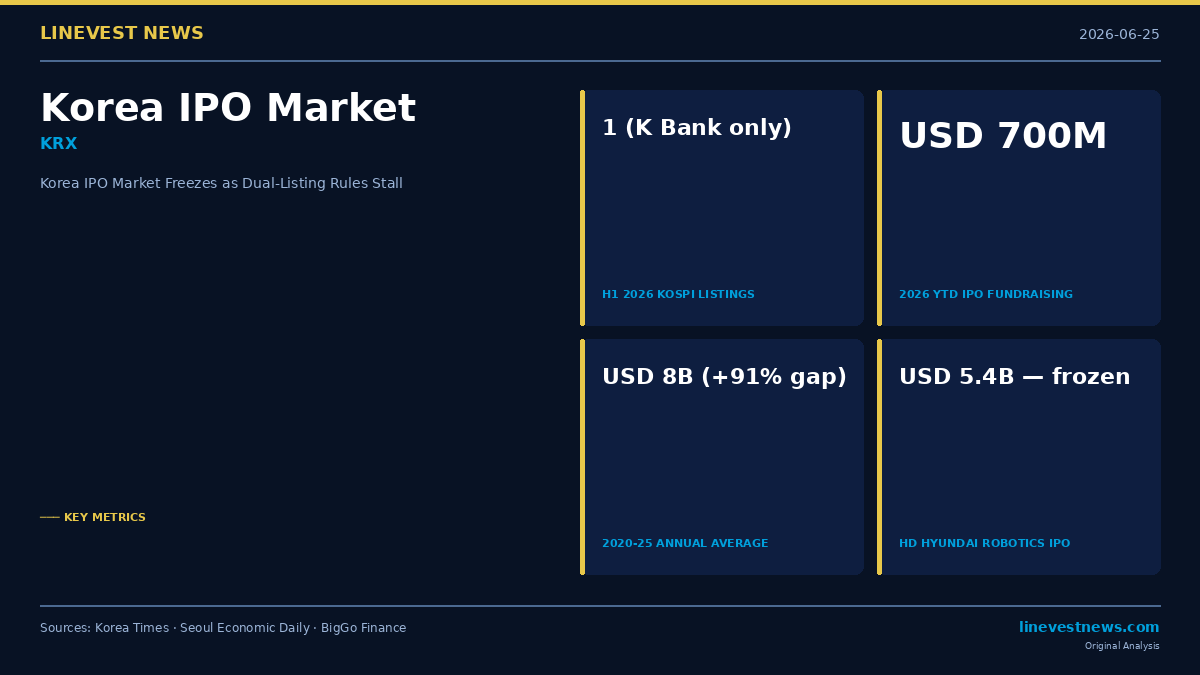
Korea's "Korea Discount" cure is becoming its own ailment. Dual-listing regulations designed to boost KOSPI valuations have paralysed the country's IPO pipeline, with only one company listing on the main exchange in the first half of 2026 while giants including HD Hyundai Robotics, SK Ecoplant, and LS Group's Essex Solutions have indefinitely shelved fundraising plans worth an estimated USD 6 billion or more.
What Happened
In early 2026, the Financial Services Commission and Korea Exchange announced plans to prohibit new listings by affiliates of Fair Trade Act-designated large conglomerate groups — a policy crafted to eradicate the structural discount investors assign to Korean stocks relative to global peers. President Lee Jae Myung specifically named LS Group in January as a prime "Korea discount" offender, signalling that political pressure underpinned the regulatory thrust.
The guidelines were initially due in June 2026. As of today, however, the FSC and KRX have pushed the deadline a third time, citing unresolved disputes over the scope of exemptions: regulators argue broad carve-outs would hollow out the policy, while conglomerates contend that uniform rules ignore vastly different ownership structures.
Companies in Limbo
The uncertainty has forced several showcase listings off the calendar:
- HD Hyundai Robotics: Controlled 81.82% by HD Hyundai (329180.KS), the robotics arm suspended IPO preparations in February 2026. The listing had been expected to raise approximately KRW 7.8 trillion (USD 5.4 billion), which would have ranked it among Korea's largest-ever IPOs.
- SK Ecoplant: The SK Group construction and clean-energy unit missed its self-imposed July 2026 IPO pledge, repurchasing convertible preferred shares from financial investors in June — effectively returning pre-IPO capital raised in 2022.
- LS Group / Essex Solutions: LS Corp (006260.KS) pulled the planned Essex Solutions listing in January shortly after President Lee's remarks, while LS Electric (010120.KS) absorbed its subsidiary LS Eco Advanced Materials back into wholly owned status via a KRW 70 billion stake repurchase.
Market Impact: USD 8 Billion Evaporates
The chill is visible in the data. Through early June 2026, only 15 companies had listed on Korea's bourses, raising approximately USD 700 million in total. That compares to an annual average of roughly 80 listings raising about USD 8 billion between 2020 and 2025 — implying a 91 percent collapse in capital formation.
The KOSPI main board tells the starker story: K Bank stands as the sole new listing on the exchange in the first half of 2026, the lowest H1 figure since 2022. Waiting further back in line — Musinsa, Megazone Cloud, and Sono International — have filed for, or are close to filing for, preliminary listing reviews, but depend on the guidelines being finalised before they can proceed.
The Paradox
The irony is acute. The dual-listing ban was conceived as a mechanism to reduce the "Korea discount" by concentrating value within parent companies rather than letting it seep into newly listed subsidiaries. Instead, it has begun to suppress the very market dynamism — fresh equity issuance, price discovery, capital recycling — that sustains long-term index appeal.
Samsung Securities analyst Kang Young-hoon noted that "dual listings and tougher listing-review regulations have reduced marquee IPO candidates and overall listings," compressing an already thin deal pipeline just as global investors are piling into KOSPI on the back of surging semiconductor earnings.
Investor Read
For holders of HD Hyundai (329180.KS), the stalled robotics spin-off means the parent retains full upside from an automation segment that analysts had valued at a standalone premium — but also retains the funding burden. For LS Electric (010120.KS) and LS Corp (006260.KS), the pivot from IPO proceeds to internal capital recycling constrains near-term investment capacity even as the power-equipment cycle accelerates.
The FSC has not provided a revised timeline for the dual-listing guidelines. Until it does, Korea's IPO clock will remain paused.
Sources: Korea Times · Seoul Economic Daily · Seoul Economic Daily IPO H2 · BigGo Finance