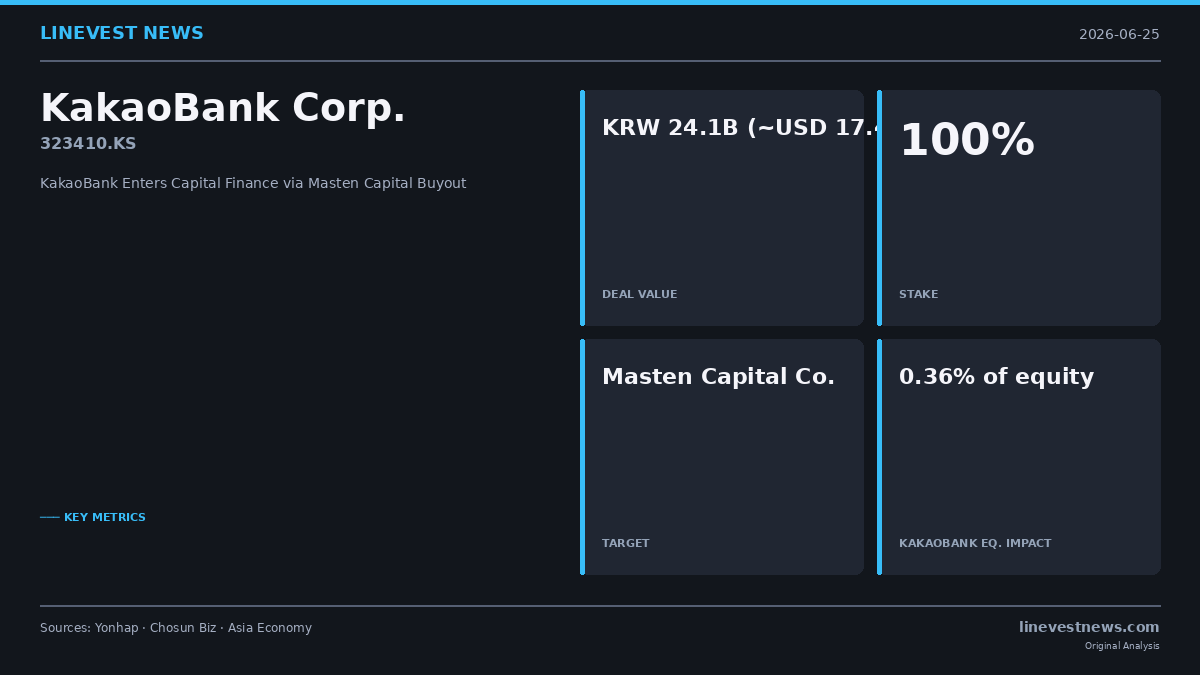
KakaoBank Targets Masten Capital in KRW 24.1B Deal
KakaoBank Corp. (323410.KS), South Korea's largest internet-only lender, announced Wednesday it is in exclusive talks to acquire a 100 percent stake in Masten Capital Co. — a specialty credit-finance firm — for KRW 24.1 billion (approximately USD 17.4 million), according to regulatory filings and multiple Korean wire services. The outlay equals just 0.36 percent of KakaoBank's equity, but the strategic implications are considerably larger: the deal would hand Korea's biggest no-branch bank its first credit-finance operating license and lay the foundation for a full-scale auto-loan business.
KakaoBank said it aims to close the transaction by year-end 2026, subject to regulatory approval from the Financial Supervisory Service.
Masten Capital: A Lease-Finance Specialist Born in 2022
Masten Capital was co-founded in 2022 as a joint venture between Masten Investment Management Co., a Korean real-asset investment manager, and NH Investment Securities Co. (005940.KS), the brokerage subsidiary of NongHyup Financial Group. The firm holds a yeosin-jeonmun-geumyungsa (여신전문금융사) licence — Korea's credit-finance designation — and concentrates on lease financing and corporate lending.
Obtaining a new credit-finance licence from scratch in Korea requires a formal regulatory review that typically spans twelve to eighteen months. Acquiring an existing licensed entity cuts that timeline by the same margin — a calculation that appears to have driven KakaoBank's search for a bolt-on target rather than a greenfield approach.
Three-Stage Expansion Roadmap
KakaoBank outlined a sequential build-out plan in its announcement:
| Phase | Timing | Product |
|---|---|---|
| 1 | 2027 | Installment finance (할부금융) |
| 2 | 2027–2028 | Auto loans and operating-lease vehicles |
| 3 | Medium-term | Lease/rental, corporate finance, investment finance |
A company spokesperson said: "We intend to extend our proven track record in digital innovation — built on a non-branch, mobile-first model — into the capital-finance sector, offering customers a seamless financial experience across every stage of their lives."
The auto-finance entry is the most commercially significant leg. Korea's automotive credit market — spanning captive finance companies, bank-affiliated subsidiaries, and independent operators — carries an estimated KRW 100 trillion in outstanding balances. Incumbents include Hyundai Capital (Hyundai Motor Group's captive arm), KB Capital (KB Financial), and Shinhan Capital (Shinhan Financial Group).
Strategic Context: From Single-Product Bank to Digital Financial Platform
KakaoBank's chief executive first flagged both the capital-finance acquisition and a Korean won stablecoin initiative in the May 2026 earnings call, signalling management's intention to transform a high-volume but thin-margin retail bank into a multi-product consumer-finance group.
The bank closed 2025 with more than 22 million active customers — a number that any traditional captive finance company would take years to replicate — and a loan-to-deposit ratio of 71.8 percent that leaves meaningful balance-sheet headroom. Its digital infrastructure can, in theory, match a customer's deposit account, mortgage, and a future auto-lease contract within a single application, providing a cross-selling dynamic that incumbent captive finance firms cannot easily mirror.
KakaoBank's market capitalisation stood at roughly KRW 11.4 trillion (approximately USD 8.2 billion) prior to the announcement. At 0.36 percent of equity, the KRW 24.1 billion acquisition price signals management's view that Masten Capital's chief value is its regulatory licence rather than its existing loan book.
Key Risks
Execution: Integrating a small lease-finance specialist into a digital-only bank's technology stack and risk framework is straightforward in principle, but auto finance introduces collateral-management and residual-value risk that KakaoBank has not previously underwritten.
Competition: Hyundai Capital and KB Capital have decades of origination relationships with dealer networks, giving them a sourcing moat that KakaoBank's superior digital UX may not immediately overcome.
Regulatory: The FSS will need to approve the change-of-control at Masten Capital. Given KakaoBank's clean compliance record, approval risk is considered low, but timing uncertainty remains.
Sources
- Yonhap News Agency, 25 June 2026
- Chosun Biz, 25 June 2026
- Asia Economy (Asiae), 25 June 2026
- E-Today, 25 June 2026