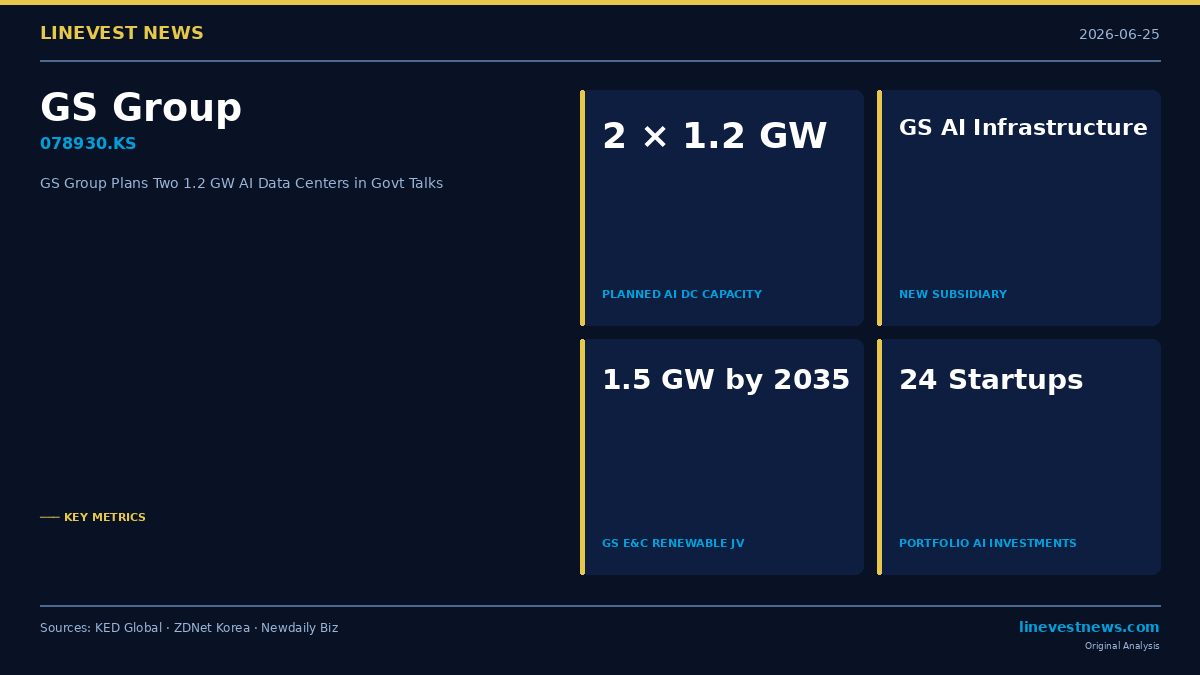
South Korea's GS Group is in advanced talks with the national government to build two artificial intelligence data centers, each with a capacity of 1.2 gigawatts, positioning the energy-and-construction conglomerate as a serious challenger in the country's intensifying hyperscale infrastructure race.
Vertically Integrated Play
Unlike pure-play technology rivals, GS Group's approach centres on combining capabilities already embedded in its portfolio. GS E&C (006360.KS), the group's listed construction arm, brings data center design and project management expertise; GS EPS and GS E&R supply captive power from existing generation assets; and GS Caltex — a refining and petrochemicals unit — has commercialised liquid immersion cooling solutions already validated at operating sites.
The two proposed campuses are expected to be co-located with GS's existing power plants, a model that sidesteps the land-acquisition hurdles that have delayed rival greenfield projects and reduces the grid-connection risk that regulators have flagged as a bottleneck for Korea's wider AI infrastructure programme.
A source familiar with the discussions noted that renewable-energy requirements could influence the final site selection, reflecting Seoul's insistence that new hyperscale facilities meet sustainability benchmarks aligned with the government's 3-gigawatt AI data-hub initiative.
Subsidiary Formed in June
On 11 June 2026, GS filed notice with the Financial Supervisory Service of a new 100-percent-owned entity, GS AI Infrastructure Co. (이하 GSAI인프라), mandated to design, build, operate and lease AI data centers. The unit is headed by Do Hyun-soo, a senior managing director drawn from GS Caltex's new-business and planning division, signalling that the group views data-center infrastructure as a revenue opportunity rather than a back-office cost centre.
Chairman Huh Tae-soo had foreshadowed the move in his 2026 New Year's address, declaring the year "the inaugural year for visualising AI business impact" and pledging to convert 24 portfolio investments in data-center and physical-AI startups into concrete revenue streams.
Renewable Energy Anchor
Three days after GS AI Infrastructure was established, GS E&C (006360.KS) signed a memorandum of understanding on 22 June 2026 with I Squared Capital, a global infrastructure investment firm, to create a joint venture targeting 1.5 gigawatts of renewable energy assets by 2035. That pipeline is expected to serve as the green-power backbone for the proposed hyperscale campuses, potentially allowing GS to market its data-center capacity as carbon-neutral — a criterion increasingly demanded by global hyperscalers choosing Korean colocation partners.
Market Context
Korea's Ministry of Science and ICT has identified AI data centers as critical national infrastructure, backing a 3-gigawatt campus programme that has already attracted interest from a consortium anchored by Stock Farm Road. Competition is intensifying: SK Group and Amazon Web Services have unveiled a USD 4 billion, 60,000-GPU facility in Ulsan, while OpenAI is in talks with SK Telecom for a facility in southwestern Korea.
GS's edge is its energy-first positioning. With power costs representing 40-to-60 percent of data-center operating expenditure, co-locating compute capacity with owned generation assets could shave meaningful basis points from the total cost of ownership — a proposition that resonates with global cloud operators scouting Korean sites.
GS Holdings (078930.KS), the group's listed holding company, and GS E&C (006360.KS) are the primary KOSPI-listed proxies for the data-center build-out. Neither company has disclosed specific capital-expenditure figures tied to the new facilities; government approvals and environmental assessments are understood to be at a preliminary stage.
Sources: KED Global (Jun 25, 2026); ZDNet Korea (Jun 11, 2026); Newdaily Biz (Jun 11, 2026); Korea Herald (Apr 11, 2026)