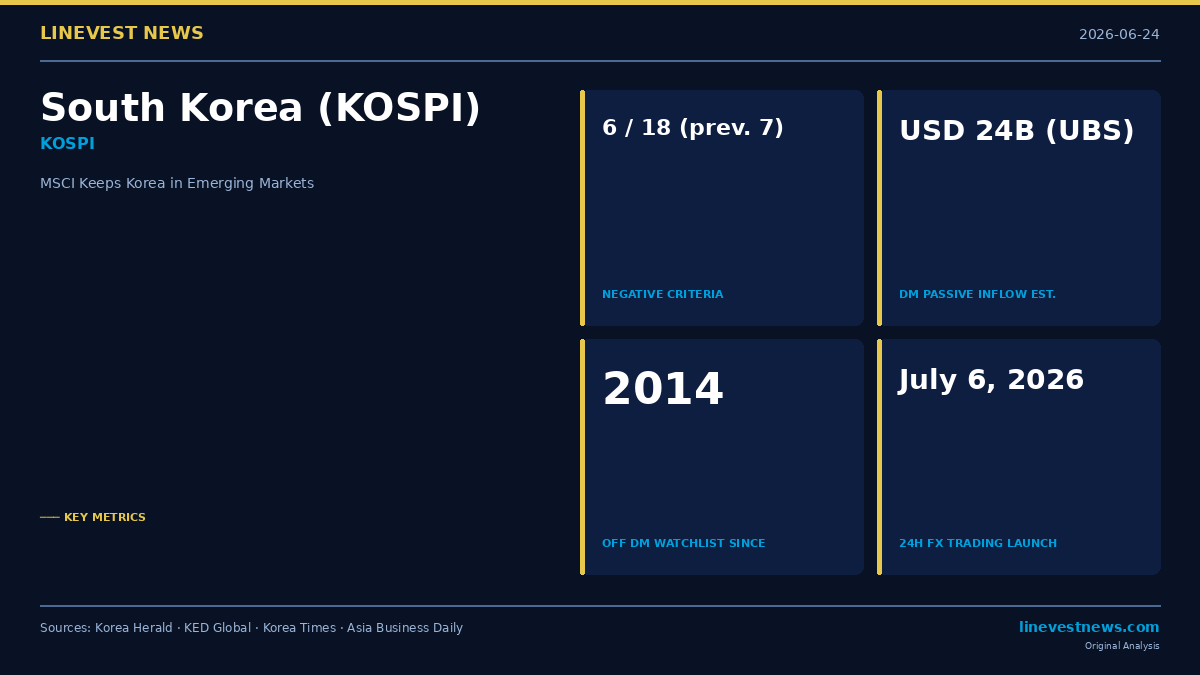
South Korea's equity market will remain classified as emerging market under MSCI's 2026 Annual Market Classification Review, the global index provider announced Tuesday, dashing Seoul's bid to rejoin the Developed Markets watchlist for the third consecutive year.
The decision extends a streak that began when Korea was removed from the DM observation list in 2014. Although MSCI acknowledged tangible reform progress—narrowing the number of negatively-scored criteria from seven to six out of 18 evaluated—it concluded that the pace of implementation still falls short of developed-market standards.
Won Convertibility Remains Central Barrier
MSCI identified limited convertibility of the Korean won in offshore currency markets as the primary obstacle to reclassification. The index provider added that "onshore liquidity during the extended FX trading hours remains largely insufficient to support tight execution at standards comparable to those observed in developed markets."
The six remaining areas scoring negatively span:
- FX market openness — limited offshore won tradability
- Omnibus account and OTC trading restrictions
- Foreign investor registration — operational frictions
- Dividend pre-confirmation — low adoption ahead of record dates
- Investable product availability — restricted instrument range
USD 24 Billion at Stake
The financial stakes are substantial. UBS estimates that a successful reclassification to developed-market status would attract approximately USD 24 billion in passive foreign fund inflows into Korean equities, as Korean stocks would enter benchmark allocations tracked by trillions of dollars in global index funds.
Those flows are now effectively deferred to 2028 at the earliest. Even if Korea secures watchlist placement in June 2027, formal inclusion would be announced in June 2027, with the actual index entry taking place in June 2028.
Government Eyes Mid-July Roadmap
Korea's Ministry of Economy and Finance said it will include a "concrete roadmap for MSCI developed-market inclusion" in a broader economic growth strategy announcement planned for mid-July 2026. The government reports having completed 28 of 39 reform tasks.
A key near-term catalyst is the launch of 24-hour trading in the dollar-won spot market, scheduled for July 6, which Korean authorities argue will materially improve the offshore won liquidity that MSCI flagged as its central concern.
FSC Vice Chairman Kim So-young had expressed confidence that the reform package would be sufficient for watchlist placement. Following the decision, officials said they would establish a joint public-private task force this month to develop the comprehensive MSCI inclusion roadmap.
Context: Day After KOSPI's Worst Session of 2026
The MSCI decision lands a day after the KOSPI recorded its largest single-day loss of 2026, sliding 9.99% on June 23 as Samsung Electronics and SK Hynix each fell more than 12%, triggering circuit breakers. The benchmark has since retreated to near the 8,200-point level.
While the MSCI classification has no direct short-term trading trigger—South Korea is not being downgraded, merely not upgraded—the failure to reach watchlist status removes a potential positive re-rating catalyst that some foreign institutional investors had been pricing in ahead of the June review.
Sources: Korea Herald · KED Global · Korea Times · Asia Business Daily