Samsung SDI Co. (006400.KS) issued letters of intent (LOI) and purchase orders (PO) to domestic South Korean equipment manufacturers on Tuesday, formally launching the physical conversion of three production lines at its U.S. joint-venture battery plant from electric vehicle cells to energy storage system (ESS) batteries, industry sources said.
Plant Conversion Scope
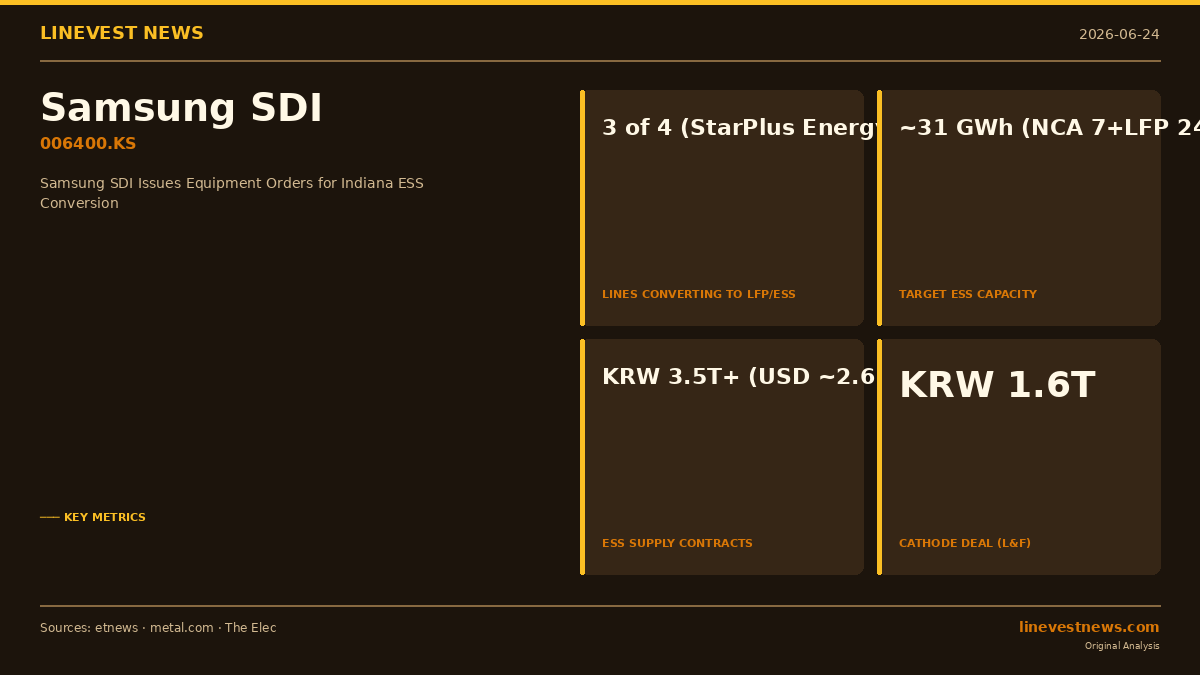
Three of four lines at StarPlus Energy Plant 1 in Kokomo, Indiana — a facility Samsung SDI co-owns with Stellantis — are targeted for conversion to square-cell lithium iron phosphate (LFP) production:
- One existing NCA line (approximately 7 GWh annual capacity) is being retooled for LFP cells
- Two new LFP lines are being built, each rated at roughly 12 GWh in capacity
The reworked configuration would give StarPlus Energy Plant 1 an ESS-focused LFP capacity of approximately 31 GWh once all lines reach full output — a significant shift for a plant originally designed around nickel-cobalt-aluminum (NCA) chemistry for passenger EVs.
Korean Equipment Suppliers Selected
Samsung SDI has designated Innometry for inspection equipment and Phil Energy for stacking machinery. M.O.T will supply packaging-process equipment, while Hanjung NCS will handle cooling systems integrated into Samsung SDI's proprietary Samsung Battery Box (SBB) containerized ESS product. Bestech is understood to be in line for electrolyte-injection equipment.
Industry sources anticipate that equipment installation will wrap up by the first half of 2027, with initial production verification to follow before supply volumes ramp in H2 2027.
KRW 3.5 Trillion+ in Locked ESS Contracts
Samsung SDI secured its first LFP battery supply agreement in December 2025 — a three-year deal valued at over KRW 2 trillion (approximately USD 1.5 billion) running from 2027 to 2029 with an undisclosed U.S. energy company. A follow-on order of roughly KRW 1.5 trillion (USD 1.1 billion) was subsequently secured through Samsung SDI's Michigan-based subsidiary, bringing total contracted ESS revenue to more than KRW 3.5 trillion.
To ensure cathode material supply for the planned volumes, Samsung SDI signed a KRW 1.6 trillion (USD 1.1 billion) supply agreement with domestic materials firm L&F in March 2026.
Strategic Pivot: From EV Cycles to Grid Storage
The conversion reflects a calculated pivot in Samsung SDI's North American strategy. Stellantis — the other half of the StarPlus Energy JV — has repeatedly revised EV production targets downward, leaving parts of the Indiana plant under-utilised. Meanwhile, ESS demand in the U.S. has accelerated sharply, propelled by AI data-centre power requirements, renewable interconnection queues, and state-level energy storage mandates.
Global ESS battery shipments are expected to nearly double between 2025 and 2027 on the strength of grid-level deployments. LFP chemistry commands the ESS segment for its longer cycle life and lower thermal risk versus nickel-rich batteries, a market segment where Samsung SDI has lagged Chinese rivals including CATL and BYD. Converting an existing JV footprint rather than funding greenfield capacity is capital-efficient: Samsung SDI avoids new land, utility connections, and permitting timelines while reclaiming utilisation at an under-used asset.
Sources
- etnews (June 24, 2026)
- metal.com / SMM
- The Elec (Samsung SDI ESS contract reporting)
- Samsung SDI official announcements
*Ticker: 006400.KS (Samsung SDI Co., Ltd.)*