South Korea's biotechnology sector claimed a symbolic milestone at the BIO International Convention this week: its own dedicated session—"Korea Rising: Don't Be Late to Asia's Next Innovation Hub"—debuting on June 24 at the San Diego Convention Center, marking the industry's arrival on the global deal-making stage.
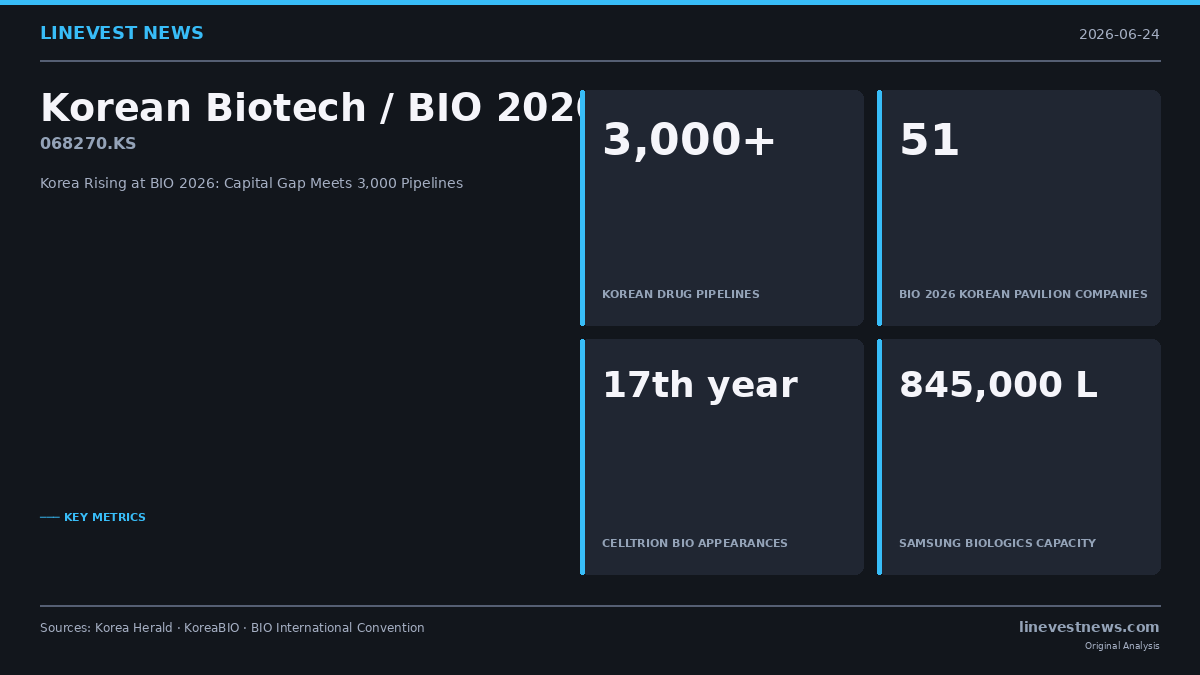
The session drew executives from Samsung Biologics (207940.KS), Celltrion (068270.KS), ABL Bio (298380.KS), Ildong Pharmaceutical (249420.KS), Boehringer Ingelheim, and KB Investment. Korea now claims more than 3,000 active drug pipelines, ranking among the world's largest biotech ecosystems on a per-capita basis, according to Hwang Jurie, director of public and international affairs at KoreaBio. More than 51 Korean companies filled the KoreaBIO country pavilion, with the convention drawing over 20,000 attendees from 70-plus countries.
Celltrion Moves Beyond Biosimilars
After 17 consecutive appearances at BIO International, Celltrion is signaling its next chapter. The Incheon-based biopharmaceutical company, which built its reputation on biosimilar drugs including Remsima and Herzuma, is now positioning itself as an innovator in antibody-drug conjugates (ADCs), multispecific antibodies, and AI-based new drug discovery.
"Celltrion will look to actively promote the company's future business vision" as it transitions beyond its biosimilar identity, the company said. The shift carries financial weight: biosimilar headwinds—including intensifying global competition and accelerating price erosion—have pushed Korean drugmakers toward higher-margin, innovation-driven revenue. AI-assisted drug design could shorten development timelines and reduce late-stage failure rates, an increasingly compelling proposition as clinical development costs escalate toward USD 2 billion per approved drug.
ABL Bio: Bispecifics and Brain Shuttle
ABL Bio, a clinical-stage Seongnam-based biotech (298380.KS), arrived at BIO 2026 with two pipeline assets drawing deal-seeker attention. Its Grabody-T bispecific antibody platform, activating 4-1BB co-stimulatory pathways in T cells for immuno-oncology, is progressing through clinical development. A second compound, ABL209—targeting EGFR and MUC1 simultaneously—will headline ABL Bio's presentation at World ADC Korea within days.
Equally closely watched is ABL Bio's blood-brain barrier (BBB) shuttle technology, embedded in ABL301 for neurodegenerative disease indications. ABL Bio disclosed that licensing discussions have been active with multiple global pharmaceutical companies since the JPM Healthcare Conference earlier in 2026, citing its Compass Therapeutics partnership on tovecimig as evidence of a replicable licensing model.
Capital Gap: "Make a US Subsidiary"
For all the pipeline depth, Korean biotech's structural capital access challenge remains unresolved. Lambert Kuk, chief investment officer at KB Investment, offered blunt guidance to Korean founders seeking US institutional money: "If you really want to get the money from a fully financial investor from the US side, make a subsidiary in the US."
The advice underscores a persistent asymmetry. While Korean biotechs routinely attract strategic partnerships from global pharma, they struggle to access deep US institutional capital pools—pension funds, endowments, and dedicated biotech VCs—that require familiar corporate governance structures and US legal standing. Ildong Pharmaceutical CEO Lee Chae-joon described "open innovation" as his company's core strategy for bridging the divide.
Infrastructure Buildout
Behind the deal-seeking sits a growing manufacturing base. Samsung Biologics has expanded its total bioproduction capacity to 845,000 liters following its USD 280 million acquisition of a former GSK facility in Rockville, Maryland—bringing US-based drug substance capacity to 60,000 liters. Lotte Biologics is on track to complete its first Korean production plant in Songdo, Incheon by August 2026, adding to the dual-site capability established after its USD 160 million acquisition of a Syracuse, New York facility from Bristol Myers Squibb in 2022.
SK Biopharmaceuticals (326030.KS) staked out its AI positioning at BIO 2026, operating under the banner "SK, AI for Every Patient" within the convention's dedicated digital health and AI zone, signaling ambitions beyond its established CNS drug portfolio.
Market Implications
The Korea Rising session signals that global biopharmaceutical majors can no longer treat Korea as an afterthought in Asia deal-making. With 51 companies exhibiting and a dedicated keynote session, Korean biotechs are actively pitching the post-biosimilar transition—though the capital access gap means that execution depends increasingly on structural adaptation: US subsidiaries, international governance frameworks, and co-development structures that speak the language of global institutional capital.
Sources: Korea Herald (June 24, 2026); BIO International Convention 2026 program materials; KoreaBIO; Seoul Economic Daily