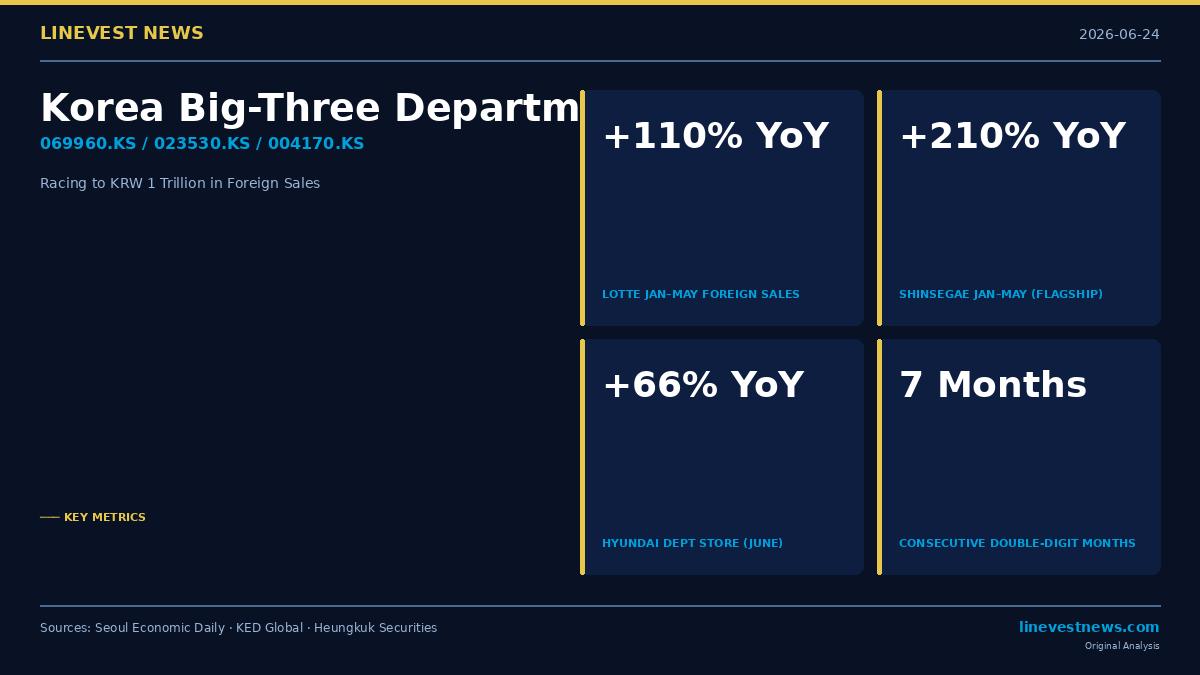
South Korea's three largest department store operators — Hyundai Department Store (069960.KS), Lotte Shopping's department-store division (023530.KS), and Shinsegae (004170.KS) — are each converging on a KRW 1 trillion (approximately USD 720 million) annual threshold for foreign-customer sales, driven by a surge in inbound tourism and K-wave-fueled demand for luxury goods and fashion.
The milestone comes as Korea reached 10 million inbound visitors ahead of its original schedule for 2026, with a weak Korean won turning Seoul into one of Asia's most attractive luxury-shopping destinations for travelers from Greater China, the United States, Japan, and Southeast Asia.
Seven Consecutive Months of Double-Digit Growth
All three operators have posted double-digit year-on-year growth in foreign-customer sales for at least seven consecutive months, a run that analysts describe as the strongest department-store cycle in two decades.
Shinsegae reported that foreign-customer sales rose 137% year-on-year across all stores in the January–May 2026 period, with its flagship main store surging 210%. Luxury-goods sales to foreign shoppers climbed 255.8%. The chain's 2025 base was KRW 650 billion across 13 stores; it is now forecast to reach the KRW 1 trillion mark "as early as late in the third quarter or early in the fourth quarter" of this year, according to the company.
Lotte Department Store recorded a 110% increase in foreign sales for the same January–May window against a 2025 base of KRW 734.8 billion — the highest starting point among the three. The flagship's fashion category led with a 180% gain. Lotte projects full-year foreign sales in the "mid-1 trillion" range.
Hyundai Department Store, with a 2025 base of approximately KRW 700 billion, saw foreign-customer growth of 20% in April, accelerating to 66% in June. The Hyundai Seoul flagship posted a 129% rise in foreign sales through May, and management expects to clear the KRW 1 trillion mark during the year.
Weak Won and K-Wave Drive the Cycle
The confluence of a persistently weak Korean won, rising K-wave cultural tourism, and the domestic wealth effect from chip-stock bonuses has repositioned Korea's department stores as beneficiaries of structural tailwinds rather than cyclical trends.
By nationality, shoppers from Greater China — including mainland China and Taiwan — accounted for the largest share of foreign-customer revenue at all three operators, followed by visitors from the United States, Japan, and Southeast Asia. Category leaders include luxury brands (Chanel, Louis Vuitton, Bulgari, Tiffany), K-fashion labels, and beauty pop-ups.
"With the positive wealth effect from domestic stocks and real estate and the increase in foreign visitors, high-margin categories are growing and the improvement in profitability is strengthening," said Park Jong-ryeol, a researcher at Heungkuk Securities.
Operating Leverage Expands Margins
Higher foreign-tourist transactions, which tend to be concentrated in high-margin luxury and fashion categories, have boosted operating profitability significantly in Q1 2026: Lotte's department-store operating profit rose 47% year-on-year, Shinsegae's climbed 30.7%, and Hyundai's gained 39.7%.
Discount retailer Daiso also emerged as a beneficiary of the tourist boom, posting record 2025 domestic sales that surpassed Lotte Mart for the first time — underscoring the breadth of the foreign-spending tailwind across price points.
Key Risk: Won Appreciation
The primary risk to the foreign-sales thesis is won appreciation. A sharply stronger won would erode the currency-competitiveness advantage that currently makes Korean luxury and fashion goods relatively cheaper for foreign visitors. Analysts note that luxury brands' continued investments in Korean flagship locations — including renovations and pop-up events — provide a floor but do not eliminate the currency sensitivity.
Sources: Seoul Economic Daily (June 24, 2026); KED Global (June 24, 2026); Heungkuk Securities research (June 2026)
"