SEOUL — Kia Corp (000270.KS), South Korea's second-largest automaker, is facing its most ambitious union offensive in more than a decade as the Korean Metal Workers' Union demands virtual veto power over management spending plans, new vehicle development programs, and the deployment of humanoid robots — all empowered by the country's newly operative Yellow Envelope Act.
The union's 2026 collective-bargaining submission, confirmed Tuesday by KED Global and Seoul Economic Daily, calls for pre-approval rights over capital expenditure plans and new model launches. If granted, the arrangement would mark a structural shift in Korean labor relations, subjecting billions of dollars in annual investment decisions to union sign-off before execution.
KRW 2.72 Trillion Bonus Demand
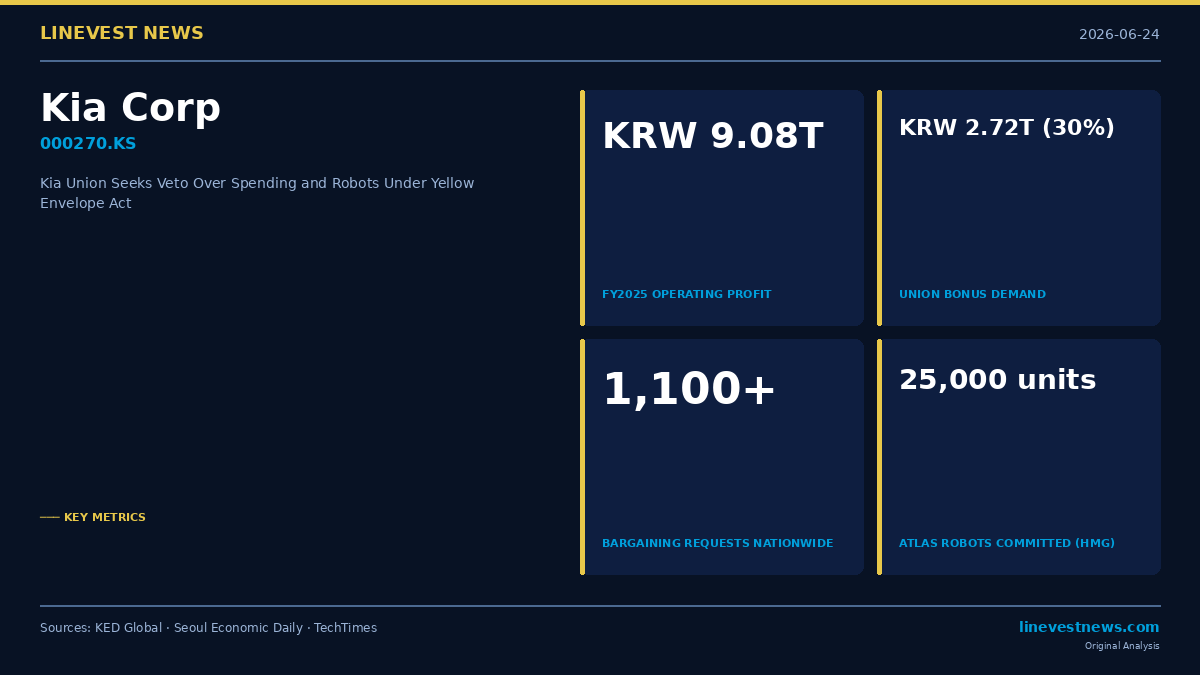
At the core of the wage demands is a claim to 30% of Kia's FY2025 operating profit, which reached KRW 9.0781 trillion (approximately USD 6.6 billion). The arithmetic is stark: full compliance would require a payout of roughly KRW 2.72 trillion (USD 2.0 billion) in performance bonuses to union members — a sum that would materially erode the company's discretionary cash buffer earmarked for EV platform transitions and overseas expansion.
Kia's parent Hyundai Motor Group has outlined aggressive capacity plans, including a target to deploy 25,000 Boston Dynamics Atlas humanoid robots across its global manufacturing network. Under the union's proposed clause, Atlas units could not be introduced on Kia production floors without prior labor agreement. Current timelines show Atlas scheduled for Hyundai Motor Group Metaplant America near Savannah, Georgia in 2028, with a phased extension to Kia AutoLand Georgia in West Point in the second half of 2029 — meaning overseas sites may absorb the initial wave while domestic plants remain shielded.
Yellow Envelope Act as Legal Foundation
The union's assertiveness draws legal confidence from Korea's revised Trade Union and Labor Relations Adjustment Act — widely known as the Yellow Envelope Act — which the National Assembly passed by a 183-to-3 majority in August 2025 and which took effect in March 2026. The law extends the scope of lawful strikes to cover "management decisions materially affecting working conditions," effectively giving unions standing to demand a seat at the table on restructuring, relocation, and product-program choices that were previously beyond the reach of collective bargaining.
The fallout has been industry-wide: more than 1,100 collective-bargaining requests have been filed across Korean companies since the law's effective date, according to KED Global, encompassing demands that range from four-and-a-half-day work weeks to restrictions on subcontracting. Business associations warn the scope expansion risks paralysing investment cycles in a sector already navigating US tariff uncertainty and an EV demand slowdown.
First Joint Campaign in a Decade
Adding to management pressure, Hyundai Motor and Kia unions have agreed to coordinate their 2026 wage demands for the first time in roughly ten years. The joint campaign amplifies negotiating leverage: a synchronized strike call across Korea's two largest domestic automakers could halt combined production of several hundred thousand vehicles annually and disrupt supply chains reaching tier-two and tier-three suppliers nationwide.
Kia's union has further requested a contractual guarantee that core EV components — including battery packs, motors, reducers, and fuel cell stacks — be manufactured in-house at Korean plants for all new vehicle programs. The clause is designed to pre-empt any management move to shift component sourcing overseas in tandem with overseas automation rollout.
Broader Implications
Analysts watching the negotiations say the outcome will set a precedent for how Korean manufacturers navigate the intersection of labor law and industrial automation. If Kia management concedes pre-approval rights over robot deployment and capital decisions, other sectors from steelmaking to shipbuilding — where the Yellow Envelope Act applies equally — could face comparable demands.
Kia and Hyundai Motor did not immediately respond to requests for comment. Negotiations are ongoing, and no strike action has been formally authorized.
Sources: KED Global (June 24, 2026); Seoul Economic Daily (May 3, 2026); TechTimes (May 22, 2026)
"