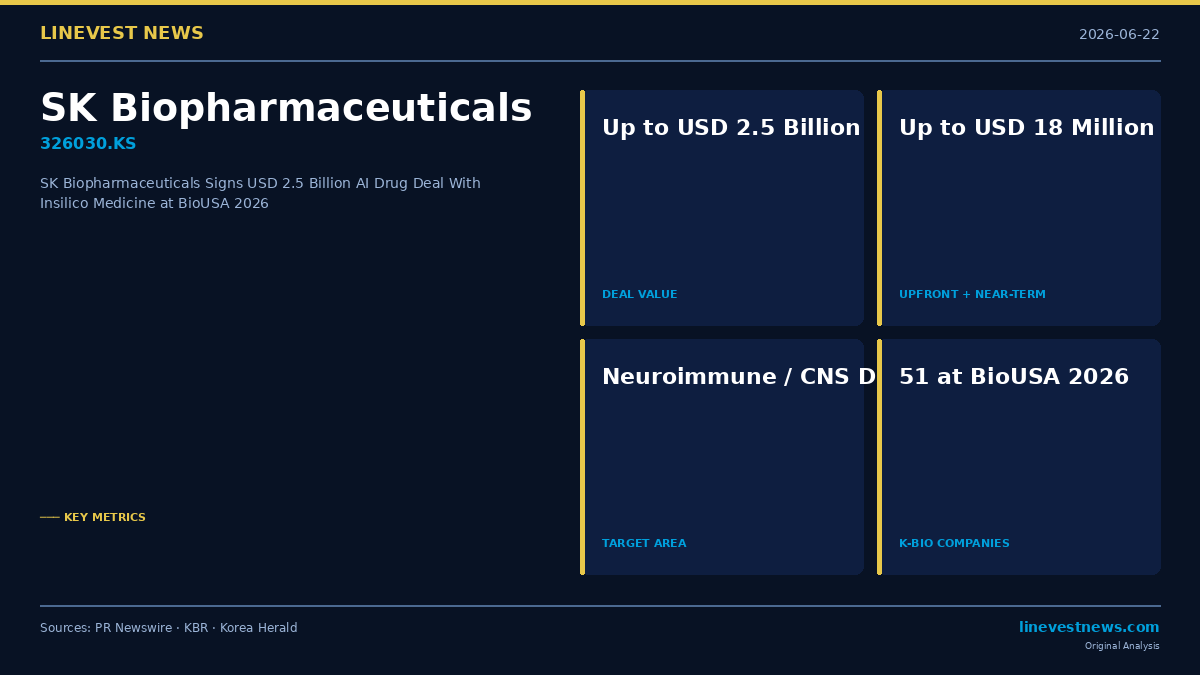
SK Biopharmaceuticals (326030.KS) has inked an AI-powered drug discovery partnership with Hong Kong-based Insilico Medicine worth up to USD 2.5 billion, the companies announced June 22 on the opening day of BioUSA 2026 in San Diego -- the world's largest biotech partnering event.
Under the agreement, Insilico will apply its Pharma.AI platform -- integrating target validation, generative chemistry, and molecule optimization -- to discover and develop novel candidates targeting neuroimmune disorders, including neuroinflammatory, neurodegenerative, and rare neurological conditions. SK Biopharmaceuticals will lead late-stage clinical development and U.S. commercialization, drawing on its established CNS infrastructure built around epilepsy drug Xcopri.
The deal is structured as up to USD 18 million in upfront and near-term milestone payments, with total potential value exceeding USD 2.5 billion across development, regulatory, and commercial milestones, plus single-digit royalties on net sales. Insilico describes it as its largest Asia-Pacific partnership to date.
"This collaboration represents an important milestone in expanding our growth beyond epilepsy into new CNS therapeutic areas," said Donghoon Lee, CEO of SK Biopharmaceuticals.
"By uniting Insilico's AI-driven target-to-candidate engine with SK Biopharmaceuticals' deep CNS mastery, we aim to unlock breakthrough therapies," added Dr. Alex Zhavoronkov, Co-CEO of Insilico Medicine.
Insilico's Pharma.AI engine has nominated 31 preclinical candidates since 2021, secured 13 IND approvals or clearances, and compresses average drug discovery timelines to 12-18 months versus the traditional 2.5-4 years, generating 60-200 molecules per program.
Broader K-Biotech Momentum at BioUSA 2026
The SK-Insilico deal headlined a strong Korean showing at BioUSA 2026, which runs June 22-25 at the San Diego Convention Center. A total of 51 South Korean companies are participating through the Korea Pavilion, organized by KoreaBIO for the 23rd consecutive year.
Samsung Biologics (207940.KS) returned with a 140-square-meter standalone booth for its 14th consecutive year, spotlighting its expanded end-to-end CRDMO platform and its new Rockville, Maryland campus. Celltrion (068270.KS) is showcasing three major biosimilars -- Vegzelma (bevacizumab-adce), Yuflyma (adalimumab-aaty), and Steqeyma (ustekinumab-stba) -- while exploring AI-assisted clinical development partnerships.
Lotte Biologics is highlighting its dual-site CDMO model linking Syracuse (U.S.) and Songdo (South Korea), with Songdo Bio Campus Plant 1 scheduled for completion in August 2026. The company is presenting three in-booth sessions covering manufacturing collaboration, scale-up strategies, and digital operations.
The quality of deal conversations has elevated sharply. "In the past, many Korean companies came to BIO mainly to introduce themselves, but now they are coming with clearer assets, defined partnering targets and more concrete deal structures," one industry participant noted.
Market Context
SK Biopharmaceuticals built its CNS foundation on Xcopri (cenobamate), an anti-epileptic drug that generated USD 467 million in net sales in 2025, with analysts projecting peak annual sales above USD 1 billion. Expanding into neuroimmune disorders via AI collaboration is designed to build pipeline depth without the balance-sheet cost of acquiring a clinical-stage biotech.
Insilico Medicine's Pharma.AI platform has drawn backing from multiple global pharma partners. The SK deal -- with USD 2.5 billion in potential milestones heavily weighted toward late-stage and commercial achievements -- reflects a standard structure for early-stage AI collaborations where clinical risk is shared across development phases.
For the broader K-biotech sector, the headline figure validates a multi-year transition away from a manufacturing-centric narrative toward one anchored in platform technology and proprietary CNS innovation.
Sources: PR Newswire (Insilico Medicine press release, June 22, 2026); Korea Biomed (KBR); The Korea Herald; KoreaBIO