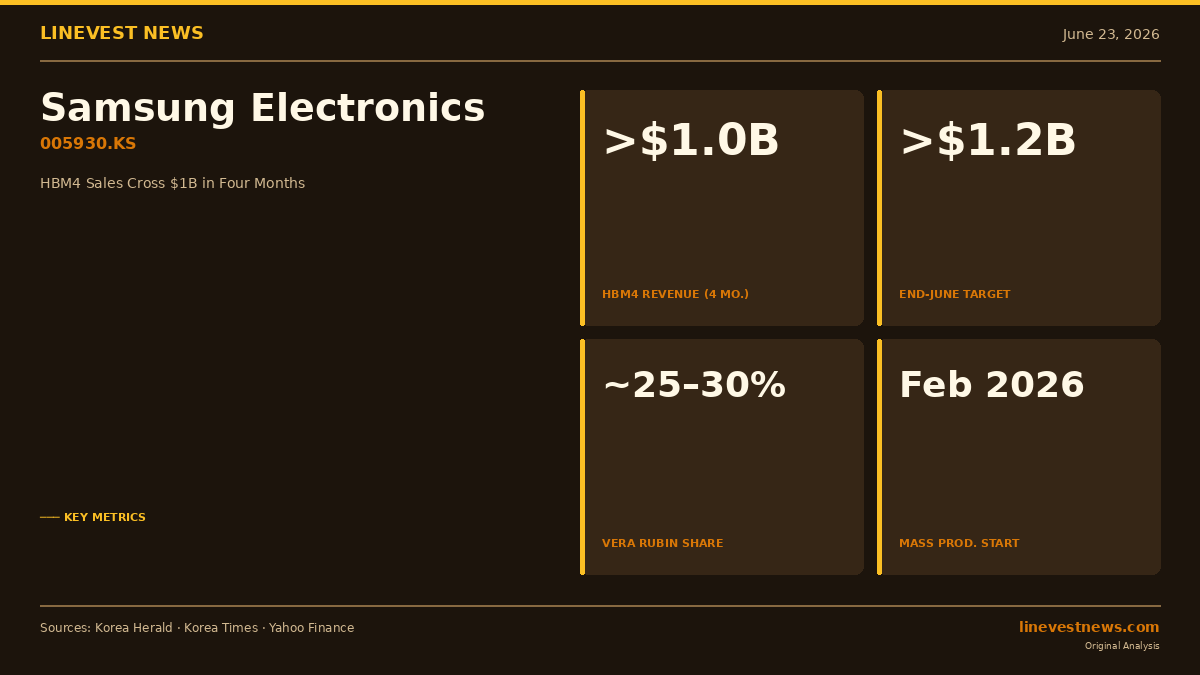
Samsung Electronics Co. (005930.KS) has crossed the USD 1 billion mark in sixth-generation high-bandwidth memory (HBM4) chip sales just four months after beginning mass production in February 2026, according to industry sources cited by the Korea Herald and Korea Times. Revenue is on track to exceed USD 1.2 billion by the end of June, a figure that signals a measurable recovery by the South Korean chipmaker in the premium AI memory segment.
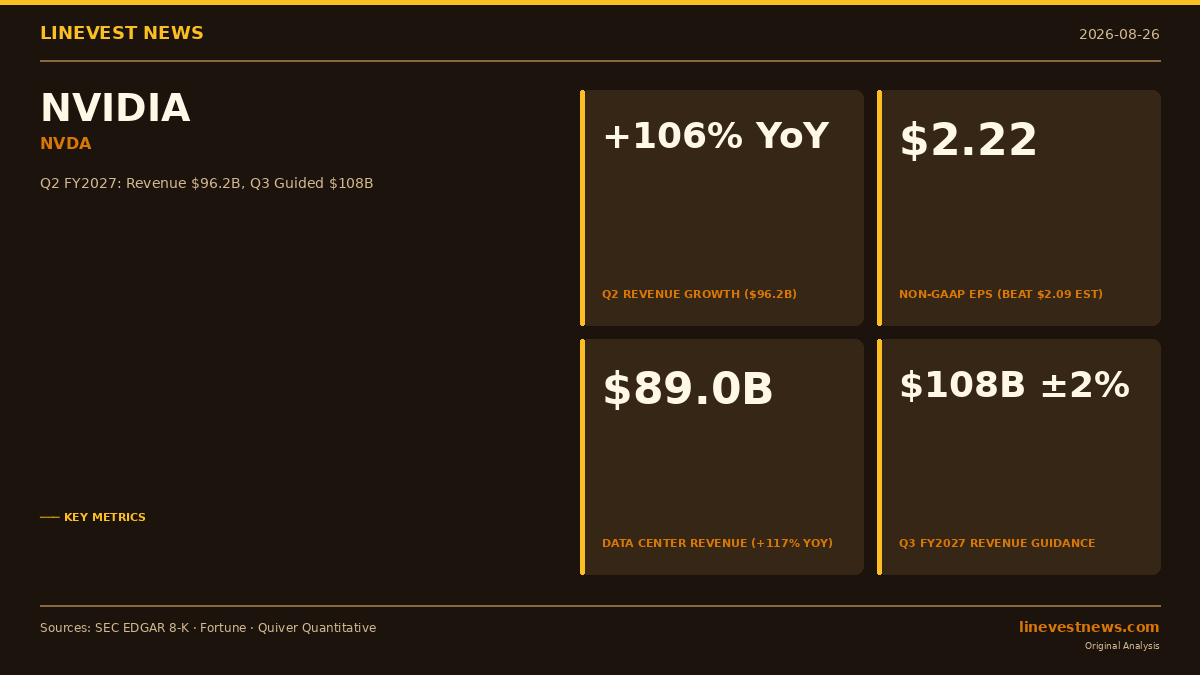
Samsung holds an estimated 25–30% of HBM4 supply volume allocated to Nvidia Corp.'s Vera Rubin GPU platform, with SK Hynix Co. (000660.KS) commanding approximately 60–70% and Micron Technology supplying the remainder. Nvidia Chief Executive Jensen Huang publicly confirmed on June 5, 2026 that all three chipmakers had cleared qualification and were actively shipping HBM4 chips for Vera Rubin systems.
Context: First to Market, Now Taking Share
Samsung was the first company globally to commence HBM4 mass production, initiating shipments in February 2026. The Vera Rubin platform — unveiled at GTC Taipei on June 1, 2026 — is designed to deliver 10 times the agent throughput at scale compared with the prior Grace Blackwell line. First Vera Rubin systems are scheduled to begin shipping to customers in Q3 2026, and supply-chain observers expect HBM4 to replace HBM3E as the primary growth driver in the global HBM market through late 2026 and into 2027.
Competitive Landscape
The USD 1 billion-plus HBM4 revenue total comes as SK Hynix briefly overtook Samsung Electronics in KOSPI market capitalisation in June 2026, reflecting the market's view that SK Hynix remains the dominant force in AI memory. With a roughly one-quarter allocation of three-supplier Vera Rubin HBM4 volume, Samsung is poised to recover competitive ground it had yielded during HBM3E qualification delays — though SK Hynix's lead remains substantial.
Global HBM demand is still anchored to fifth-generation HBM3E products in volume terms, but analyst commentary reviewed by LineVest broadly anticipates HBM4 will become the key earnings catalyst for Samsung's memory division as AI accelerator demand scales through 2026.
Revenue and market-share figures are based on estimates from industry sources and have not been independently confirmed in a formal company filing. This article is for informational purposes only and does not constitute investment advice.
Sources: Korea Herald · Korea Times · Yahoo Finance / TechTimes