KOSPI Suffers Largest Single-Day Drop of 2026
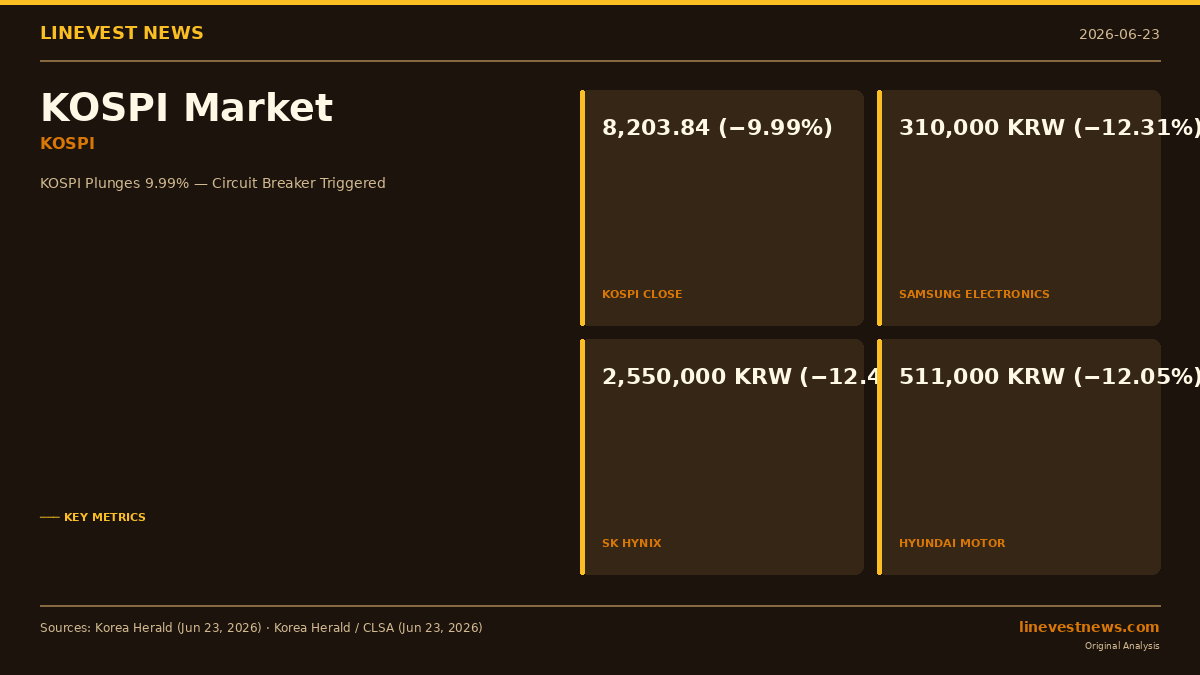
South Korea's benchmark KOSPI index tumbled 9.99% on Monday, closing at 8,203.84 — shedding 910.71 points in what market operators confirmed as the steepest daily decline of the year. The Korea Exchange (KRX) activated a sell-side circuit breaker at 2:33 p.m. local time, halting all trading for 20 minutes in a move that marked the fourth such suspension of 2026. An earlier sell-side sidecar had already kicked in at 11:40 a.m., signaling the broad and accelerating nature of the selloff.
The retreat came just 24 hours after SK hynix (000660.KS) had displaced Samsung Electronics (005930.KS) as KOSPI's most valuable company for the first time in 27 years, underscoring how rapidly sentiment can reverse after a stretch in which the index had surged more than 110% year-to-date.
Semiconductor Giants Lead the Decline
The sell-off was concentrated in the semiconductor sector, which had powered most of this year's rally:
- Samsung Electronics (005930.KS) closed at 310,000 won, down 12.31%
- SK hynix (000660.KS) settled at 2,550,000 won, off 12.47%
- Samsung Electro-Mechanics (009150.KS) dropped 9.60% to 1,990,000 won
- LG Energy Solution (373220.KS) lost 6.10%, closing at 362,000 won
The auto sector was drawn in as well: Hyundai Motor (005380.KS) fell 12.05% to 511,000 won, even though the company had no company-specific negative news. Analysts noted the broad de-risking reflected valuation anxiety rather than fundamental deterioration.
The KOSDAQ small-cap index declined 7.94% to 891.52, while the Korean won weakened 2.1 won versus the dollar to 1,539.1 per USD.
Trigger: U.S. Tech Turbulence and Stretched Valuations
Overnight losses in U.S. technology markets — led by a 16% fall in SpaceX shares following the company's latest fundraising announcement — depressed risk sentiment heading into the Asian session. Alphabet and Amazon had also slid between 4% and 6% in New York amid renewed anxiety over hyperscaler capital expenditure cycles.
Domestic analysts pointed to stretched multiples as an amplifying factor. Sanjeev Rana, head of Korea research at CLSA, had warned in a note published earlier on Monday that KOSPI's year-to-date advance was "heavily driven by Samsung Electronics and SK hynix alone accounting for more than half the benchmark" — a concentration risk that left the index structurally exposed to any single-sector shock.
"Valuation concerns have grown for major South Korean semiconductor stocks" following their rapid ascent, one Seoul-based market analyst said, citing the fresh round of foreign selling.
Record Retail Buying Cannot Stem the Tide
Foreign investors net-sold 4.13 trillion won during the session, while institutional sellers offloaded a net 4.55 trillion won — together representing an eight-trillion-won supply overhang that overwhelmed demand. Retail investors stepped in with net purchases of 8.58 trillion won, the largest single-day retail buying on record, but proved unable to arrest the index's decline.
The pattern — mass foreign and institutional exit absorbed by domestic retail — mirrors episodes from 2020 and 2022, when similar surges in retail purchasing preceded extended periods of consolidation.
Structural Context: AI Thesis Intact, But Correction Was Overdue
Despite the sharp intraday selldown, most institutional commentators were reluctant to declare the broader AI-driven memory upcycle broken. CLSA's Rana argued earlier Monday that Korean memory suppliers are "signing multiyear supply deals at record high prices" as hyperscalers lock in capacity, with 50–70% of output potentially committed to long-term contracts.
SK hynix's early leadership in high-bandwidth memory (HBM) and its supply arrangement with Nvidia are widely seen as durable advantages, while Samsung has rebuilt credibility through HBM qualifications with Nvidia, AMD, Broadcom, and OpenAI over the past twelve months.
The consensus view is that Monday's move constitutes a corrective flush after a period of unusually rapid appreciation rather than a signal of fundamental deterioration in the AI memory demand outlook.
Sources: Korea Herald — KOSPI Crash Report · Korea Herald — Profit-Taking Reversal · Korea Herald / CLSA — AI Memory Cycle Analysis