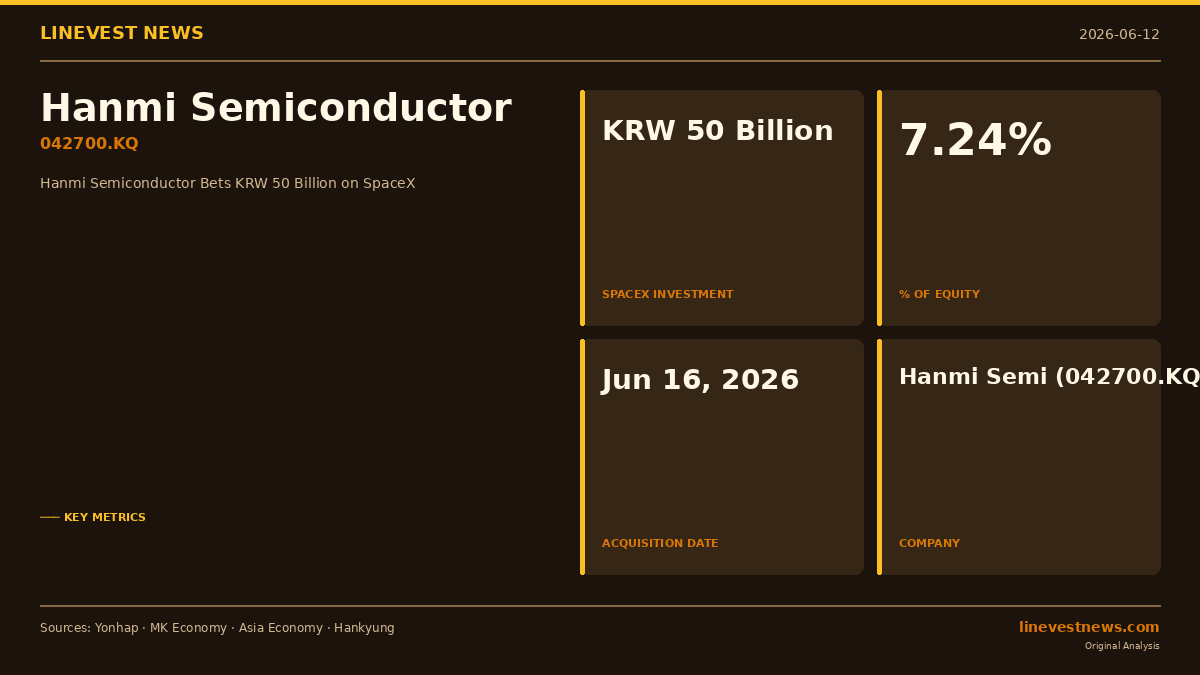
Hanmi Semiconductor Co., Ltd. (042700.KQ), South Korea's leading thermal-compression bonder manufacturer and a critical supplier to SK Hynix's HBM production line, disclosed on June 12, 2026 that it would purchase KRW 50 billion (approximately USD 36 million) worth of SpaceX shares through the open market. The planned acquisition date was set for June 16, representing 7.24% of the company's shareholders' equity.
Strategic Pivot Beyond Semiconductor Equipment
In its regulatory filing, Hanmi Semiconductor framed the SpaceX investment as a bet on the convergence of space technology and advanced semiconductor demand: "Investment in the future growth potential of Elon Musk's Terafab and SpaceX due to the explosive demand for AI, satellite communications, space aerospace, and advanced semiconductors."
The move comes as SpaceX, the Elon Musk-founded rocket and satellite company behind the Starlink broadband network, was preparing for an IPO that has drawn substantial interest from South Korean institutional and retail investors. SpaceX's Starlink satellite constellation — which requires advanced semiconductor components for its phased-array terminals — makes the investment an alignment of business interest as much as a financial bet.
Part B — Why It Matters for Korean Markets
Hanmi Semiconductor's KRW 50 billion allocation to SpaceX is notable on several fronts:
Scale relative to equity: At 7.24% of shareholders' equity, the position is large enough to be material. Korea's Capital Markets Act requires disclosure once an investment exceeds 5% of equity, placing this firmly in headline territory.
Diversification signal from a pure-play equipment name: Hanmi has built its franchise almost entirely on TC bonder technology used in packaging high-bandwidth memory chips. The SpaceX stake marks a deliberate departure from that focus, suggesting management is looking to capture returns from the broader technology convergence wave — AI compute infrastructure, low-Earth-orbit satellites, and what Musk has termed the "Terafab" vision of gigawatt-scale AI data centers.
Context: Korean corporate SpaceX interest peaks: Hanmi is not alone. In the same period, Korean retail investors poured KRW 1.2 trillion into SpaceX shares on its debut day, and Mirae Asset faced an FSS investigation after its SpaceX IPO product failed to deliver shares to Korean clients. The announcement reflects South Korean corporate capital increasingly viewing U.S. space-tech as a strategic asset, not merely a speculative trade.
Investment risk: SpaceX is not publicly traded in the traditional sense, and the valuation at the time of purchase implied a company worth over USD 350 billion. At that multiple, the KRW 50 billion investment carries meaningful market-risk. However, the strategic logic — tying Hanmi's fortunes to the same compute-and-satellite cycle that drives HBM demand — offers a coherent narrative.
Sources: Yonhap News Agency, MK Economy, Asia Economy, Hankyung — June 12, 2026