Toyota Motor's Korean subsidiary and China's BYD are converging on a niche of the South Korean automotive market that domestic giants Hyundai Motor (005380.KS) and Kia (000270.KS) have deliberately left open: plug-in hybrid electric vehicles (PHEVs). The two foreign brands are racing to claim territory at the Busan International Mobility Show, which opens June 26 at BEXCO, as a wave of data signals the segment remains structurally underserved in Asia's fourth-largest auto market.
Toyota Opens With the RAV4 PHEV
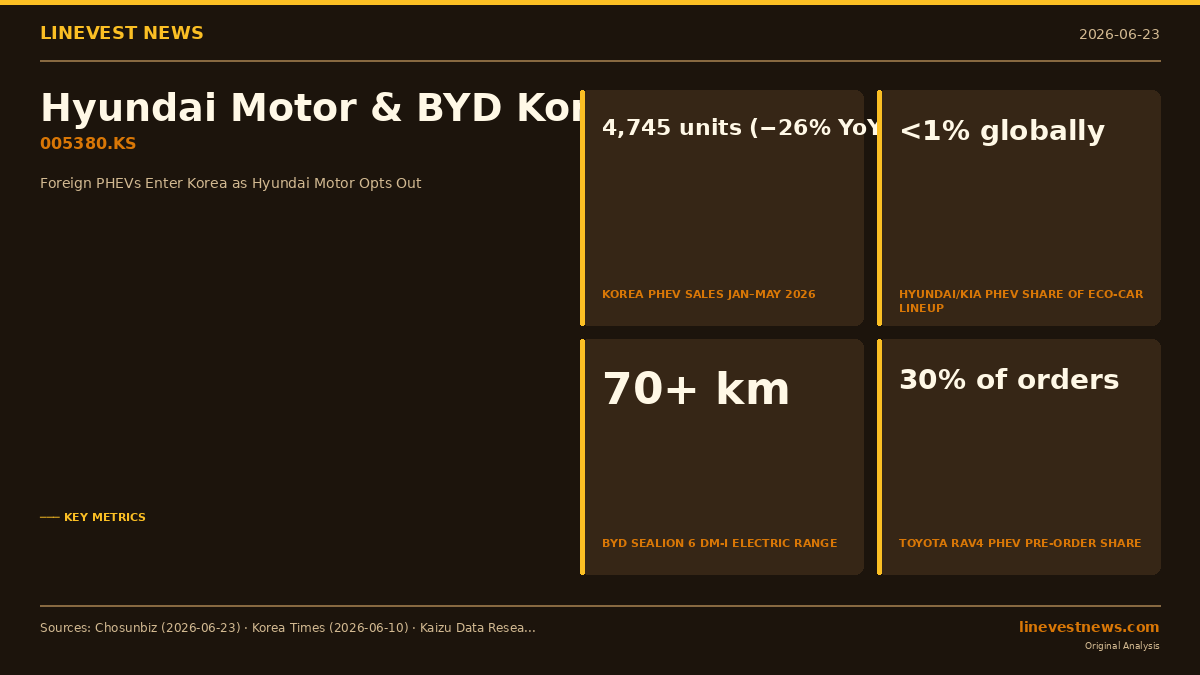
Toyota Korea launched the fully redesigned RAV4 on June 16, significantly expanding its PHEV trim options. The RAV4 PHEV can travel up to 77 kilometres on battery power alone and charges from 10% to 80% in 35 minutes, at a fuel efficiency of 15.3 km/L. Buyer demand has been notably skewed toward the PHEV variant: approximately 30% of all RAV4 pre-orders have been for the PHEV trim, according to Toyota Korea.
BYD Brings DM-i to Busan
BYD will stage its most consequential Korea launch to date at the Busan show. Under the exhibition theme "The Power of Duality," BYD Korea plans to debut its DM-i (Dual Mode-intelligent) platform in Korea for the first time, with the Sealion 6 DM-i expected to be the centrepiece. The Sealion 6 DM-i delivers more than 70 km of electric-only range and charges from 30% to 80% in under 30 minutes — figures designed to match EV-level usability while retaining the fuel-range safety net of a combustion engine.
BYD Korea has said it expects PHEV volumes to reach roughly three times its EV sales in Korea. The DM-i platform is not a new concept: BYD has refined the system over 18 years, and it now underpins more than eight million vehicles globally. Since entering Korea with the Atto 3 EV in January 2025, BYD Korea has surpassed 10,000 cumulative vehicle sales — the fastest pace of any imported brand to reach that milestone. The company's target for 2026 is more than 10,000 units sold in the calendar year, a 64% increase from the 6,107 vehicles it delivered in 2025. The PHEV launch is expected to be central to hitting that number.
Pricing is expected to land in the KRW 38-42 million (approx. USD 27,000-30,000) range when BYD's PHEV models formally go on sale in the second half of 2026.
Korea's PHEV Gap: A Market Dominated by Imports
The combined PHEV push from Toyota and BYD is made possible by an unusual structural condition in the Korean market. Hyundai Motor and Kia — together commanding more than 90% of domestic car sales — do not sell PHEVs in Korea. Even on a global basis, PHEVs account for less than 1% of the two groups' combined eco-friendly vehicle sales as of May 2026, according to Kaizu Data Research Institute.
The numbers reflect the segment's marginal status domestically. Korean PHEV registrations totalled 4,745 units during January-May 2026, down 26% year-on-year, and represent just 0.8% of the total domestic auto market. Within the import-car segment, PHEV share reaches only 3.3%.
Hyundai and Kia have PHEV technology — both groups sell PHEV variants of the Tucson, Santa Fe, Niro, Sportage, and Sorento in overseas markets. But the domestic PHEV lineup was effectively discontinued after the Korean government abolished a KRW 5 million per-vehicle subsidy in 2021, at which point PHEV versions of the Sonata, Ioniq, and K5 were retired from the domestic market.
Why Hyundai and Kia Are Standing Aside
Industry analysts cite two structural factors. First, South Korea's predominantly apartment-dwelling population faces logistical barriers to home charging that blunt a core PHEV advantage — PHEVs deliver maximum efficiency when regularly charged at home overnight. Second, South Korea's compact geography reduces the long-range benefit that makes PHEVs appealing in markets such as continental Europe or China, where cross-region driving is common.
"If EVs sell well, there isn't much value in PHEVs," said Lee Ho-joong, research director at the Korea Automobile Research Institute. "PHEVs are a transitional vehicle — a stepping stone on the way to EVs."
A third dynamic is regulatory. In Europe, automakers with heavy internal-combustion portfolios must include high-efficiency models such as PHEVs to meet EU CO2 standards. Hyundai Motor Group, which is pressing ahead with electrification in Europe, has not faced the same portfolio-balancing pressure that traditional European OEMs have in embracing PHEVs as a compliance tool.
The European Shadow and Strategic Risk
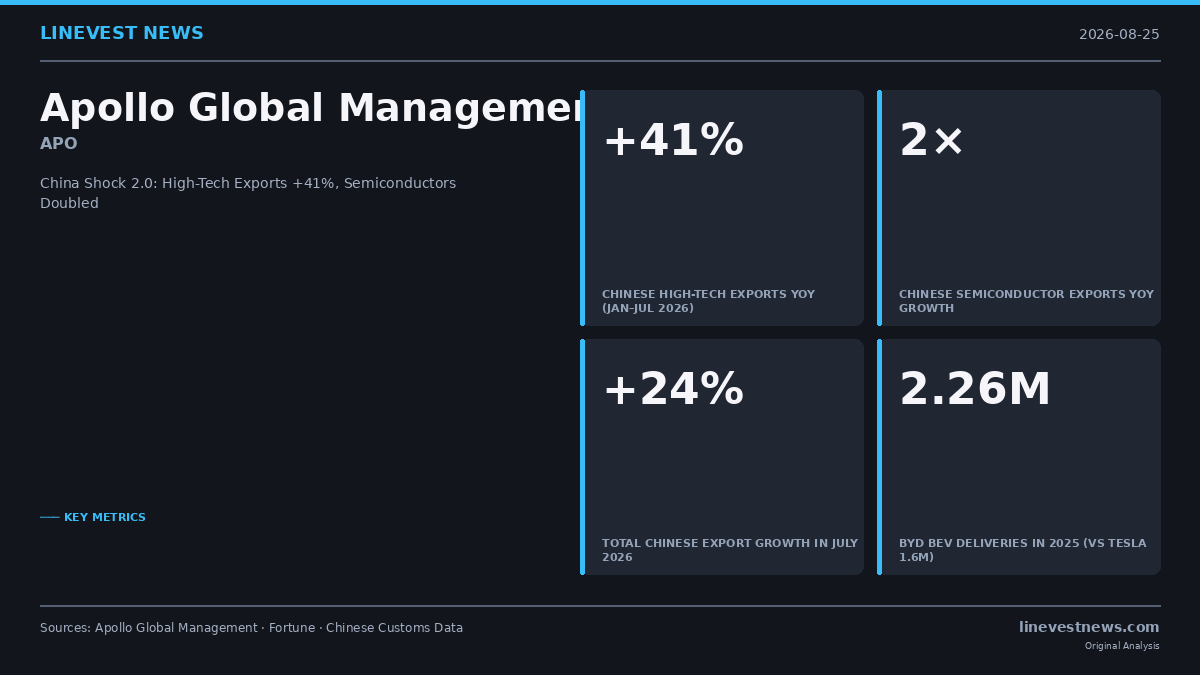
The strategic subtext to the Busan launches is that PHEV growth in Europe — where Chinese brands recorded a 236% surge in April 2026 — may eventually force a reassessment of global strategy. Chinese manufacturers, facing EU tariffs on battery-electric vehicles, have been routing PHEVs into Europe at aggressive volumes. European regulators are now reportedly evaluating whether to extend tariff parity to PHEVs as well.
For Hyundai Motor and Kia, the immediate competitive risk in Korea remains limited: the PHEV niche is small and the groups' HEV and BEV lineups are well-positioned. The more strategic question is whether a sustained PHEV push by BYD and Toyota in export markets — particularly in Europe and Southeast Asia — will eventually require Hyundai to reconsider its product architecture in markets where it still has meaningful combustion-engine exposure.
Sources: Chosunbiz (2026-06-23), Korea Times (2026-06-10), Kaizu Data Research Institute, BYD Korea official statements.