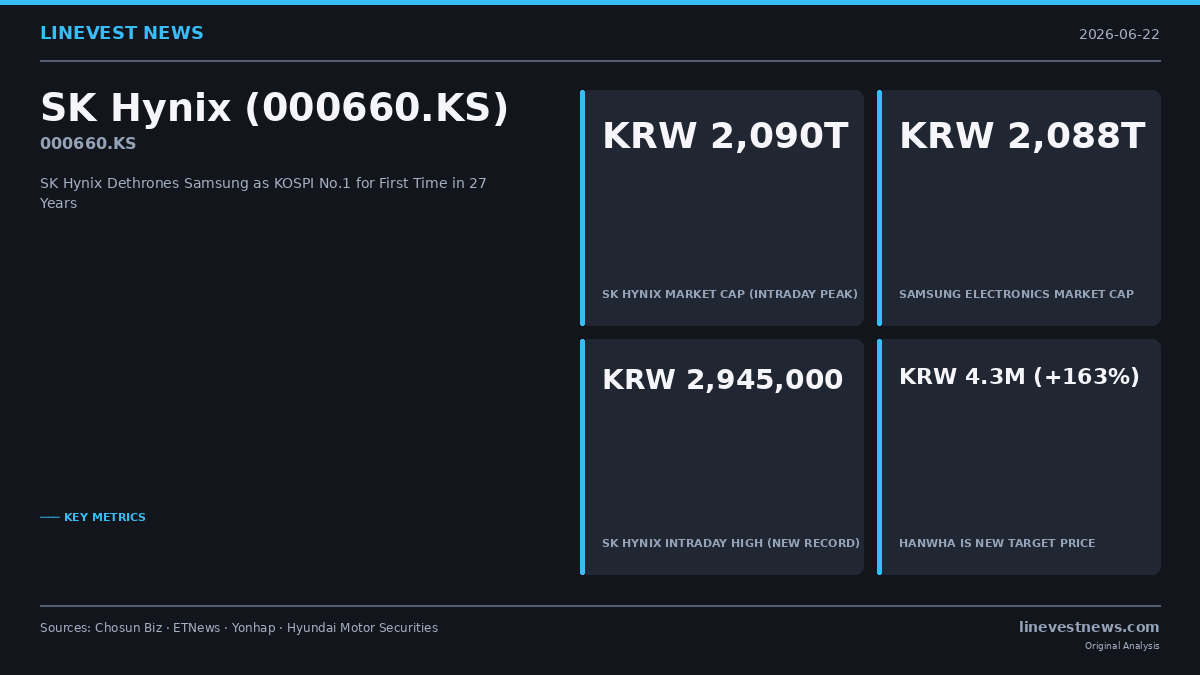
SK Hynix (000660.KS) briefly surpassed Samsung Electronics (005930.KS) on Monday to become South Korea's largest company by market capitalization — a milestone unseen since 1999 — as the AI-driven high-bandwidth memory (HBM) supercycle sent its shares to an intraday record and prompted analysts to revise targets sharply higher.
Part A: 27 Years of Samsung Dominance, Broken in a Single Session
At 12:40 KST on June 22, SK Hynix's market cap reached KRW 2,090 trillion, edging past Samsung Electronics' KRW 2,088 trillion to claim the No. 1 position on the KOSPI — the first time Samsung had surrendered the top spot since 1999. SK Hynix shares surged as much as 6% intraday, touching a new all-time high of KRW 2,945,000 (approximately USD 2,150), while Samsung gained only marginally.
Hanwha Investment Securities moved quickly, raising its SK Hynix target price from KRW 1.63 million to KRW 4.3 million — a 163% upward revision — citing sustained HBM and server DRAM earnings momentum. KB Securities Research Director Kim Dong-won set a separate target of KRW 3.8 million, projecting that SK Hynix's Q2 2026 operating profit would surge 7.5 times year-on-year to KRW 69 trillion, with an operating margin of 77.2% — No. 1 globally across all industries.
The numbers reflect a staggering 12-month transformation: SK Hynix's market cap expanded from roughly KRW 187 trillion in June 2025 to over KRW 2,090 trillion, a more than tenfold increase, while the stock itself gained over 920% compared to approximately 480% for Samsung over the same period.
Part B: Why HBM Rewrote the Market Cap Order
The structural divergence comes down to business mix. Samsung Electronics operates across smartphones, home appliances, displays, and advanced foundry services in addition to memory chips. SK Hynix is a focused pure-play memory and HBM supplier — a concentration that has proven decisive in the current AI buildout cycle.
SK Hynix was the first chipmaker to supply Nvidia with HBM, securing a dominant position in the market that has become the essential "bandwidth layer" of AI data-center infrastructure. That first-mover lead has compounded: Hanwha and KB analysts both note that demand for HBM and server DRAM is accelerating from cloud providers into edge AI devices — PCs and smartphones — potentially extending the upcycle further.
SK Hynix is also expanding its global footprint: the company filed Form F-1 registration documents with the U.S. Securities and Exchange Commission in March 2026 for an American depositary receipt (ADR) listing on a U.S. exchange in the second half of 2026, which analysts expect would attract a new wave of international institutional investors.
Monday's KOSPI session opened down 1.08% at 8,954.43, weighed by reports that Iran's delegation had walked out of ceasefire-MOU implementation talks with the U.S. in Switzerland after President Donald Trump threatened to strike Iran again over Hezbollah. The market recovered sharply to above 9,200 by mid-session, driven primarily by domestic retail and institutional buying into Samsung and SK Hynix, even as foreign investors net-sold the broader market.
Hyundai Motor Securities noted that since September 2025, individual investors — dubbed simultaneously "Donghak ants" (Korean stock buyers) and "Seohak ants" (U.S. stock buyers) — have been the primary force behind the KOSPI's roughly 184% advance, with foreign investors net-selling KRW 118 trillion over that period. Single-stock leveraged ETFs tied to Samsung and SK Hynix have amplified that retail fervor, though FSS Governor Lee Chan-jin warned Monday that the products — which carry 92% individual-investor ownership and generate an estimated KRW 5–10 trillion in brokerage commissions — are raising market volatility beyond their originally intended benefit of repatriating offshore leveraged demand.
Samsung Electronics, for its part, is not conceding the longer-term race: the company is regaining HBM market share and working to restore competitiveness in advanced foundry. Most sell-side analysts see both stocks continuing higher through the AI cycle, and the market-cap contest between the two flagship KOSPI names is expected to remain fluid in the months ahead.
Sources: Chosun Biz, ETNews, Yonhap, Asiae.co.kr, Hyundai Motor Securities Research (June 22, 2026)